

 Share
Share Print
PrintShelly Leavens
From Discourse 7
Jordan
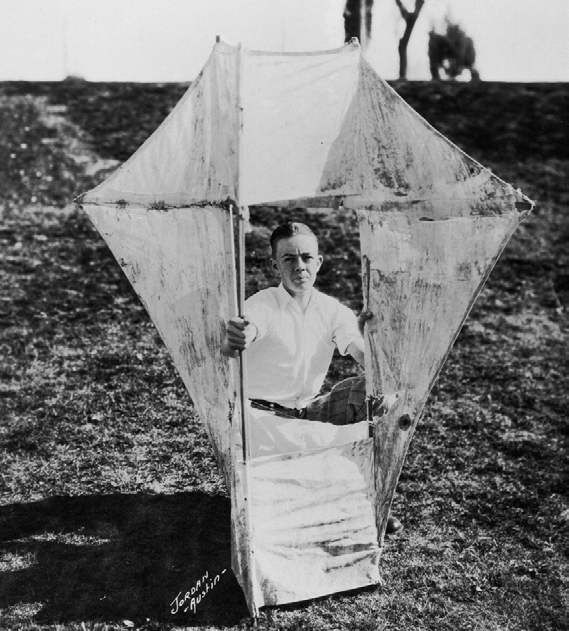
Winifred Gustofson at the first Austin Kite Tournament in 1929. The event was moved to Zilker Park in 1936.
ONE OF KITING’S “FIRST FAMILIES” & THE LONGEST RUNNING KITE FESTIVAL IN THE UNITED STATES
For the past twelve years, Richard Robertson, 82, of Austin, Texas has been attending a class entitled “Writing Your Memoirs.” It has encouraged him to start chronicling his life, much of which includes stories about his lifelong passion for kiting. Besides Austin being a desirable place for the Robertsons to live, work, and rear a family, the city is also home to the longest running kite festival in the United States. The Zilker Park Kite Festival (hereafter referred to as Zilker) is held the first weekend in March and had a record-breaking day at this year’s 82nd Annual, when it lived up to its reputation as being Austin’s harbinger of spring. The organizers estimated that nearly 15,000 people came out to the newly renovated “Great Lawn” to bask in the warm sunshine, and to watch and fly colorful kites soaring on perfect, light breezes. It doesn’t get much better, especially for the Robertsons.
Zilker has been an important part of the Robertsons’ lives for 48 years. In honor of Richard and Zilker, we’ve compiled a brief history of the festival, along with excerpts from Richard’s charming memoirs. [Note: Memoir excerpts are italicized in the text.]
ZILKER – EARLY HISTORY AND ED ST. JOHN
In 1929, Ed St. John, a young civic leader and later president of the Exchange Club of Austin and the Austin Chamber of Commerce, was looking for an activity in which the youth of Austin could be creative and active. He
remembered flying kites as a kid in the fields now known as Zilker Park, where his father leased land for his brick making plant from Mr. Zilker. “So we got the clay in Zilker Park, and they transported the clay [to the brick plant] by buckets on cable, conveyor… Mr. Zilker decided he was going to sell the brickyard but he leased it to dad for 25 years. He appealed to dad to give up his lease,” said Ed in an interview with Richard at the 50th anniversary of Zilker.
With his memories of kite flying, Ed needed to garner attention from the Exchange Club in order to make his idea into an event. He described to Richard how he got it going:
“I made this kite, it was a pretty little old kite, it wasn’t too practical from a flying standpoint. It would fly alright but not very much, but it was pretty, had a lot of colors. So I let my little nephew fly it. [Then] I took it up to the Exchange Club and I said, ‘Now look, we could get a lot of ideas if we just recognize artistic kites, craftsmanship, small kites, high kites and all that type of thing.’ See I had nothing to go on, I didn’t know. We just created all this stuff, nothing was official. They got a little enthused about it then, seeing this kite. So we set it up. Got a permit from the city to hold it.”
On March 10, 1929 the first annual Austin Kite Tournament was inaugurated. It was held at Lamar Park, (which is no longer in existence) and continued at Lamar until 1936, when it was moved to the “polo grounds” at Zilker Park. For Ed St. John there couldn’t be a better place – considering how tied Zilker was to his personal history. The festival moved only once more, to the Great Lawn of Zilker where it is now held.
Beyond encouraging children’s activities, the festival has always benefited local children’s groups. As a result of Ed St. John’s pioneering vision and commitment to the
cause, no other American city of any size has had such a longstanding and continuous kite festival. Beyond growth and development, the basic tenets of the festival have changed little over the years, something that Richard would like to believe will continue for a long time. Participants have always been required to fly only homemade or handcrafted kites (Ed’s idea of encouraging creativity), and no one can fly the same kite in more than one event. This results in many unique kites in each event, and certainly lots of kitemaking by the Robertsons through the years.
A FAMILY NARRATIVE: THE ROBERTSONS REALLY
GET INTO KITES
“Who would have thought that an eight year old boy building his first kite would eventually have two hundred kites of all varieties that can decorate the sky as well as any artist’s canvas? I have always been interested in kites and as an adult have become heavily involved in this wonderful hobby of making and flying kites.”
Richard, a Texan his whole life, graduated from the University of Texas in 1951, went to work at Fort Hood, and the following fall married his sweetheart and #1 kite-sewer, Marian. Richard, Marian and four children moved back to Austin when he found human resources work for the State.
Marian (also writing memoirs) describes the early years:
“I had discovered his great fascination with kites early in our courtship while attending a college-group church retreat, when instead of joining a group swim in the lake, Richard chose to make and fly a kite on the lake shore while the rest of us luxuriated in the cool waters of Lake Buchanan.”
She also elaborates on what drew her to
become heavily involved.
“As time moved on, the kites and the years floated by and things began to change. Kites appeared that had been sewed from a variety of bright materials, patterned boldly for impressive long distance viewing. Sky art began to link hands with flying efficiency and dramatic design, and kiteflyers all over the world drew in their breath and exhaled a universal collective “Ahhhhh”! Paper and plastic and wooden sticks began to be replaced by fiberglass, carbon, and graphite rods companioned with mylar, ripstop, and Tyvek materials painted and appliquéd. As kite designs improved, flyers began to demand that their kites be strong, sturdy enough to last for years, and beautiful. Oh, my word. Suddenly my interest in sewing, color, shape, and design drew notice and willy nilly, I was pressed into service. Now think of 6 to 10 kites per year…and think of storage!!!”
Like many obsessive hobbies, there are communities of people who are equally obsessed. Richard found fellowship through the American Kitefliers Association (AKA) and has been a member for 43 years. He felt the main purpose of the club was to connect kite fliers, and for him and a few others especially, to exchange kite making plans. They relied on each other for testing materials, designs, and methods. It resulted in a network of kite makers, where Richard found himself centered and corresponding feverishly. At the heart was 38 years of correspondence with AKA founder Bob Ingraham, forming a close friendship despite only meeting twice.
“In 1967 I discovered the recently formed American Kitefliers Association, begun in 1964 by Bob Ingraham from Silver City, New Mexico. When I joined there were about 180 of us – all men and all over 21 years of age because that was the
requirement. Bob put out a roster and the members wrote to each other, exchanging kite plans and ideas. There were very few books published on kitemaking. From the newsletter and correspondence with other men, I was able to bring a number of new and different kite designs to the annual [Zilker] festival. My kids enjoyed winning and all participated in some part of the kite making.”
“We’re really enjoying being a kite family,” Richard wrote to Bob at the upswing of his family’s involvement with the AKA and Zilker. As soon as the AKA allowed youth memberships in 1971, every Robertson was a bona fide card-carrying kite flier, and Bob gave them the moniker of “Kiting’s First Family.” He and Marian had five children, three daughters and two sons. All were raised to love making and flying kites, including one of his sons who battled bone cancer his senior year of high school and died when he was still just a young man in college. The family’s loss is reflected in his letters with Bob, who sent him one of his special delta kites when he heard the news. Richard wrote in response to receiving the kite and in appreciation of his friendship, “Thank you. In the midst of some very stressful times, I received therapy from the kite activities.”
Kiting was a hobby that clearly brought their family together, and Richard and Marian started working on more complicated kites with advanced designs.
“When we tackled the making of a 49 square foot parafoil in 1972, [Marian] sewed from midnight ’til one or two in the morning. It took 100 hours to complete, we received tips from our friend Domina Jalbert, and it flew beautifully. We still fly it from time to time. In the seventies we learned to make Chinese centipedes and in 1977 flew our 100-foot version. Among
Richard Robertson
Marian Robertson
Richard Robertson Marian Robertson
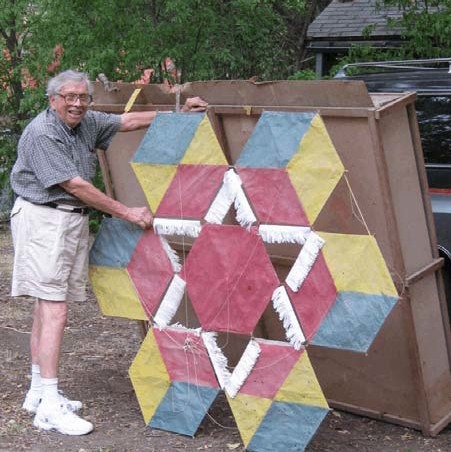
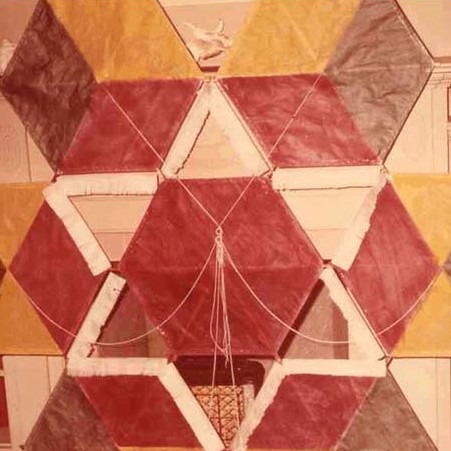
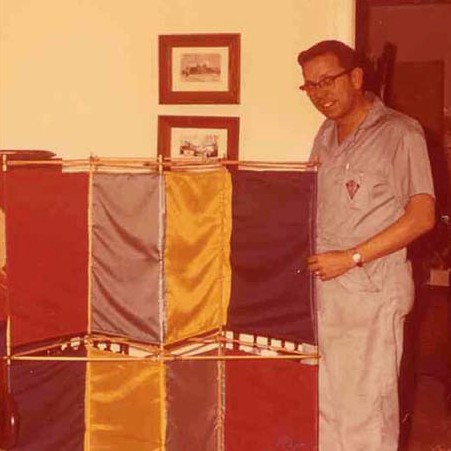
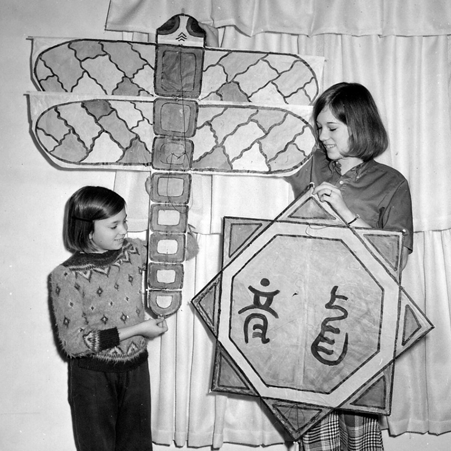
ABOVE LEFT: Jeannie and Linda Robertson with their kites, February 1970. ABOVE RIGHT: Richard with the W kite in 1969. BELOW LEFT: The Seven Sisters Kite in her heyday, the summer of ’69. BELOW RIGHT: Richard discovers the Seven Sisters Kite in safe storage forty years later.
many others, we made an 18-foot turkey vulture, a 14-foot pterodactyl, a 13-foot golden eagle, and a 50-foot Mylar serpent. Later we made a 15-foot Cody and a 12- foot Six Flags Over Texas Seven Sisters Kite.”
There was a turning point when the couple attended Betty Street and bill lockhart’s 1990 Junction Kite Retreat. “We of course got hooked on Junction,” said Richard. While they missed the first annual Junction, they have gone to every one since and plan to go again this year. They have met many people influential to kiting there, and Richard has been encouraged to start sewing again in earnest. Last year, despite missing a couple of days, Richard built a box kite out of recycled post office Tyvek, while Marian made a tie-dyed coffee filter kite that now hangs on the wall in his office. “It’s beautiful,” he says.
“My wife and I each take our sewing machines and materials and look forward to seeing our friends at what we call ‘adult summer camp.’ We appliqué ripstop nylon and frame with carbon, fiberglass, or graphite rods. A 7-foot Mary Poppins is one of our best creations and a 10-foot genki kite with swimming dolphins has been a favorite with spectators at kite events.”
ZILKER THROUGH THE YEARS
With his and Marian’s clear aptitude and interest in making kites and their undying support of Zilker, (Richard is considered a long-time “unofficial promoter”), Austin Parks and Recreation asked him in 1983 to put together a workshop to teach people how to make kites. For 27 years the workshop has been held two weeks before the festival and provides a “kick off” to the big weekend.
“ I n the early days of our f amily participation, I did not fly competitively.
With five kids I was busy making and helping fly our homemade kites. Usually we have some of our kids and some of our 10 grandkids with us at the annual festival… now, with over 200 kites in our inventory, we need to have some of them flown at Zilker. So, this year, in addition to the “old coot award” (trophy for the oldest flyer), I won a first place trophy for the Most Unusual Kite category.”
The morning of the festival, they get there at 6:30 a.m. sharp to “stake things out.” The Exchange Club gives the Robertsons and their Suburban full of kites and kids a VIP parking spot. But, Richard says, it’s not like the days when he used to back up directly on the lawn to the kite ring and unload the kites. He says he’s never sure which kites he will bring (it depends on the wind), but he always brings enough variety for his family and all their friends to fly. “Anybody who wants to come fly a kite, well, I have a kite for them to fly. Everyone has fun,” he says in his sweet southern drawl.
One of Richard’s most memorable festivals was when their oldest son Rick, in high school at the time, decided to register that year as “Hoot Beaver” for a practical joke. He didn’t tell anyone he had done it and all the kids won prizes in the competition. The following day Richard got a call from the local newspaper asking, “Who the heck is Hoot Beaver?” It turned out that Rick had still given his correct address and phone number for the registration, and the whole family had a laugh. It also turned out that Hoot Beaver was a real person – he was a man that ran a fishing camp near Rockport, where the Robertsons had their summer home. The name had stuck with Rick.
ZILKER 2010
“All day, the sky was crowded with birds, butterflies, dragons, jet airplanes and the
Bill Campbell
Rick Robertson
Bill Campbell
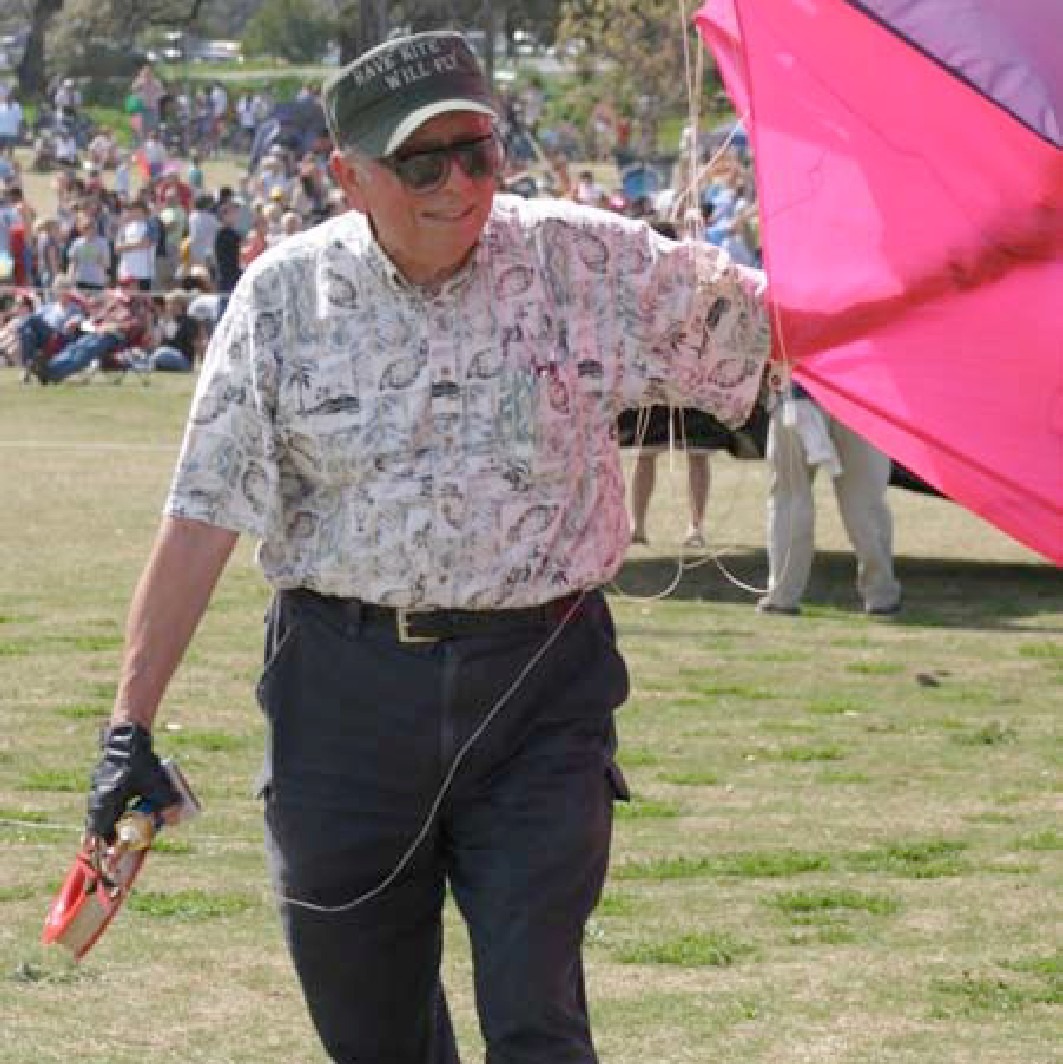
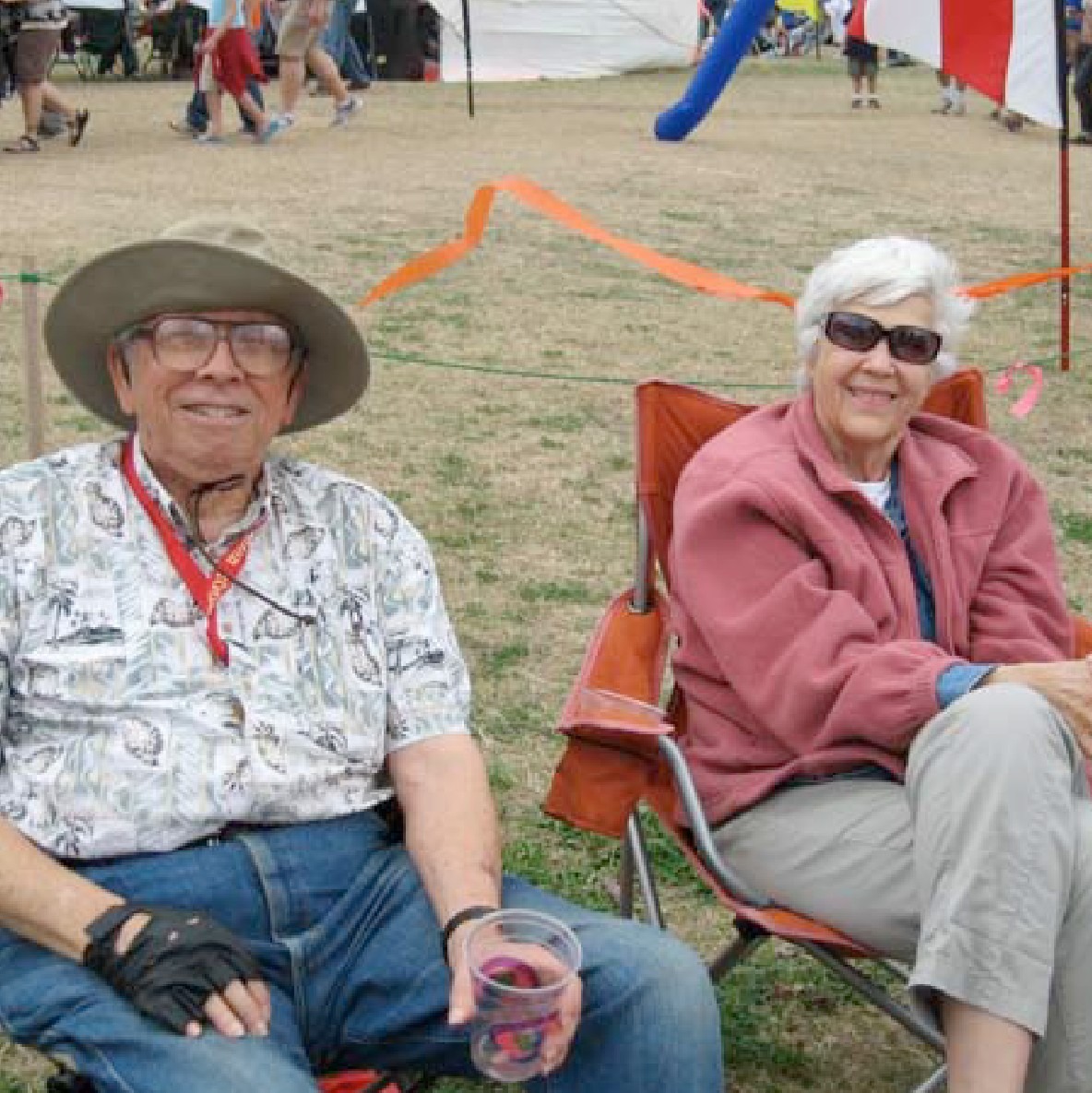
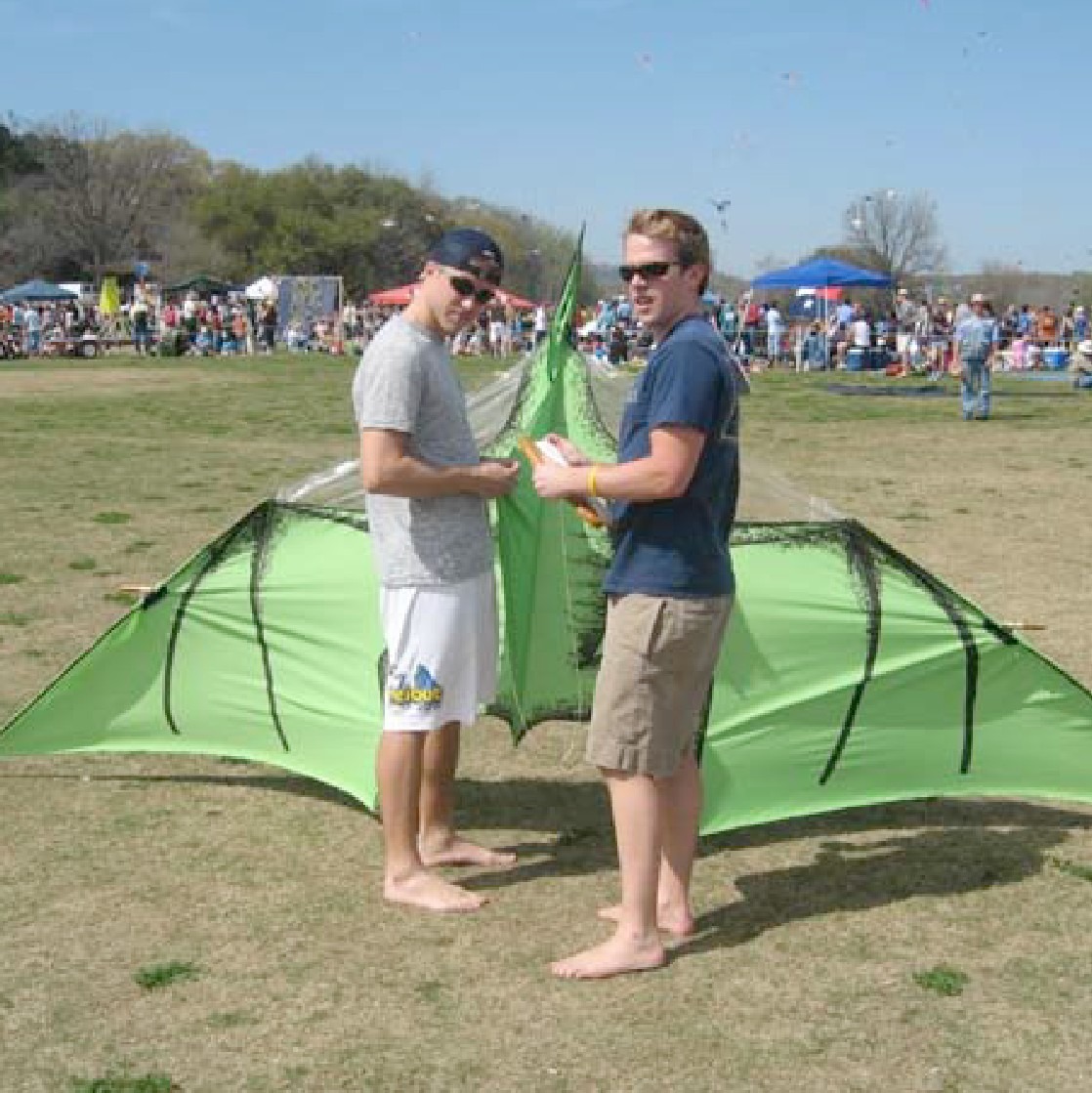
ABOVE LEFT: Richard and Marian at the 2008 Zilker Park Kite Festival. ABOVE RIGHT: Grandkids Bryan Campbell and Travis Robertson at this year’s Zilker, ready to fly the Pterodactyl Richard and Marian made in 1976. BELOW: Richard with Puff the Magic Dragon at this year’s Zilker.
The kite won first place in the “Most Unusual” category.
occasional googly-eyed octopus. Kites were everywhere: in the air, on the ground, and, in a few sad cases, lodged in trees.” – Partick George, Austin American-Statesman
Zilker had 174 kite fliers and 5,000 spectators for the 40th Anniversary in 1968. The numbers this year were nearly triple. This is in large part due to the year-round efforts of Bunnie and Dorsey Tidwell of the Exchange Club, who have organized the festival for many years. Last year the city needed to renovate the Great Lawn, so rather than skip a year of the festival, they moved the flying across the road to the old “polo grounds.” This year they are back to an even Greater Lawn, complete with sprinklers and new sod. The festival is largely volunteer reliant, has vendors galore, a place to make kites, and even a kids’ 50-yard dash. In short, it’s an 82-year- old tradition of fun for the whole family – one that goes to a good cause to boot. “We take a part of the proceeds from the vendors and we put that in a mission by supporting non-profits in the Central Texas area that are serving children and getting them out of a bad situation,” says Bunnie.
When asked which kites he planned to bring to Zilker this year, Richard commented on a few of his favorites. “Puff the Magic Dragon is a crowd pleaser, it is a double wing kite with a 13-14’ wingspan, and while colorful and fun, never did fly very well. Two years ago I took Puff to Junction to the ‘Ask the Expert’ session, and they fixed it up. Now that it flies better, I am happy to bring it back out. It used to have small speakers taped onto the cross spar that would play the song ‘Puff the Magic Dragon.’” Richard also loves to take the Pterodactyl, which is now over 30 years old, and the kids love to fly it. He also mentioned taking his Spencer Chun Tetrahedral, and the ever-popular Mary Poppins kite.
The day after the festival Richard noted in an email, “The six grandchildren who were there all flew my kites in the competition. I did get to fly Puff the Magic Dragon and it won first place in the ‘Most Unusual’ category. It was a grand day. We were there from 6:30 a.m. to 5 p.m. and came home exhausted!”
A COLLECTION OF KITES AND MEMORIES
Understandably, Richard and Marian have quite a collection of kites – many going back to 1967. They still have the first kite they made from nylon, plus an 8 foot Eddy kite, which was featured in Bob Ingraham’s Kite Tales. They also still have the first Scott Sled they ever made out of plastic. The couple recently needed to clean out an old garage space and came across a big box imbued with memory.
“Leaning up against the standing wood rack was a mattress box with a wooden frame around it. We knew what that was! Forty years ago we built a Seven Sisters Kite that was about 5 feet by 6 feet that had all of the sticks tied and glued together. We couldn’t get it in our station wagon to take it to fly so we got a mattress box, framed it with cast off 1 by 2s from Pier One, put suction cups on it and took it to the Zilker Kite Festival. Our son, Rick, won a first prize with it, but we had no place to store it. So it had been in the garage for nearly forty years. We put it on top of the Suburban and brought it home. I pulled it out of the box and lo and behold it was completely intact except for pin holes in the silk span covering. It will fly again before we completely retire it!”
Now, while Richard and Marian no longer build as much as they used to, nor does Richard correspond in the same way he used to, they still attend Junction and email back and forth with kiting friends and family. Richard doesn’t plan on missing
Zilker any time soon either, but he did comment on the effect kiting has had at his age. “It gets a little more physically demanding,” he says. “The Zilker Festival made me a serious kiter. It brought a great activity for our family. It has and continues to have a healthy and wholesome activity for families. Who would have thought an eight year old boy with a brown paper barn door kite would still be making and flying kites almost 75 years later?”
Fly on, Robertson family. Fly on, Zilker.
To view more photographs of this year’s Zilker, visit: http://galleries.austin360.com/ gallery/zilker-kite-fest/
RESOURCES
The Exchange Club of Austin. “Fun, Family and Free.” Zilker Park Kite Festival official website. Online access: http://www.zilkerkitefestival.com/
George, Patrick. “Weather makes for a high-flying day at Zilker Kite Fest.” Austin American-Statesman. Monday, March 15, 2010. Online access: http:// www.statesman.com/news/local/weather-makes-for-a-high- flying-day-at-357311.html?cxtype=ynews_rss
Robertson, Marian. “In The Beginning – Kites.” 2006.
Robertson, Richard. Correspondence with Bob Ingraham. Various dates.
Email to the author, dated March 15, 2010.
Memoirs. 1998 – 2009.
Telephone interview with the author. March 9, 2010.
St. John, Ed. Interview with Richard Robertson and Charles Locklin. November 1977.
“Zilker Kite Festival, Let’s Go Fly a Kite.” myFOXaustin. Online access: http://www.myfoxaustin.com/dpp/news/ local/Zilker-Kite-Festival