
 Share
Share Print
PrintRalf Maserski & Holm Struck
From Discourse 9
Ralf Maserski and Holm Struck. The 10th Historical Kite Workshop logo.
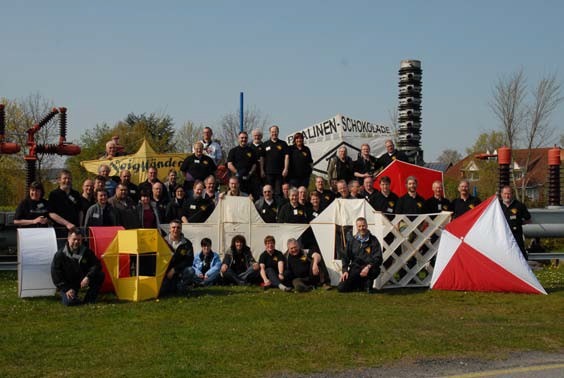
Ralf Maserski and Holm Struck. Participants with all the Workshop kites.
In 2001, Achim and Sabine Kinter, supported by Drachen Foundation, organized the 1st Historical Kite Workshop in Haltern, Germany. Since then, this event has taken place every year in Germany or in The Netherlands. It is always organized by different people without any kind of fixed structure or an elected committee.
The 10th Historical Kite Workshop took place in Stade, a small town close to Hamburg, Germany, on April 23-25, 2010. The event was organized by Werner Luehmann, Ralf Maserski, and Holm Struck.
FRIDAY
In the afternoon, the participants arrived at the youth hostel in Stade. After moving into the rooms, the first kite talks began. The dinner and the official welcome opened the event. First we heard a very interesting lecture from a lawyer about inheritance and how to write a last will. This is not only important for owners of a valuable kite collection, it is important for everybody who has something to pass on.
Then we did a tour guided by two night watchman through the old part of Stade. We learned a lot about buildings from the middle age and could see excavations of an ancient monastery. The evening ended with a nice get- together where everybody received an event shirt.
SATURDAY
Usually, the organization team tries to find a special location for the Workshop, as they did in 2010. Stade is a small town, but it is big enough for a few museums. One of them is the museum for technology, transportation, and agriculture. It has different small exhibits for steam machines, tractors, trains, fire trucks, old cars, planes, and much more. In 2009, Holm got in touch with Walter Mueller, a museum representative. Holm told him about our interest in cooperating with the museum for the Workshop in 2010.
The exhibition about the military airport in Stade during WWII was our main interest. A part of this exhibition is the airplane rescue kit that was used by German pilots. Except for the antenna kite, this kit was complete.
We choose this kite for the practical part of the Workshop. The only documents we had about the antenna kite were a copy of a drawing from 1940 and some pictures we took from the original antenna kite which were shown at the 2005 meeting in Lindenberg and 2009 meeting in Bad Hersfeld. First we discussed the possibility of reproducing the kite. Very soon we found out it would not be possible to prepare a large number of kits with the original method of construction, so we decided to work with a modern, self-constructed concept, which was as close as possible to the original.
From October 2009 to March 2010, we worked on the kite. We made drawings, spoke with companies that produced the metal parts for the kit, and looked for cotton fabric and sticks. Furthermore, we reproduced the drawings and text for the kite sail and gave it to a company to print it onto the cotton fabric.
In spring 2010, the prototype was almost perfect. We only had to do some changes on the main connectors. Then we could order all parts and prepare the kits.
After breakfast on Saturday, Workshop participants walked or drove from the youth hostel to the museum. We received a welcome from Walter Mueller and his team. All participants were astonished by the different machines and exhibits in the museum. After giving the kite kits to the participants, everybody was busy. Some preferred talks, some walked around the exhibitions and took photographs, and others started working on the kite.
Kite kits and manuals were prepared in a way so that the participants could finish the kite at home. So it was not necessary to work too hard on the kite. It was a relaxed day in a special location, and as far as we know, everybody enjoyed this day.
At the end of the day, the organizer of the Workshop gave the prototype kite to Walter Mueller in order to complete the rescue kit shown in the museum.
Back in the youth hostel, we had dinner and heard a lecture from Achim Kinter on how it all began. It was very interesting to hear that years before the 1st Historical Kite Workshop, other events took place in France and The Netherlands where the idea came up to start a workshop series. In summer 2000, the registration opened, although no one knew what would happen in April 2001. The event turned out to be a great success and a wonderful beginning for the Workshops.
After the lecture, everybody had to stand up and was asked if this was their first Historical Kite Workshop. If so, they had to sit down. The remaining people were asked if this was their second Workshop, and so on. In the end, only seven people were still standing. These seven people attended all ten Workshops.
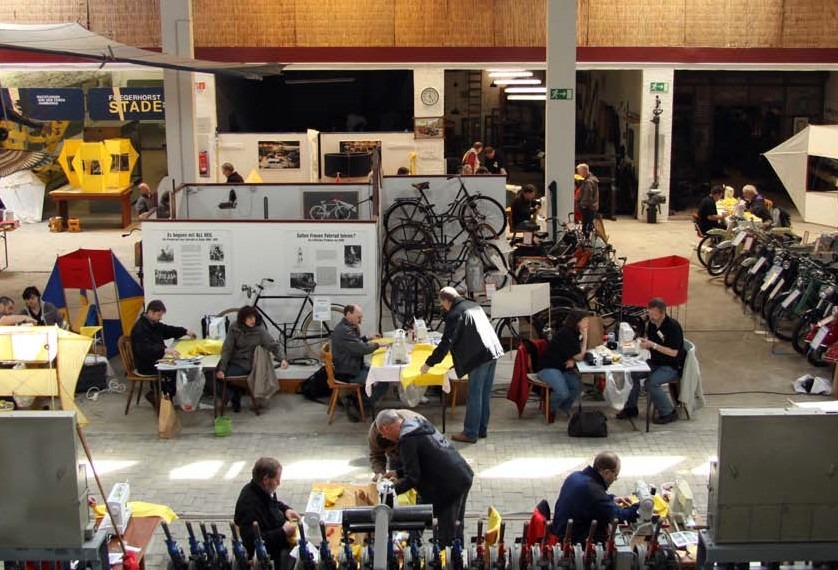
Ralf Maserski and Holm Struck. Kite making inside of the museum.
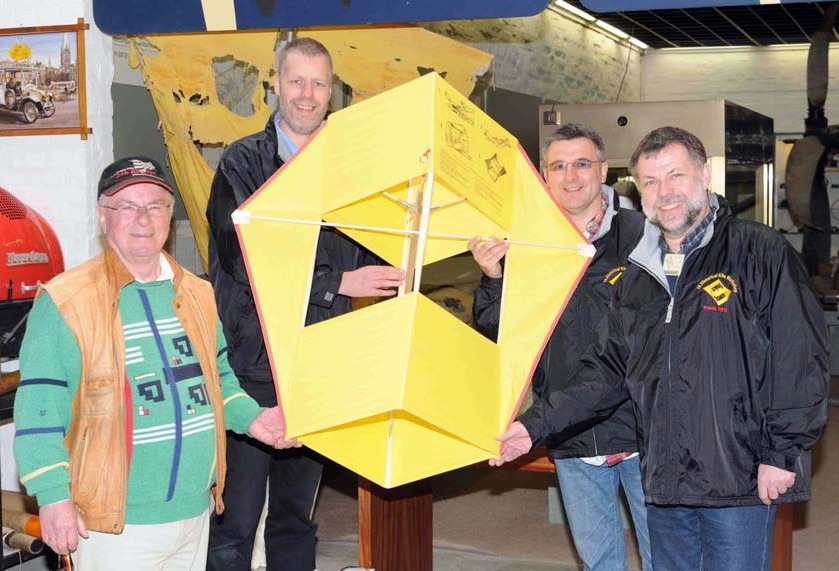
Ralf Maserski and Holm Struck. Walter Mueller gets the antenna kite for the museum from Holm Struck, Ralf Maserski, and Werner Luehmann. An antenna kite is a box kite that lifts an antenna into the sky.
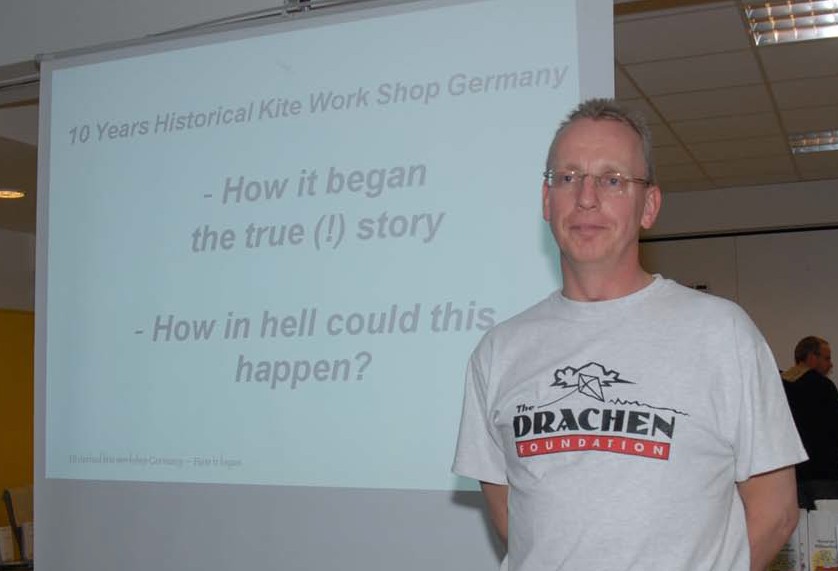
Ralf Maserski and Holm Struck. Achim Kinter – “How it began, the true (!) story.”
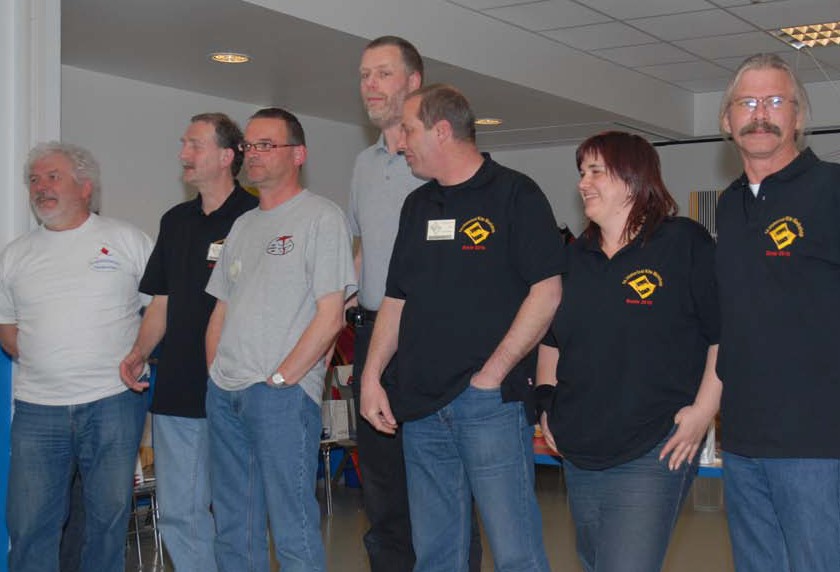
Ralf Maserski and Holm Struck. All time participants: Richard Schubert, Frits Sauvé, Falk Hilsenbeck, Holm Struck, Henry and Sonja Johns, and Detlef Griese.
Now the big party started with a raffle. We had more than 100 items donated by the participants and collected around 800 Euro ($1100). This money is part of the budget for the next Workshop and will help the new team get started on organization.
SUNDAY
After breakfast, we got the last round of lectures from Jan Westerink (kites by Matthew Sellers), Douwe Jan Joustra (kites in general), and Frits Sauvé (philosophical considerations and outlook for the next Workshop).
The last question of every Historical Kite Workshop is: “Who takes the baton?”
It went to Jan Westerink, Douwe Jan Joustra, and Frits Sauvé. They will be organizing the 11th Historical Kite Workshop which will take place in The Netherlands.
We would like to say a big thank you to Drachen Foundation, because they started this event and still support every organizing team with event shirts, donations for the raffle, or with money.
Visit the Historical Kite Workshop online: http://www.historical-kite-workshop.de