

 Share
Share Print
PrintRECOLLECTIONS ON (ALMOST) 20 YEARS OF KITE BUGGYING
From Discourse 7
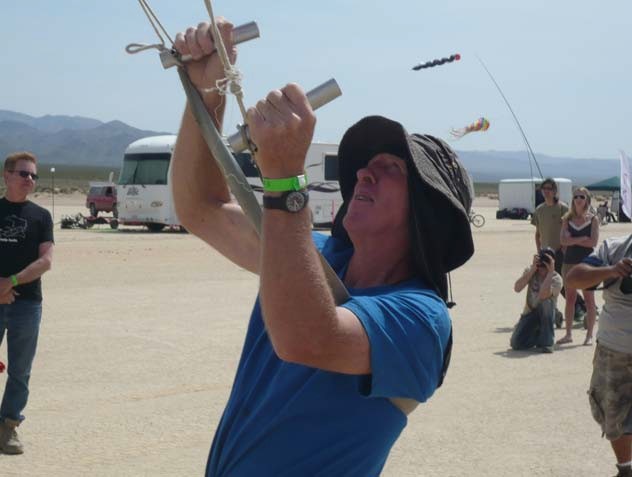 Scott Skinner
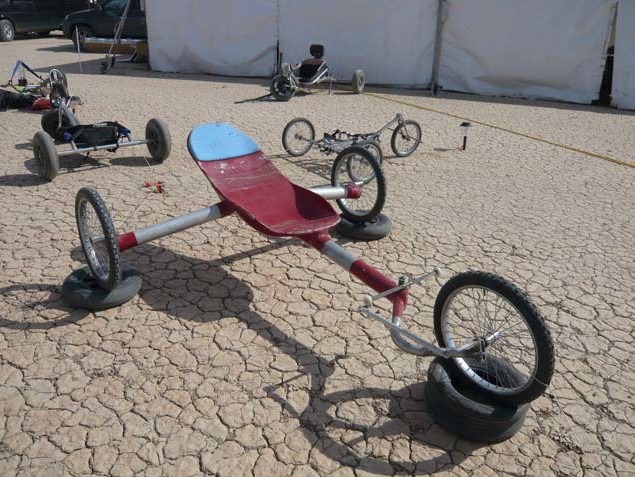
Scott Skinner
LEFT: Peter Lynn’s Buggy Number 1, with past and current editions close by. RIGHT: Peter Lynn with the first “dead man” handles – aptly named, as he is flying Traction Kite
Number 1, unsafe at any speed!
I first saw Peter Lynn in his kite buggy in either 1990 or 1991 on a beach in Japan. My first thought was, “He’s done it, he’s found a way to get in everyone’s way!” But that was shortsighted and selfish – what Peter had really done was to reinvent kite traction, this time as a sport for thousands.
This new, three-wheeled buggy, coupled with recently developed power kites, created the perfect storm, leading to twenty years of kite and buggy progress since. Kite Buggy Number 1 was actually a converted “kite boat,” one which Peter confesses
worked best when cruising about 3 feet below the water line with Peter’s nose causing the bow wave in front! A converted sport parachute was the first “motor” and the Lynn family quickly moved on to two- line sport kites, like large Hawaiian Team kites, that provided (a little) more safety.
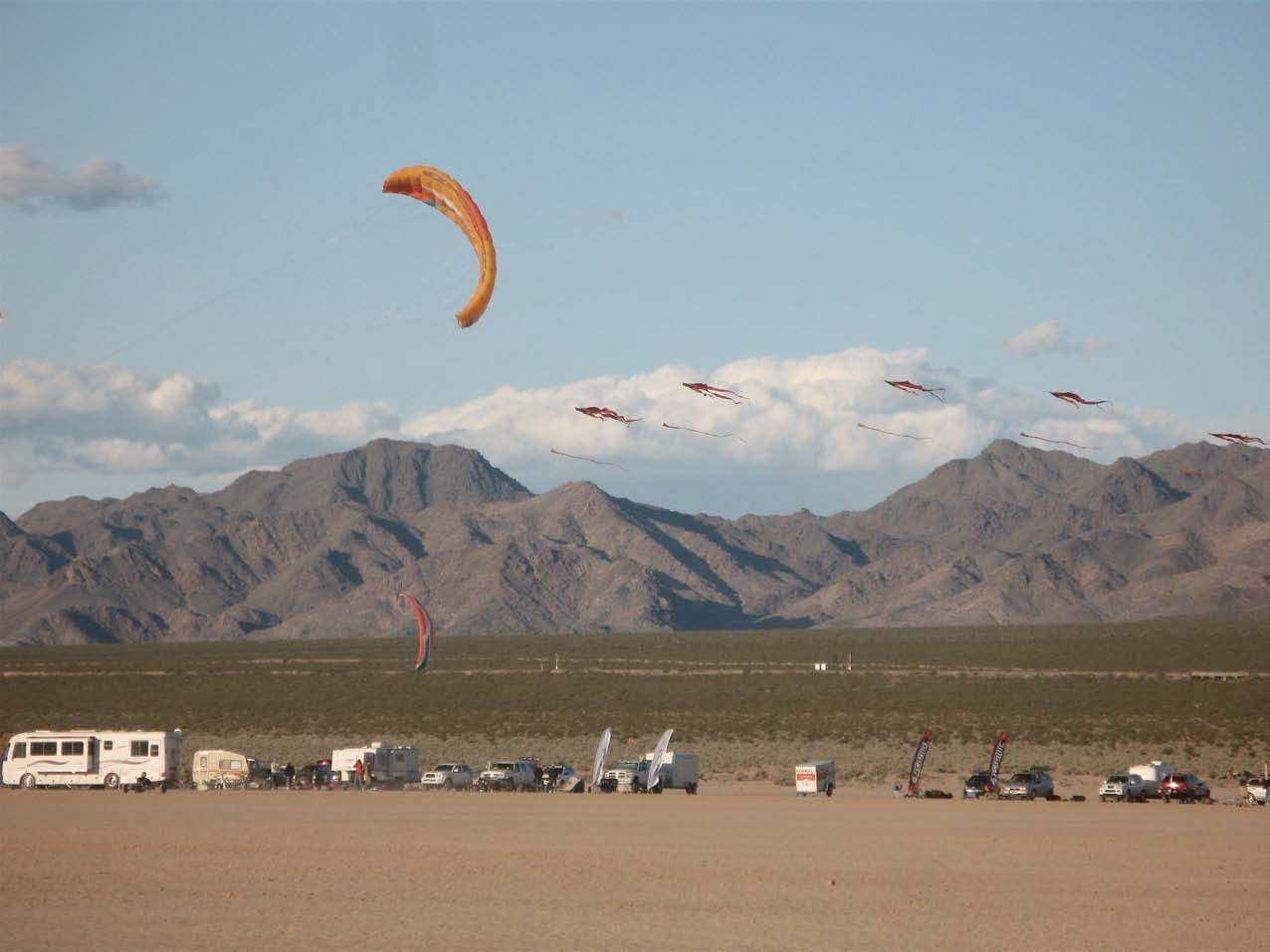
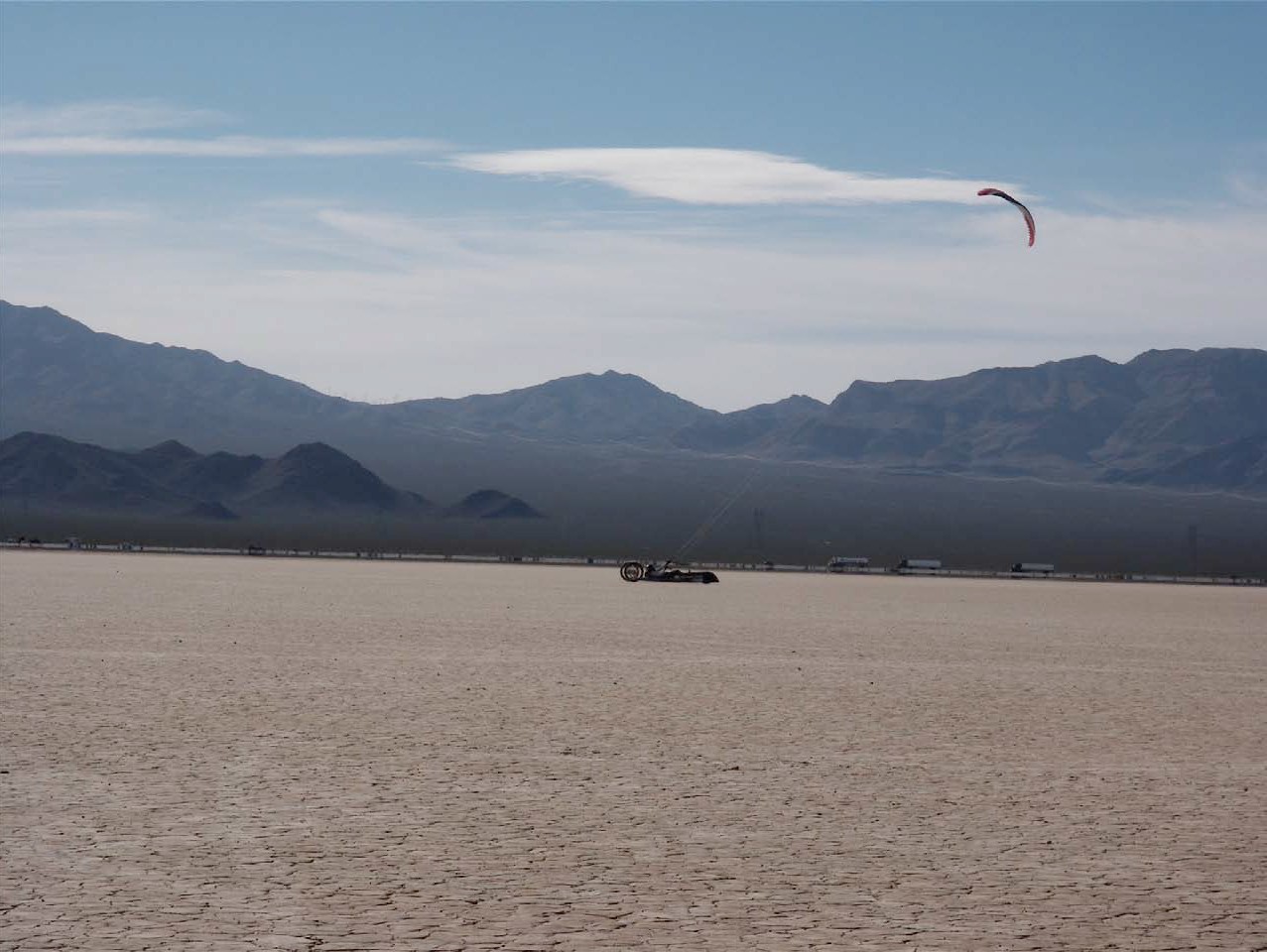
This year’s North American Buggy Expo (NABX) celebrated 20 years of modern land kite traction. It has become the primary North American traction event, where all the latest gear can be desert-tested on the very fast surface of Nevada’s Ivanpah Lake.
It wasn’t always so! Twenty years ago, on his son, Fritz’s, spring break, Fran Gramkowski brought his buggy to the desert for a week of practice. Corey Jenson, from Carmel, California at the time, came to join them, and the time and place for the event was set. Corey has since relocated to Las Vegas – mainly due to the proximity of the dry lake bed – and has become the official Mayor of the event. It’s unbelievable to think that Corey and I spent Thanksgiving of 1995 on Australia’s Lake Gairdner doing this very sport. Fran and Corey were instrumental in those early years of buggying, as they were kite retailers who supported the idea that this could really work!
It has been extremely interesting to watch the technological developments that have accompanied the sport: modern traction- kite design has been driven by the need for safe, efficient buggy “motors.” From early quad-line foils, developed by Ted Daugherty and others; to the two-line peels, Pauas, and zip-tips of Peter Lynn; to the NASA-wings that took Europe by storm in the late 90s – all were pulling us forward to what is now available: LEI kites developed in the kite- surfing industry, twin-skins, continually refined by Peter Lynn, and Power Foils made by Vlieger Op under the Lynn name.
Because buggy-racing is much like sailing, upwind and downwind performance is important, and simple brute force is not the answer. Additionally, a de-power capability is extremely important since we try not to be a “jumping” sport. (Of course, the British would disagree, as a whole school of buggy riding has developed there that features jumps, aerial 360s, various two-wheel tricks, and speed too!) Controlled use of power during gusts has been shown to be an invaluable racing asset. Control of the predominantly four-line kites has gone to the control bar, since so many people come to the land-based sport from kite-surfing or
snow-kiting, where it is the standard.
Buggy design has progressed as well. In his earliest production models, Lynn started with some basic parameters in his design: weight under the legal airline limit, center of gravity below the height of the rear axel, and frame components able to fit within airline baggage limits. Because of the evolution of the sport, these limits have been left behind. Here in the United States, dry lake beds in the west have proven to be the best venues, so longer, heavier buggies have evolved. Airline limits are avoided by driving with buggies (they easily fit in car racks), having a friend drive (my preferred method – thanks, Blake!), or even shipping, another reason that Corey and WindPower Sports in Las Vegas are so popular.
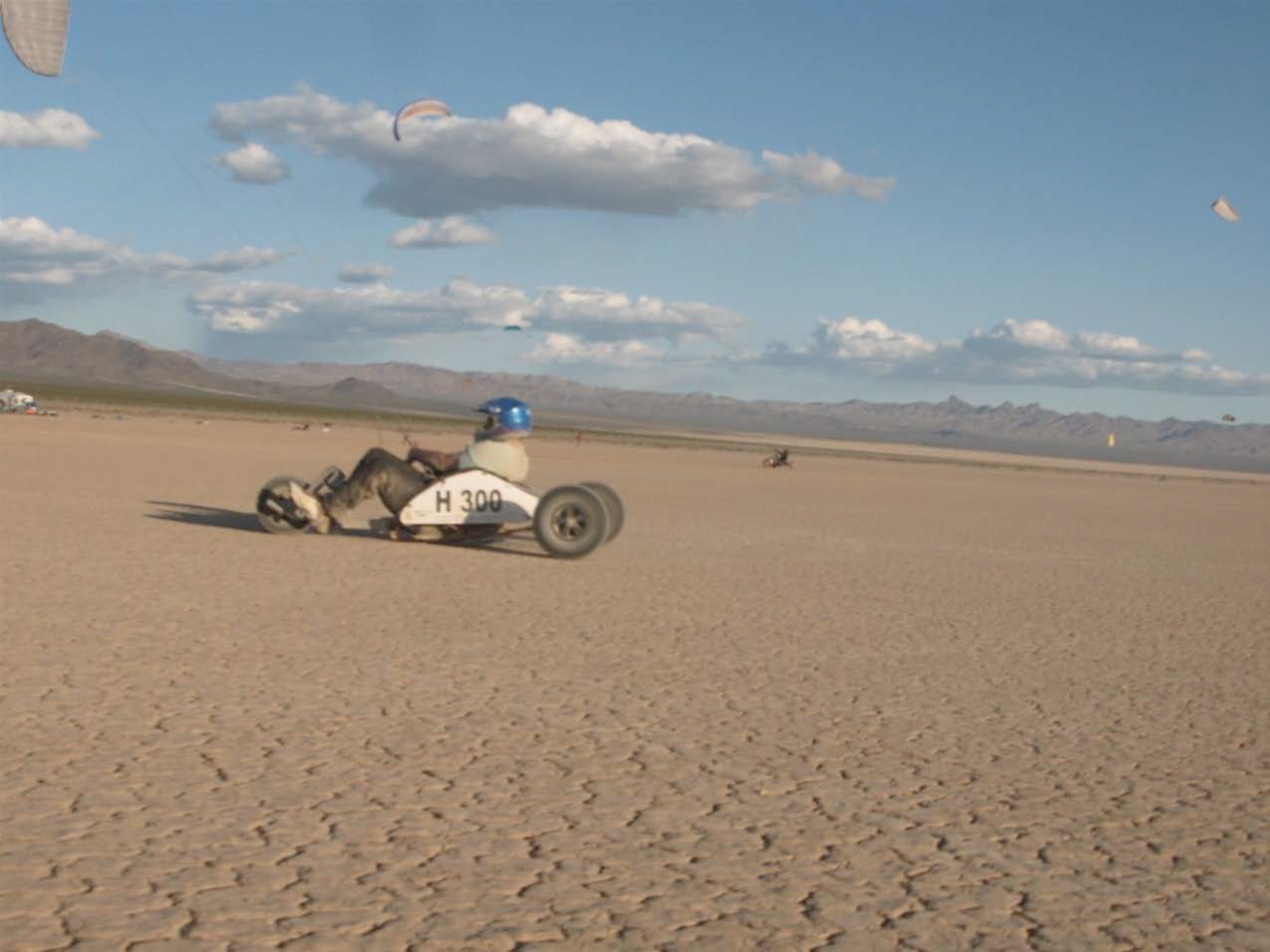
The premium has now moved to speed. Long, heavy, full-suspension buggies will always have a place here. Arjen van der Tol and his Dutch team set speed records both last year and this year (now at 82.9 MPH) with a combination of leading edge kites, buggies, and pilot skills. With current GPS technology, a top speed can be quickly verified. NABX intends to be the clearinghouse of all information related to k i t e l a n d s p e e d r e c o r d s . ( S e e www.NABX.net for current information.)
Finally, it has to be said that 2010 was a year to celebrate kite traction. Organizer Dean Jordan, another of those early-year buggiers, wanted this to be a NABX to remember. In a far cry from those early days, this year we had meals in the desert, parties on three nights, and even a beer sponsor – all is good in the world!
Also on hand at Ivanpah Lake was Lenka Chludova, who I would describe as a video DJ. She presented our sport in exciting visual ways, using her own original footage as well as submitted footage. This was a
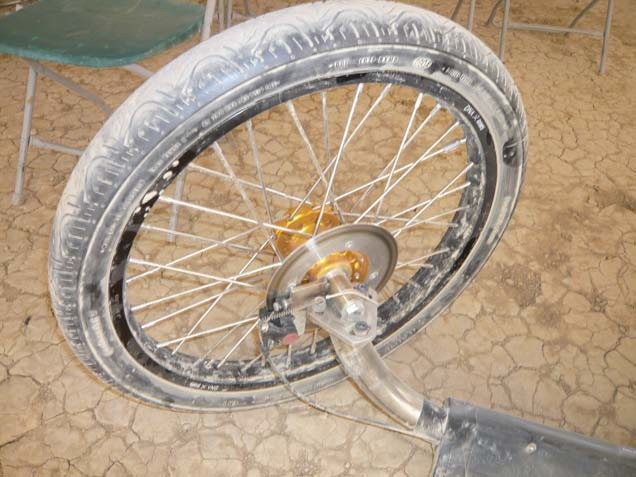
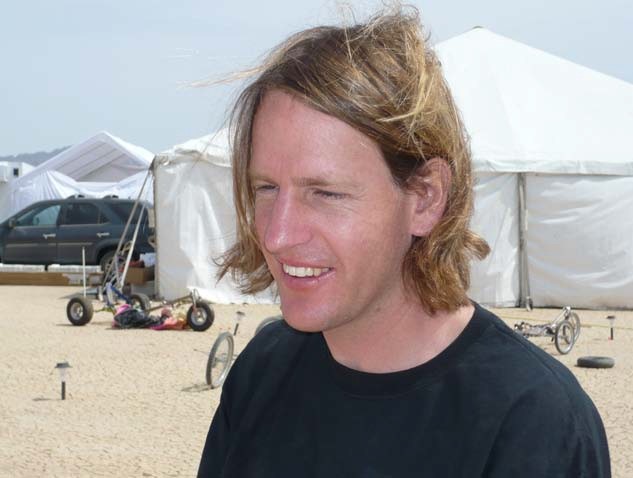 Scott Skinner
LEFT: Detail of tire and disc brake on the Peter Lynn Speed Buggy. RIGHT: Pete Lynn, Peter Lynn’s son and crash test dummy for many of Peter’s early traction ideas.
great way for newcomers and veterans to meet and mix when the wind and sun went down. Craig Hansen and Steve Gurney of New Zealand also presented a slide show on their unbelievable buggy trip across the Sahara Desert (article on page 18). See www.NABXtv.com for more, and support it with some of your own buggy shots.
Speaking of buggy shots (I’m not talking about shot-cars, another desert incarnation whose evolution has paralleled the kite buggy’s), take a look at the GoPro SD or HD camera. Here is a compact, multisport digital video camera that can be helmet- mounted, or with a down-tube attachment can be placed anywhere on a buggy for action shots of you and your buggy-friends. It comes in a water-proof casing (that also means dust-proof for those of us in the desert!) and takes some amazing action shots.
As we head into the future of land-based kite traction, it is interesting to me how close Peter Lynn came with his original Buggy Number 1 to where the sport is now going. Add aerodynamic fairing, stronger suspension and components, and Buggy 1 might be a speed record contender.
If we continue to come to the southwest’s deserts for speed runs, might our basic buggy configuration change? (There was a “crab-buggy” from Mexico here this year.) Could there be two-wheel configurations, built solely for speed? Might we start using framed kites like Joe Hadzicki’s Power Blast to optimize high-speed performance? (Joe still buggies as fast as any, but is the most power-hungry, using his Power Blast on handles with no harness.) Could we all end up using a variation of Pete Lynn’s “kite-on- a-stick?”1
I can pretty much guarantee that it will be a heckova ride!
NOTES
1. See Peter Lynn Newsletter, “Kite-on-a-Stick,” March 2010 online at: http://www.drachen.org/ personalities_lynn_news_March2010.html and Peter Lynn Newsletter, “Going Fast on a Kite Buggy,” April 2010 online at: http://www.drachen.org/ personalities_lynn_news_April2010.html
ADVENTURES IN KITE TRACTION
IMAGES FROM NABX
Jose Sainz
 Jose Sainz
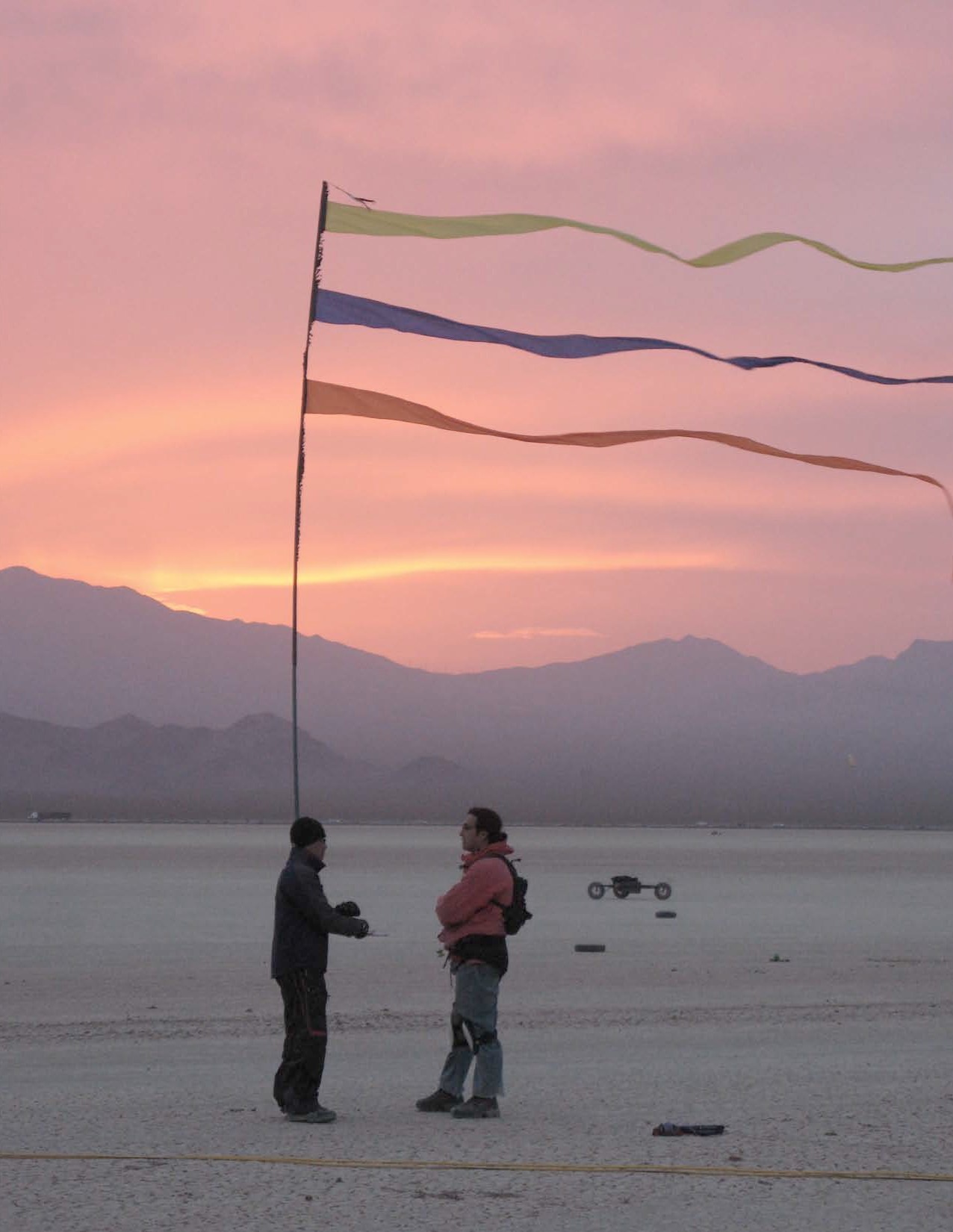
The 2010 North American Buggy Expo (NABX), where the latest traction gear is desert-tested on Ivanpah Lake, a dry
lake bed in Nevada’s Mojave Desert.
 Jose Sainz
Buggies zoom across the fast lake bed surface. The speed record was set this year at 82.9 MPH, with a combination of leading edge kites, buggies, and pilot skills.
 Jose Sainz
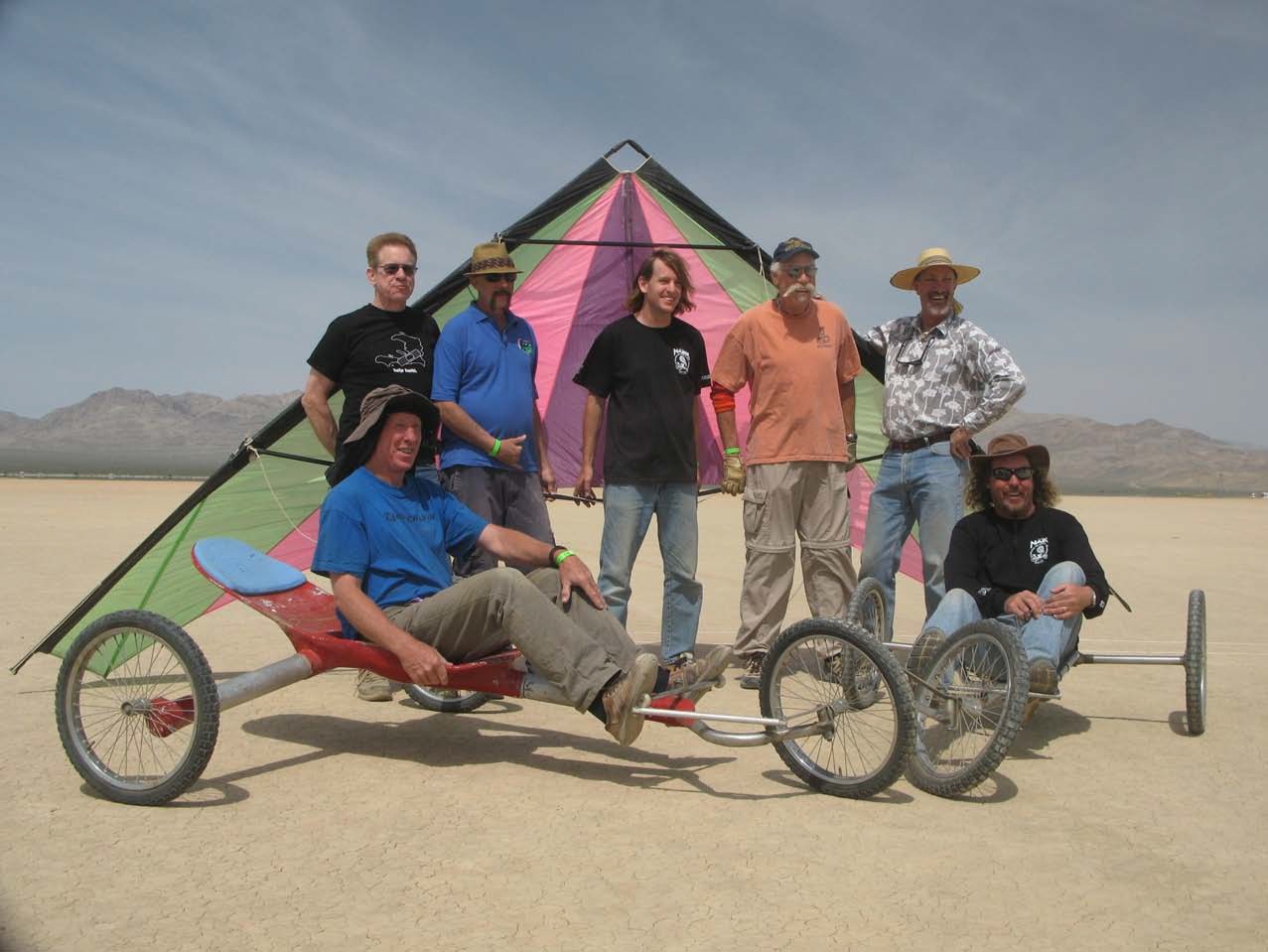
Back row, left to right: Dave Culp, Dean Jordan, Pete Lynn, Corey Jensen, and Scott Skinner. Seated left: Peter Lynn in the first buggy he made. Seated right: Phil McConnochie in the first production buggy made and sold.
 Jose Sainz
This year’s NABX celebrated 20 years of modern land kite traction. NABX has become the primary North American traction event.
ADVENTURES IN KITE TRACTION
WELCOME TO THE MAD WAY SOUTH
Victoria Crafar
 Mad Way South
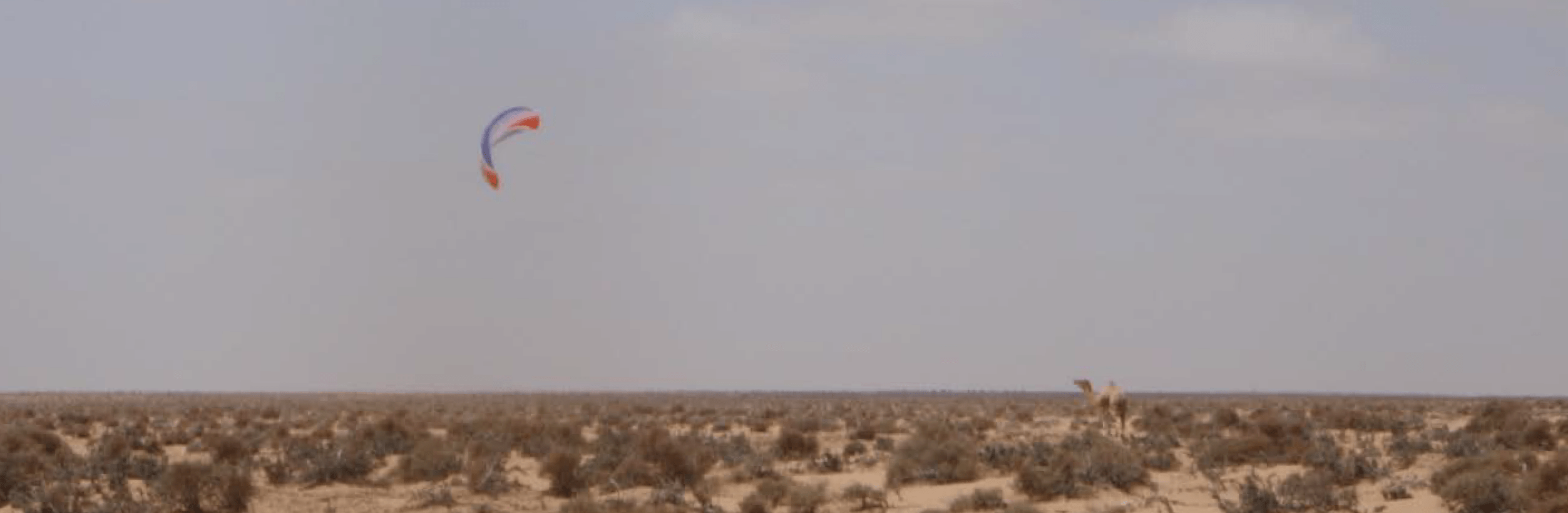
A camel watches as a Mad Way South kite flies over the Sahara Desert. Two teams of two men cross the Sahara in a wind-powered race to raise money for SHE Rescue Home.
The story about to be told is one of great heart. At times unbelievable and utterly mind-blowing, it has come straight from a self-confessed mad-man. He is Ashburton, New Zealand’s Craig Hansen, aged on the edge of half a century, and the record is entirely true and correct. It speaks of four men and a support crew who conquered the rugged, unforgiving Sahara Desert and its many barbs – all the while in buggies – by harnessing the power of wind as their fuel alone. It tells of determination, innovation, inspiration, and new world records.
Welcome to the Mad Way South. It is all for a good cause.
Enter Kiwi (New Zealander) Steve Gurney, former professional multi-sport and triathlon athlete, now adventurer and legend. About four years ago, he and Craig were already acquainted and had missions on their minds.
At that stage, the target was the Namibian Desert to the Skeleton Coast solely by wind power, and funding was being sought from the New Zealand Government’s Sport and Recreation (SPARC) department. Out of many applications, the men made the final three, but missed out on the support. It went to two New Zealanders who were planning to walk across Greenland. However, the
homework had already been done. “We knew it was possible, but we didn’t have the right time or money to do it,” says Craig.
Enter Australian Geoff Wilson, veterinarian and adventurer, obsessed with all things wind-driven. Hearing of Craig’s interests and goals, he got on the blower. “He said to me, ‘Hey listen, have you ever thought about crossing a desert?’ I had the redundant plan in my draw. I pulled it out, put it on my desk, and said, ‘Yes, of course.’”
Geoff dreamt of crossing the Sahara. Craig wasn’t too sure on doing something as dangerous as that, but the more they conversed, the more Mad Way South became a reality. The details were nutted out. The Mad Way South was to be a wind- powered race to traverse the Sahara Desert, between two teams of two men – the Kiwis and the Aussies – epitomizing the age-old tradition of trans-Tasman rivalry.
The reason behind the madness: SHE Rescue Home, a secure haven for young Cambodian girls at risk of being trafficked or who have been forced into the sex trade. All funds raised by the trip and its effects would be given to the organization.
“That’s what motivated me to take on something more dangerous like the Sahara Desert,” Craig says. That, and he is a rather competitive person and can not often let a challenge go by the wayside. “I knew I would want to be there to win.” But it would have to be fair.
Ex-Zimbabwean, military-trained Craig is a masterful kite flier with many years of experience. Geoff, while passionate, did not have Craig’s expertise. So they decided to pick up a handicap for Craig, and an advantage for Geoff. Craig says, with a grin and a giggle, “Steve Gurney became my
handicap, which is a hellova thing to say in New Zealand. I said to Geoff, ‘Don’t worry about it, he’s a good bloke. He’ll be right. I’ll ask him if he wants to come.’”
Although Steve had little knowledge of flying kites, knowing Steve and his capacities, Craig was confident. “He was chosen as the handicap for a reason – because he absolutely was not going to be a handicap. He was going to be an incredible advantage.”
Meanwhile, Geoff gained a professional kite instructor. Enter Australian Garth Freeman, a kite flier since age 12.
Having secured the personnel, other issues had to be considered, like making the race fair. “Like match racing in sailing, everybody races the same boats. Then it’s about personal skill, time, effort, energy, and personal ability, more than money and who has got the best gear.”
Nine months of detailed and conscientious creation, preparation, and planning ensued. “I’d wake up at 3am thinking, ‘Crikey, what about…’ and would have to go and make it.” Almost everything needed for the trip was engineered from scratch, mostly done by Craig and the “nothing’s impossible” team at Peter Lynn Kites, Ashburton. (Incidentally, and rather fittingly, Peter Lynn himself designed the first kite buggy 20 years ago. Craig is co-owner of the factory.) “We needed to prepare some gear that had never been made before. So we needed to invent some stuff. It didn’t need to be high tech, it just needed to do the job.” Steve made the racers’ buggying suits. They were made out of cheap white linen, purchased from perhaps one of New Zealand’s most “budget” stores, The Warehouse.
Next, maps were sourced. The only available were 25-year-old Russian Cold
Mad Way South
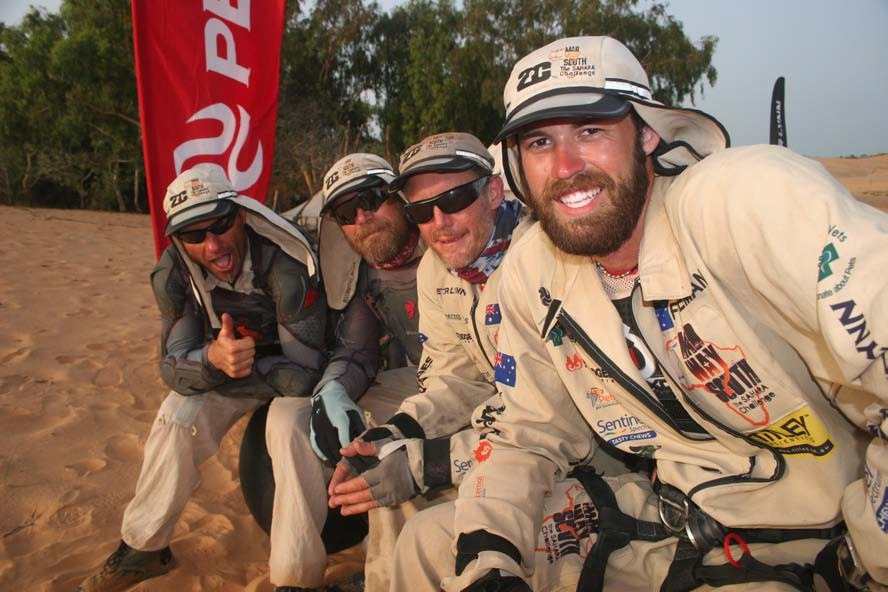
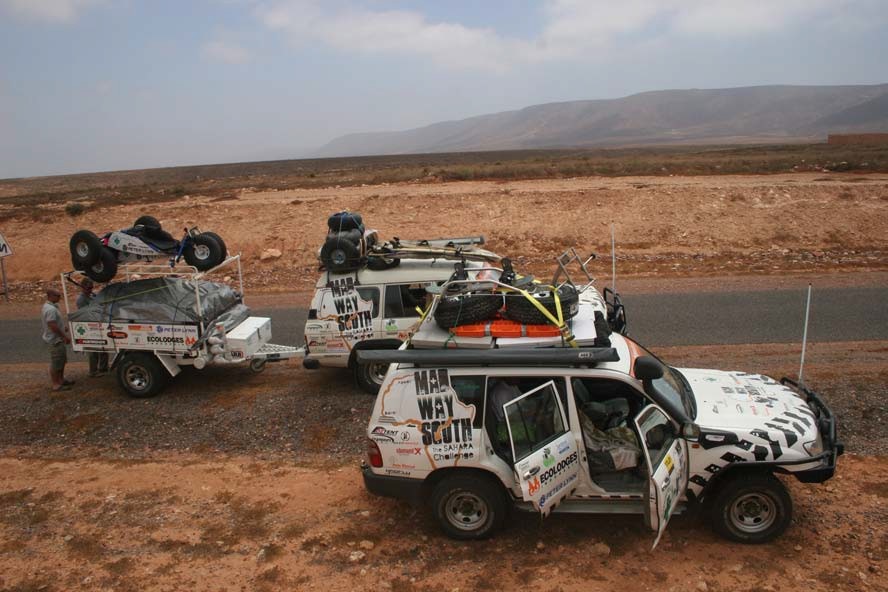
Nine months of preparation and planning led to this adventure for four buggiers and their nine-man support crew. The team travelled approximately 1367 miles.
War maps, which somehow made it to market. The guidelines were expensive and in Russian. “So we learned a bit of Russian.”
Then, specific roles such as way finding were designated to each individual, including their nine-man support crew.
At every end, their individual preparation for the group continued and the initial gathering point was defined. It was to be a couple’s garage in Kent, London. “They were family friends of Geoff, of whom we abused terribly,” Craig jokes.
Tons of gear was about to make its way from the other side of the world – “by hook or by crook” – by multiple routes. Reaching its destination at various times, the gear, teams, and crew dripped in to the Kent garage before driving to Portsmouth to catch the ferry to Spain. It was the first time the whole Mad Way South crew met.
The following 38 hour ferry ride could be likened to the calm before the storm. “So by the time we got to the boat, we were zombie-ish. So we got some down-time, caught up on some sleep, and then had our first meeting as a group and worked out who was who.”
Then they drove from Northern to Southern Spain, crossed into Gibraltar and into Africa, and drove to Morocco before delving into the dangerous desert. “Steve identified the definition of adventure very early on,” Craig says. “The definition of adventure is: outcome unknown, and there were a lot of things we went into where the outcome was unknown. The big unknown, of course, was the weather. What weather were we going to get? We went by previous records and made our best decisions based on those.”
It was getting towards crunch time. On the
way to find their starting point, the enormity and responsibility of the situation caught up with Craig, especially when they considered the distance they had just travelled was around the same as what they were about to buggy. “We’d just spent four days trying to get to where we were about to begin, and for me that quantified it. It gave me goose bumps.” The group were about leave from Agadir, Morocco, to take head-on the Sahara, and hopefully make it to Dakar, Senegal, inside 30 days. “We laid in our best plans and prepared as best we could for all situations and different outcomes, but we just didn’t know what was going to happen,” Craig said, quite honestly.
After an hour of driving to find a suitable start point, the Toyota truck convoy halted. “I don’t get car sick, but I had to call the vehicles to a stop, and had a vomit, because of the realization of it all. My body just couldn’t take it, I think.” Months of preparation came to a head – the promises each of them had made to sponsors, their families, and to themselves.
So the scene was set.
“It was something nobody had ever done before and it was something that was going to be done purely by the power of nature – which in itself is not extraordinary; people have been sailing around the world for years. But they’re able to choose the direction they travel in. We were, first of all, trying to cross a piece of land which doesn’t have the advantage of going anywhere you want. There are obstacles. It’s supposed to be ‘free’ and ‘sandy.’ However, that’s not what we found. Planning is always a good thing and we did all of that, but sometimes ignorance is also a good thing, because if we’d known then what we know now, we never would have started in that area.”
“We just absolutely could have said, ‘This is
impossible,’ but because we started with such ignorance and ended up having to cross terrain that was unimaginably difficult, we had no choice but to cross it, because we had begun. So we did. We crossed it because we had to. But if we had the choice, if we’d walked up and looked at it, we would have said no, and started further down the track.”
However, this meant less mileage would be covered, hence less funds raised – and it didn’t help record chances either. After all, the goal was to cross the whole Sahara. “We’d set a goal of 80 kilometers (50 miles) a day, at 10km (6 miles) an hour. That was our plan. In reality, we ended up doing up to 16 hours a day in our buggies. The first day, we started on a beach and did 40km (25 miles) in 45 minutes. Towards the end, 20km (12 miles) took 13 hours. It was ridiculous.”
This great start was just the Sahara’s welcoming gesture. She didn’t seem to appreciate the visitors entering her depths. The deeper they got, the tougher she became. “There were some days when I thought, ‘Crikey, Hansen, we’re really in amongst it now.”
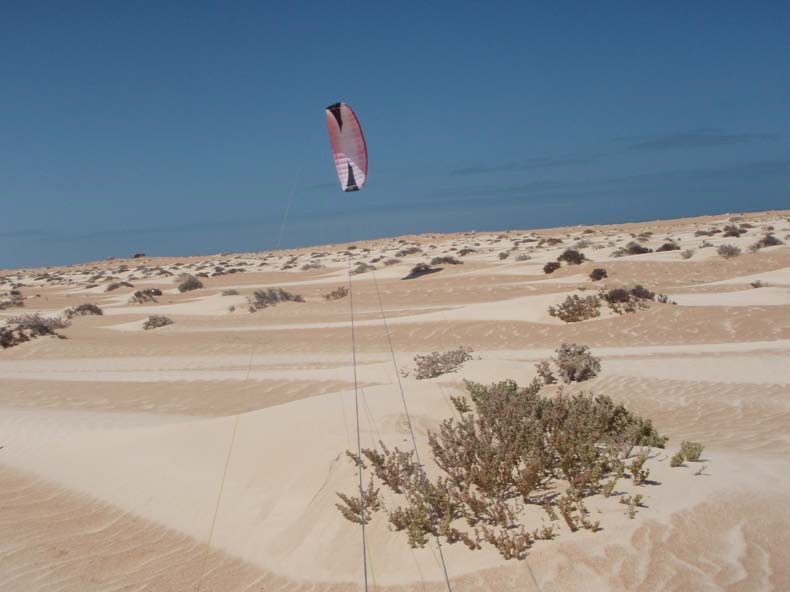
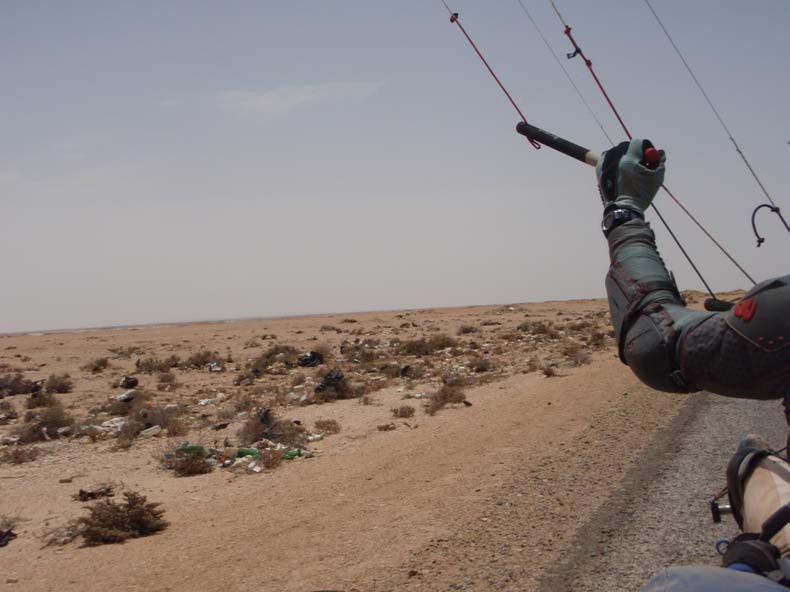
From Google Earth research, the lot of them knew the desert would be partially vegetated. “How wrong could we be? There were huge amounts of vegetation and all of it was full of thorns. There was no bush that didn’t have a thorn on it, and there were rocks and sand dunes everywhere in quantities that we never anticipated.” The reality check would not only effect racing times, but would also test the strength and ability of each of the Mad Way South members, including their buggies and kites.
“We didn’t expect it to be as hard as it was. We did have a contingency plan. We said we’d give it three days. If we were not able
to successfully work out a plan to negotiate this difficult terrain at the beginning – we thought it might be 30 or 40km (20 or 25 miles) from our limited research we were able to do on Google Earth – that we would call it quits, drive 100km (62 miles) down the road, and start again. Well, we ended up in this terrain for 600km (373 miles), at least!” All in all, the terrain was an ultimate test. “It tested us to the absolute limits of our personal mettle and tested our buggies to the point where they broke and we had to do some major repairs.”
To pass the time of his working days, besides having a stake in Peter Lynn Kites, Craig also directs Genesis Computers, which specializes in system integration for law and accountancy firms. This means one of his main concerns is building redundancy into systems, so if something happens, a backup comes into play and the system remains stable and in operation. When applied to Mad Way South, the teams’ buggies were designed to tow a trailer, which quite simply was another buggy, to act as the redundant contingency. It came in handy. “It absolutely saved our bacon.”
Under the strain, buggies cracked near the welds and tires wore. It became a case of Steve to the rescue. A Canterbury University graduate of engineering, Steve’s specialty is metallurgy. “Steve worked out what was going on, designed templates out of cardboard, and stuck them on where they should go with duct tape.”
The shadowing support crew whipped the cracked buggies away to a local workshop and the issues were fixed with stainless steel. Three days later they were able to continue in their normal buggies. By all accounts there is no lack of finding stainless steel in the desert – destitute ships line the coast and are scavenged by all and sundry.
Mad Way South
“We were, first of all, trying to cross a piece of land which doesn’t have the advantage of going anywhere you want. There are obstacles. It’s supposed to be ‘free’ and ‘sandy.’ However, that’s not what we found.” – Craig Hansen
“It’s something we didn’t bank on, but it was providence at work.” Providence seemed to have played a crucial role on the journey, as later events shall tell too.
However, the state of the gear bothered Craig. It hit him at his core because it was part of his responsibility to the crew. It became yet another inner battle to deal with. “When the buggies started to fail in the first week, I just thought, ‘No! I’ve got it all wrong and I’ve really let all these people down, the 13 people here. I’ve really done it this time.’ But it wasn’t as bad as I thought.”
Besides the numerous challenges Mad Way South had faced already, the biggest risks were yet to be met, but they were coming. “The biggest single risk was the political instability. You’re pitting yourself against nature and mankind – mankind was the biggest risk. Certain people didn’t come on the adventure because of that.” Growing up in war torn Rhodesia taught Craig that most situations in geographical locations such as the Sahara often hang on a knife-edge. “Things can go really badly, really quickly.”
One night, men armed with AK47 rifles approached their campsite, wanting to know who and what they were doing, and at one stage, the Kiwi team was followed by men in Land Rovers with AK47 rifles sticking out. “Fortunately they lost interest in us.” These occasions are simply a couple of examples of encounters the group had with lawless people of the land. Luckily, each time they managed to steer the conversation towards a safe and positive outcome.
Really, what the team lacked was a decent guide, someone that would go ahead and secure Mad Way South’s safe passage. They did have one, but he proved to be an “out- of-work actor” who did little but tag along.
Craig says, “Steve really put a lid on it when [conversation with the guide] started to get wild.”
Their only other two strategies to deal with aggressive souls were 1) to hand out colorful Peter Lynn baby octopus kites to children, so by the time their parents got there, they’d see the buggiers had made their offspring happy; and 2) to respond to aggressors by waving and greeting them with the standard French line “Ca va?” “We learned that very quickly. Everyone wanted us to stop all the time,” Craig says.
Minefields were always a problem, and not always marked. For a sizable part of the trip, the buggiers were confined to the road because of them. However, it wasn’t a land mine that almost killed one of the Kiwis.
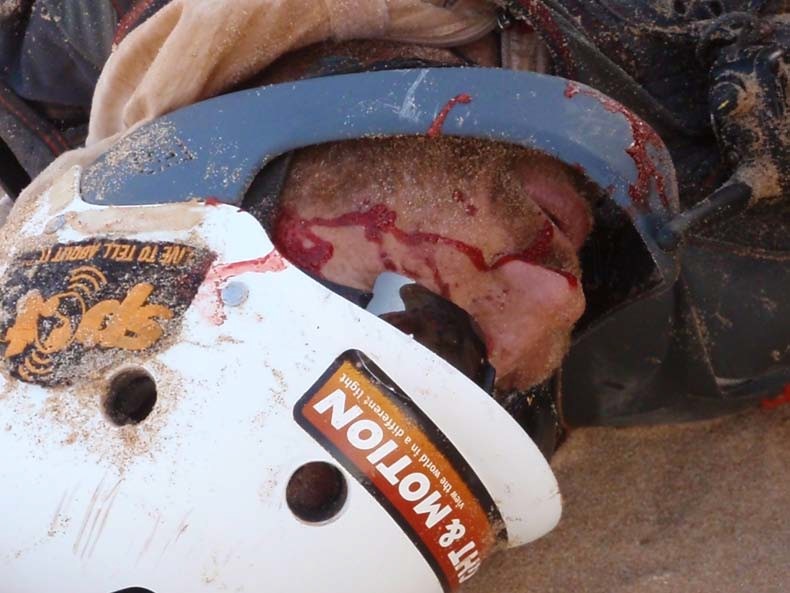
Steve endured four skull fractures, a broken scapular, disrupted sinuses, and a torn rotator cuff, not to mention brazen bruising and wicked wounds, partway through the journey. “It was just a moment of inattention. We’d been buggying through some pretty difficult terrain. It was late in the day and we’d been up since early, early in the morning. We’d had pretty low wind. I’d completely wrecked my body armor that day. I’d been flipped upside down, and Geoff had been rescued from a mine field by one of the local people.”
The teams and crew kept in touch with radios and Spot GPS tracking gear. “We had managed to make our way down to a beautiful beach. It was just heaven after just having smashed our way through all this rugged terrain. The sun started to set. We were up to 60kmph (37mph). “But I guess we were all tired and really starting to enjoy it. We’d come down off the plateau 300 feet (90 meters) above.” Wind was dropping, light was waning on the seaside cliffs, and bigger kites had to be tacked on to catch the
right breeze. “We had 6.4 meter (21 foot) kites on 50 meter (164 foot) lines. We’re talking about a lot of power. If you get it wrong, you’re going to be in trouble.”
The pair was getting towards the end of the beach. “I climbed up some of the rocks with my buggy to look for a way out to the south so we didn’t have to climb. Otherwise it would be a real pain. Steve had continued on from where I’d jumped up onto the rocks and started negotiating the hill to see if there was a way further down, but it just got steeper and steeper.” Then, disaster struck.
“Momentarily, Steve lost his attention on the kite. The kite looped in the power zone, picked him up, and smashed him into the s i d e o f t h e c l i f f , k n o c k i n g h i m unconscious.” The kite looped and did it again, when he was unconscious, dragging him further up. “I was looking down towards it and thinking, ‘Well, that’s just horrible.’ I didn’t think anyone could survive that.” Craig says on his way to Steve’s aid, he wasn’t sure how he was going to tell New Zealand that one of its most bright sporting icons, Steve Gurney, was dead. His body had looked like a rag doll being tossed around the cliff face.
But Steve’s grit stayed true to his constitution. “He walked out of the valley of death, literally.” When Craig got to him, Steve was unconscious and his sunglasses were mangled into his brow. Craig put the dreaded “man down” call out to the Australians by radio. After initial damage control, Steve got to his feet and with assistance hauled himself back up onto the plateau. “Jeez…Steve’s tough.” Craig scaled it pulling both his buggy and Steve’s.
At the top, Geoff the vet patched Steve up before the long, painful bumpy ride to the local, make-shift hospital. He was told by the Saharan medical professionals that he
was fine, just bumped and bruised. It wasn’t until Steve returned to New Zealand and had a more thorough, technologically advanced check up that revealed the true extent of his injuries. However, Steve was back in the buggy a few days later, flying his kite only with full use of one arm.
Not long after the crash and the 1000km (620 mile) mark, an entire team meeting was called. Gear was being destroyed and they were getting hurt. “And all for competitive edge. It was becoming lunacy.” As the starting point’s primary objective was remembered, so was the reason for the trip: the SHE Rescue Home. “We stopped racing at 1000km (620 miles). It was too dangerous. So we formed the ANZAC team. We were in this together.” That they were, and it was about to get even tougher.
While in the desert, Mad Way South members met several interesting people doing equally extraordinary things. One lady was running the length of it. Two Polish men were taking it by motorcycle; their mission was to motorbike from Poland to Dakar and back. When the team met the Poles, they said going through the border post at Rosso (southwestern Mauritania’s major city and a direct route to Dakar) was a bad idea, as it was a pretty rough place. The Mad Way Southers had already experienced Nouakchott, a city they passed through in the early hours under the cover of darkness to avoid its manmade threats. The Poles had been there too, and they reported Nouakchott was a walk in the park compared to Rosso.
In going to Rosso, the team risked losing everything they had, and their Mauritanian visas were running close to their expiration date. According to their new friends, Digamma’s border could be a better option. The pros and cons were then weighed. The decision was made to buggy through the
Mad Way South
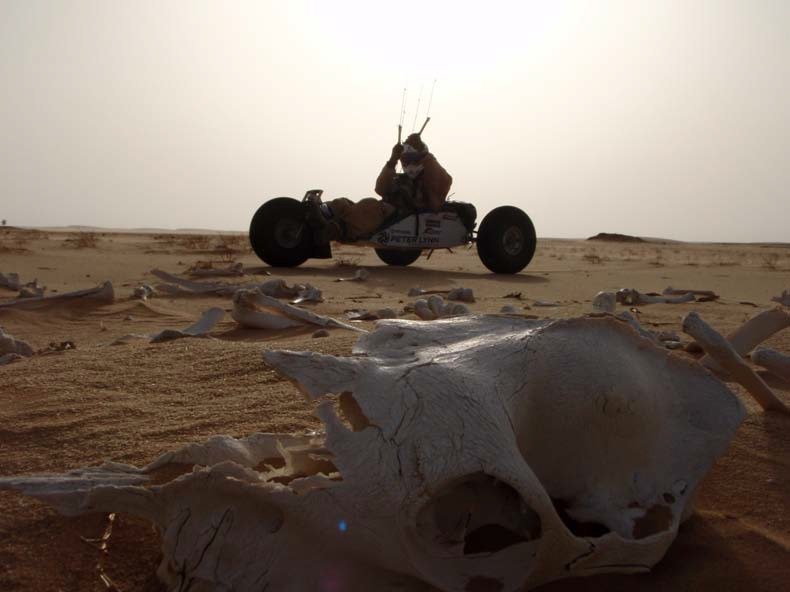
“We stopped racing at 1000km (620 miles). It was too dangerous. So we formed the ANZAC team. We were in
this together.” – Craig Hansen
border post at Digamma, which would mean crossing a dry wetland. Although the wetland’s outcome was unknown, Digamma was safer, so they left the path to Rosso for the dry wetland.
Enter Sahara’s fury. “We buggied in that night deeper and deeper into it on a narrow path through the trees.” Tricky, but possible – the team slowly pushed its way though the various obstacles like acacia bushes. Then Craig saw a familiar sight. “I managed to fly my kite between these two trees, looked up, and saw these weaver bird nests,” Craig says, knowingly. His childhood was graced with the pleasure of having weavers around, and their behavior would be monitored by many as an indicator of the weather and seasonal changes. If weaver birds built their nests mid-way up the tree, it would be a normal rainy season; if they built low, it indicated drought; if high, beware, the floodgates will soon unleash. The nests Craig spotted were high. He thought about telling the others his inkling, but feared sounding mad. Steve was almost straight- jacket material at that stage anyway, hallucinating off his malaria prevention medication.
Trudging along in the dark, Craig and Steve took hourly turns towing each other, until all four could trudge no more. They lay on dry mud, wrapped tight in their kites, and tried to nod off to sleep. “The mozzies (mosquitoes) were quite good at penetrating everything.” The little buggers breached the kites and their sweat-wet racing suits, so the threat of malaria was also present.
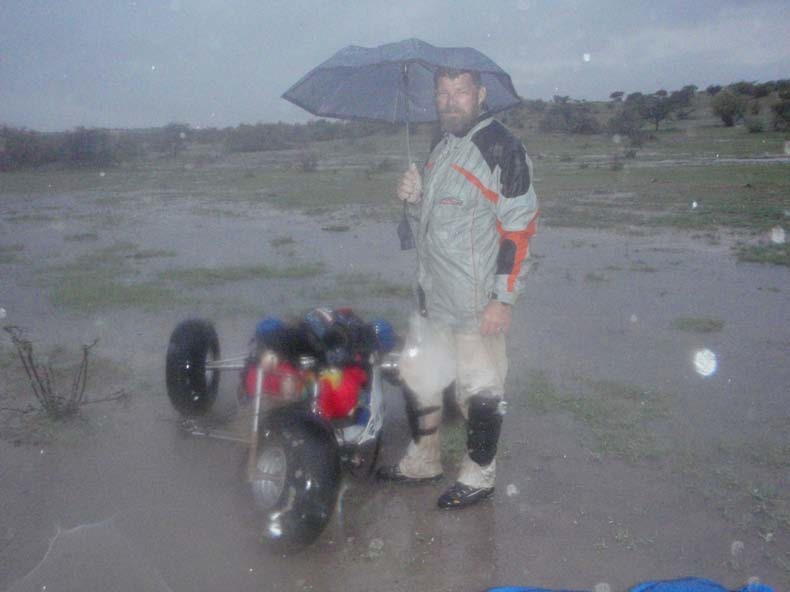
The buggiers then received a nasty wake up call at 3am. “A wind of unbelievable proportions came up. It was blowing the buggies away from us with all our gear.” It tugged their tightly wrapped kites off them too. “It was really this mad wind, followed by torrential rain. Three rain drops and
you’re wet,” Craig says. “So we started walking. I knew we were in trouble at that point. I don’t know if everybody realized that.” Sixteen hours of hard slog followed.
The cats and dogs eventually stopped, and by 10:30am it was 100% humidity, 40C (104F) plus, and there was no shade in sight in the now-wet wetland. They had no food, no water, were “miles to nowhere,” and they couldn’t spot a border post anywhere. Their support crew had no chance of rescuing them because all roads were closed and, rubbing salt into the wounds, the crew had the team’s passports. Time was running out.
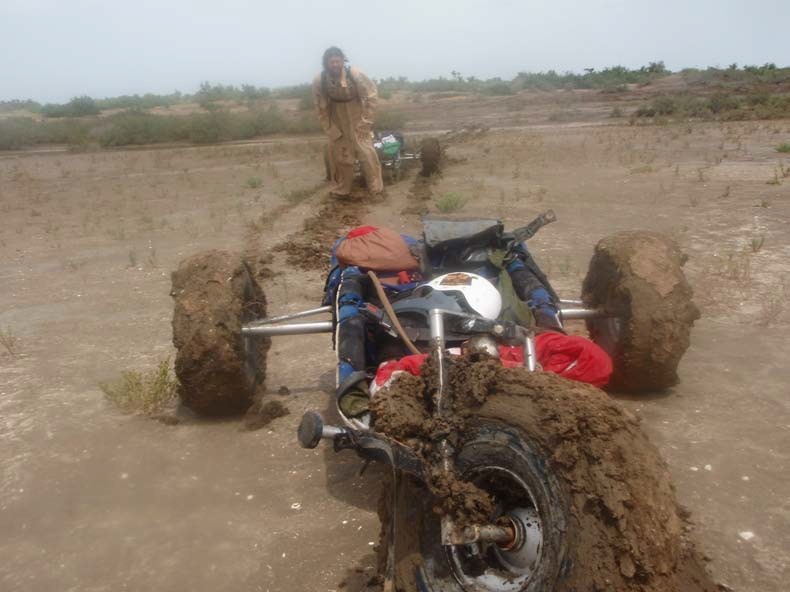
Plugging on saw mud build up on their shoes to the size of red-light-district-style platforms, and the buggy wheels picked up just as much. “We were in all kinds of trouble. We had no idea how we were going to get out.” Two and a half days of this carried on. “On our feet, awake, trying to get out of this place.” It was “murder” scaling the dunes to use the highest point, trying to spot Digamma.
Then, finally, something. The color yellow flashed in the distance. It was a heavy truck, stuck. The team crawled its way to it. Here, providence was perhaps at work again. The vehicle was freed a half hour after they got there. There was room for two in the cab and the rest in its trailer. Steve and Geoff called shotgun, and Craig and Garth took the back. “We were literally levitating!” The driver thrashed the truck over the dunes at about 140kmph (87mph) so he wouldn’t get stuck again. The trip lasted 60km (37 miles). The team soon reunited with the crew, and they all ended up at Rosso anyway.
It cost them $2,000 AUD to get through the volatile border post. “Stuff got pinched. It was just a nightmare,” Craig says. Disappointed, the entire group boarded a
Mad Way South
In the Sahara Desert, torrential rain leads to a mucky aftermath. “We were in all kinds of trouble. We had no idea how we were going to get out.” – Craig Hansen
ferry to St. Louis, Senegal, “knowing we had to get back to Mauritania to cross the desert. We hadn’t crossed the desert. It was just the absolute low point of the whole thing.” Their Mauritanian visas had now officially expired too.
But the French-settled town of St. Louis had a surprise in store for Mad Way South. The owner of the hotel they stayed at had been involved in desert-testing buggies sent from Peter Lynn in the 1970s. The group told him of its plight and the amazing adventure they had been on and how they absolutely needed to complete it. The fellow, whose family had rooted in St. Louis at the time the French settled, was somewhat an unofficial Mayor of the town. “He’s the most connected man there.” He knew everyone, the authorities and their strings, and he was excited at the prospect of being involved in buggying again. Providence?
The Mad Way Southers, besides their visa issues, had a couple of complaints from locals against them. They’d allegedly hit somebody with a buggy wheel on the way past and had two minor vehicle accidents. One of their drivers had even been arrested and locked up for it. Thanks to the hotelier and his connections, the problems were resolved by morning and the driver was released.
Additionally, a new window of opportunity to complete their task presented itself. A quirk in the local geography featured a Mauritanian sand pit that ran parallel with the coast. It ended at Port St. Louis and started from where, days ago, the team had left their route to go into the wetland. Their St. Louis savior organized for the border guards to be bribed so they would let the buggiers through without visas. The catch was, their passing had to be done that night, and they had to be back before the border guard was changed at 6am.
Suddenly, crossing the Sahara was back in the cards. The team would sneak through the border, head up the beach 60km (37miles), and buggy all the way back to complete their adventure and overall goal. “It was just this mad buggying rush in the darkness,” Craig says.
It wasn’t easy either. For approximately 40km (25 miles) of the Mad Way South’s final leg, “camels the size of pick up trucks” in herds of between 40 and 50 were resting on the beach, having come out of the desert to avoid the desert rains’ mucky aftermath.
“We had 6m (20ft) kites up that were way too big, and we were helicoptering down the beach with the wheels off the ground. We had no choice.” For several reasons. Gear in working order was running low, everything was wet-through from the continuing heavy rain, and they had to meet the 6am deadline. Otherwise it would be a case of consequence unknown.
“The next morning we crawled across the border with an offshore wind. The kites were out over the sea.” The wheels of the four buggies rolled into the Senegal River’s waters at 6am on the dot. “That was us. We had crossed the desert, and that was like, wow, at last! It was a funny feeling. We were smashed to pieces,” says Craig.
The Mad Way South crew retreated to the hotel, had a feed, and got some well- deserved shut eye. It was done. The Sahara had been conquered by wind power alone. It was time for some reflection. “I have a huge amount of respect for the desert. It didn’t go quickly. It tried everything it could to try and stop us from doing it. Everything conspired against us to do it, but we just kept doing it. We weren’t going to stop trying.”
Their efforts had finally come into fruition
Mad Way South
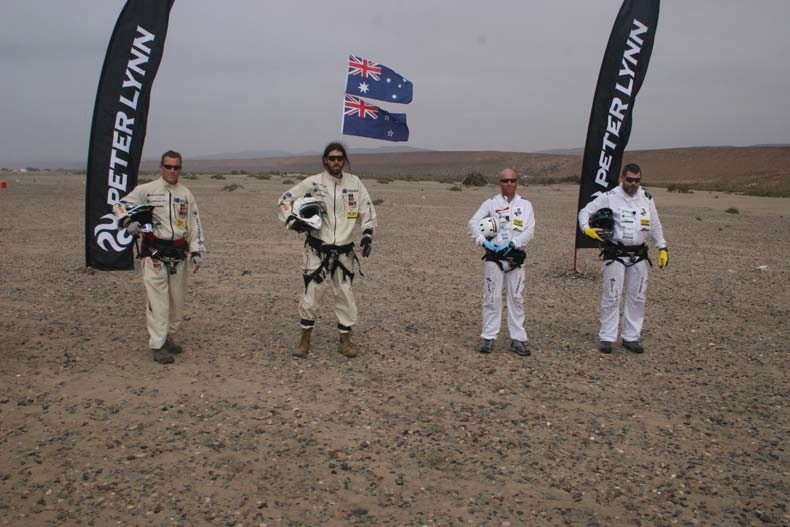
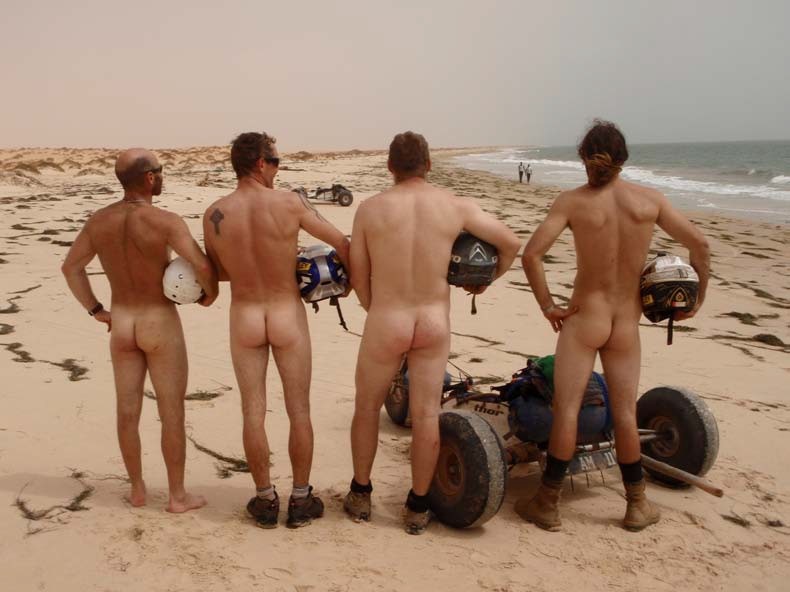
“We all have a deep bond,” says Craig. “We shared some stuff. We were successful and triumphant through some very difficult times.” ABOVE: The Mad Way South buggiers stand united and ready for adventure. BELOW: Together, they join the exclusive, international Buggy Naked Club.
and because of it, new world benchmarks were set. They’d achieved Mad Way South’s ultimate goal – crossing the Sahara fueled solely by wind – which was a first, and they blew the wind-powered distance record out of this world. The record was 1000km (620 miles). According to Craig’s GPS log, the men travelled a total of approximately 2200km (1367 miles). “It is 2169km (1348 miles) definitely, maybe more,” Craig says. These numbers are in the process of being ratified by Guinness World Records.
Along the way, the men also joined an exclusive, international organization, the Buggy Naked Club, after one particular, brief brainwave. “We did it on this deserted beach, which turned out to be not so deserted,” Craig says. Out of respect for their efforts, the foursome was sponsored membership by the club and recently received their pins in the mail.
Now, a little more than six months have passed since their return from the mighty Sahara. But the Mad Way South lives on, as it will for a while yet. “We all have a deep bond. We shared some stuff. We were successful and triumphant through some very difficult times. We saw people at their best and at their worst, and we’re still able to be friends. The more I got to know Steve – oh, I don’t know. I love Steve as a brother as I realized on our trip. I just admire him, you know. He has found a place in my heart. I just wish he wasn’t so hard on himself. He could really afford not to be.”
All four are still in constant contact. “Geoff is the eternal optimist. For him, the glass is not just half full, it’s half full and overflowing. Garth, well, he is a gentle giant and the best neighbor a man could have.”
The Mad Way South instigators often share their story with community groups, businesses, and other organizations,
inspiring people and raising even more funds for SHE. They have been trying to source interest to make a documentary about the entire journey.
All up, after everything, the Mad Way South proved Craig’s life-long suspicion. “It’s OK to dream. It’s OK to think up big things and have a go at them.”
Thank you for taking the Mad Way South.
ADVENTURES IN KITE TRACTION