

 Share
Share Print
PrintA Native Indian Community in Jujuy, Argentina
Diana C. Ross and Roberto Trinchero
From Discourse 14

Welcome sign to Yavi Chico. Gerardo Fugaretta – LiveArgentina
In mid-June, 2012, we set out on an oft-imagined journey from Bariloche1, our home town in Pa- tagonia, to La Quiaca, 2,887 kilometers north, on the border of Argentina and Bolivia. During the ascent towards the Puna (Andean Plateau) through the Quebrada de Humahuaca2 , we si- lently contemplated the multicolored hills and imposing rock formations, while sighting llamas and vicuñas3. With its scattered Indian settle- ments, and rich in archaeological remains – pu- carás (meaning fortress in Quechua), antigales (archaeological sites), and rock and cave paint- ings–we understood why La Quebrada, a caravan road for the Inca Empire in the 15th century, was declared a World Heritage site by UNESCO in 2003.
We had brought along a couple of kites, but they had remained in their bag throughout the trip, forgotten among the heaps of luggage and provi- sions in the back of the pickup truck, while we went sight-seeing and on long hikes. Between mate and mate4, I said jokingly to Roberto, “We will fly kites in Yavi Chico.” He laughed.
But my casual remark came true and became oneof the most vivid memories of this long voyage. It was our visit to Escuela de Frontera Nro 2 (Fron- tier School Nbr. 2) Rosario Wayar, in the aborigi- nal community of Yavi Chico, province of Jujuy, where the kites finally came out to fly.
Frontier School “Rosario Wayar.” Diana Ross
Yavi Chico
Situated on the border with Bolivia, and at 3,400 meters above sea level, Yavi Chico is a small vil- lage with around 80 inhabitants. It is flanked by huge natural rock walls. To get there, one must take a winding graveled road across the typical jujeño (Argentinian) scenery, dotted with cactus- es, prickly bushes, and interesting wind and wa- ter sculpted rock formations. Around Yavi Chico, however, there are green pastures. Several variet- ies of maize are grown, thanks to the rivers Que-brada de Cajas and Arroyo Yavi, whose conflu- ence occurs near the village.
Besides the typical adobe Andean dwellings, there is a small chapel, Nuestra Señora de Luján, and close by, Escuela de Frontera Nro. 2 Rosario Wayra. A welcome sign, which also offered tour- ist information, encouraged us to enter the prem- ises and introduce ourselves.
The Children and The maize (Corn)

We were warmly received by the school director, María Cristina Yurquina, who showed us around. In a luminous multipurpose hall, decorated with mobiles and other crafts made by the children, which serves as dining room and general meet- ing place, María Cristina gave us a detailed description of the work carried out by the school. The educational project, under the title “El maíz, ese grano de oro americano” (Corn, the golden American kernel), is based on using this large grain plant in an interdisciplinary way involving many aspects of school activity and daily life. More than 20 varieties of maize are produced in the area, this being the principal source of subsistence of the inhabitants. The school has a small farming project, in which traditional farm- ing methods and knowledge are applied to rais- ing the different plant varieties. Also, corn based dishes are prepared throughout the school year, and crafts are made, using the different colored grains and husks. Finally, a great deal of work is dedicated to recovering, classifying, and teaching traditional songs, legends, and customs, with the object of preserving and defending the local in- digenous culture. Listening to the children’s ideas and daily experiences, with maize as a means of encouraging dialogue, has served an essential purpose, explained Maria Cristina. Before this project existed, communication with the children and their families was much harder to attain.
The Kites
After this very interesting introduction, during break, we flew the delta-box and a diamond kite in the soccer and basketball court, with the chil- dren and some teachers. For some it was a novel experience, and we quickly had a team of little helpers, excitedly buzzing around, playing with the diamond kite’s tails and clamoring to hold the reel.

Getting the diamond ready to fly. Diana Ross

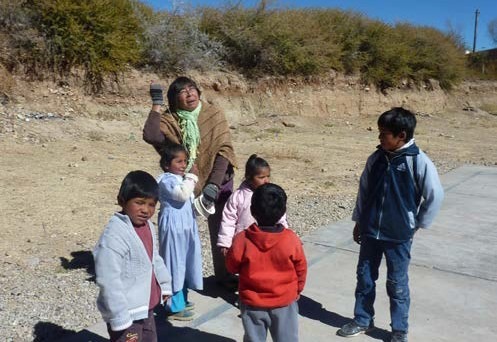 Diana Ross
Top: Flying high above the rocky cliffs.
Diana Ross
boTTom: María Cristina Yurquina and the children.

Long-fringed square, their first kite. Roberto Trinchero
“So…would you like to do a kite workshop,” I asked tentatively, before going to lunch.
Yes of course!! After lunch, Ariel, the art teacher, gathered a group of eight of the older children who had been invited to make kites. I had made a small list of the materials we would need: dowels, plastic bags, lightweight paper, and any kind of sticky tape…just a little worried about what sort of kite we could make in the hour or so we had left.
I need not have worried at all. The children brought bunches of a kind of reed or “bullrush”
I think it was totora – which I had never seen before, newly cut and fresh, light and strong enough for our purpose. There were some long rectangular pieces of transparent plastic sheet, a bit heavy (but there was no other material avail- able) sticky tape, and cotton string. Due to the shape of the plastic sheet, the best option seemed to be square kites with long fringes. During the next forty minutes we worked together on the ta- bles in the multipurpose hall, and as a result, six transparent long-fringed squares were ready, just in time to fly before the school day ended. In fact, we did not decorate them. The children were so eager to fly their kites that I suggested they do this with Ariel on some other occasion.
Back to the court, under the blazing afternoon sun, we spent the next, strenuous, half-hour get- ting the kites to fly. The breeze was much milder and more irregular than it had been in the morn- ing, but fortunately, for a while, and with much effort and perspiration, we were able to get all the kites up into the sky. Running at more than 3,000 meters above sea level is absolutely exhausting! So concentrated were we on flying the kites that we did not take many pictures, which of course I feel sorry about now.
And then it was time to say goodbye. María Cris- tina gave us brochures, small handicrafts, and asked us to tell others about her little school and the maize project.
I called her recently to let her know I was writing this article. She told me that they had been flying kites again and one piece of good news was that the school now has a projector and a camera, thanks to a grant.
Should you ever visit the area, do drop by the little rural school in Yavi Chico. It will surely be a worthwhile experience, and a memory to cher- ish.
This is the school’s webpage: http://www.yavichico. com.ar/ (in Spanish), where there are more photos, information on the project, and a contact address.
You can read more about Diane’s kiteflying and teaching experiences in Argentina in Issue 10 of 50
Getting the squares to fly from the basketball court. Roberto Trinchero
Footnotes:
- Bariloche is a city situated in the foothills of the Andes on the southern shores of Nahuel Huapi Lake. It is a major tourism centre.
- The Quebrada de Humahuaca is a narrow mountain valley located in the province of Jujuy in northwest Argen- tina, 1,649 kilometers (1,025miles) north of Buenos Aires. It is about 155 kilometers (96miles) long, oriented north- south, bordered by the Altiplano in the west and north, by the Sub-Andean hills in the east, and by the warm valleys (Valles Templados) in the south.
- The vicuña (Vicugna vicugna) is a wild South American
Camelid, which lives in the high areas of the Andes. It is a relative of the llama. Vicuñas produce small amounts of extremely fine wool, which is very expensive because the animal can only be shorn every three years and has to be caught from the wild. When knitted, the product of the vi- cuña’s fur is very soft and warm. It is understood that the Inca valued vicuñas highly for their wool, and that it was against the law for any but royalty to wear vicuña garments.
- Mate is a traditional South American infusion, particular- ly in Argentina, Uruguay, Paraguay and the southern states of Brazil. It is prepared from steeping dried leaves of yerba mate (llex paraguariensis) in hot water. Mate refreshments often relax an individual to the point of forgetful distraction.
Source: Wikipedia.

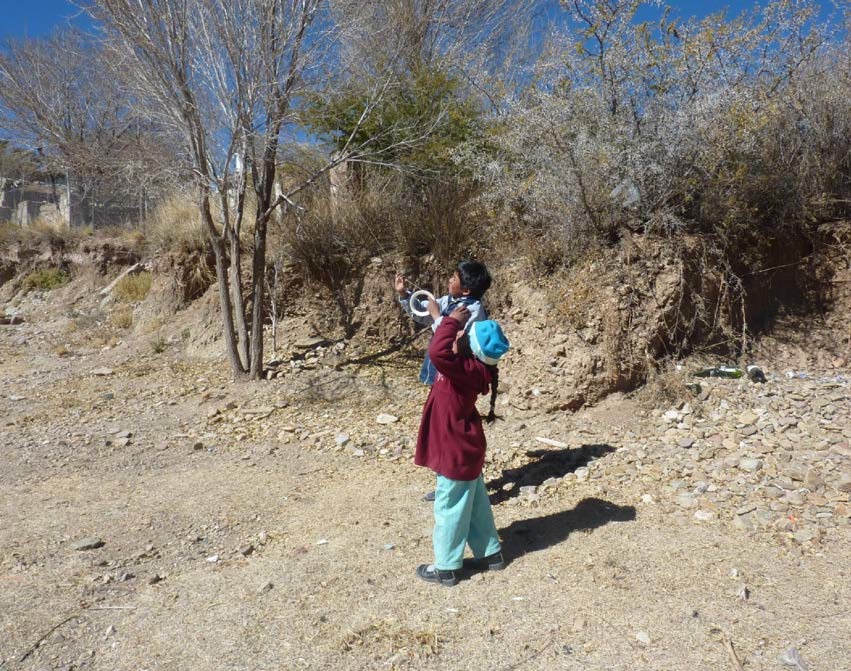 That kite’s flying really high! Roberto Trinchero