

 Share
Share Print
PrintScott Skinner
From Discourse 15
It’s time to reflect on twenty years of the Drachen Foundation and talk about some of the moments that have made us proud.
Before doing that, let me take a moment to thank three people who made the Foundation what it is. First, my wife Sherry, who agreed so many years ago to let me pursue this passion and then participated in funding the organization through its history. Sherry was nice enough to let me travel the globe while she managed kids, dogs, and household emergencies. Without Sherry’s support, the Drachen Foundation would have remained nothing but a dream.
Next, of course, is Ali Fujino, who, while perhaps not the heart and soul of the organization, was its muscle and bones. Ali has done all the detail-oriented tasks that an administrator must do, and has added an energy and focus that would never have been present had I been “in charge.” She was the driver of almost every Drachen project, from patches, pins, and t-shirts to collection acquisition to completed publications. Without Ali, there would have been no Foundation.
Finally, Ben Ruhe, with his energy, insight, and child-like curiosity helped to put a public face on the Foundation. With his in-depth interviews, his passion for finding a compelling story, and his attention to detail, Ben wrote countless s tories for the Foundation’s Journal , which brought personalities, events, and traditions to readers worldwide. Ben was the adult supervision of the organization and served to guide us and mentor us as we progressed.
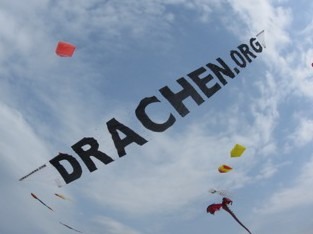
Paul Reynolds. Now celebrating its 20th anniversary, the Drachen Foundation has sponsored and participated in kite events and exhibits around the world. Here, Drachen kites fly in Italy.
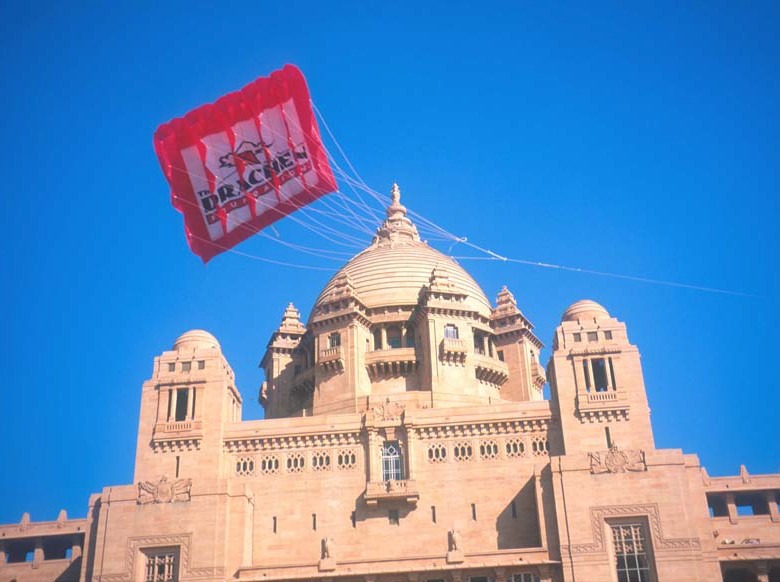
Drachen Foundation. Now celebrating its 20th anniversary, the Drachen Foundation has sponsored and participated in kite events and exhibits around the world. Here, a Drachen kite flies at India’s Umaid Bhawan Palace.
It’s time now to talk about those twenty years; to highlight some of the accomplishments and reflect upon the kiting landscape now and going forward. There have been so many great moments, and most of you readers probably know what I’m going to write about. But I’m going to start with something we didn’t do – spread a rumor, perhaps – and maybe influence one of you to pursue this story or one like it.
In the early years of the Foundation, we had occasion to work with Robert Trepanier, probably in a workshop situation, as Robert helped to develop many of our paper and bamboo kite kits. Robert relayed a story, told to him by a Canadian journalist, about kites being used in a small fishing village in southern Mexico. The kites were not used in a traditional fishing manner, i.e. to carry line out to the fish. Rather, they were large kites that were used to lift the full fishing nets so they could be taken more easily to shore. The capper was that these large kites were made from “fish bladders” (skin, internal organs, who knows!) and were as tall as a man. From trips to Mexico, where we enabled whale researcher Oscar Frey to use kite aerial photography, to trips to Guatemala, where we studied the history and power of the barriletes gigantes, we were never able to track down this kite tradition and see it for ourselves. Does it still survive? I hope so, and hope that someone with a quality camera stumbles onto this elusive story.
Probably the most significant moment in the Foundation’s history came when Ali and Ben traveled to London to participate in the Samuel Franklin Cody auction at Sotheby’s auction house. Having learned specifics of this auction only days before, we made the decision that we must participate and try to keep as much of this collection’s kite material together as possible. Ben and Ali arrived a day early and tried very hard to get a lay of the land and to see who else might be interested in the kite material. The last thing we wanted was to be bidding against other passionate kite people. We received valuable “intel” from attendees Jan Desimpelaere, Paul Chapman, and Frits Sauve, and when the dust settled, the Drachen Foundation owned a significant portion of the Cody kite collection – photos, documents, and artifacts – a collection that literally put the Drachen Foundation archive on the map. A very significant follow-up to the auction was 1994’s Dieppe Kite Festival, at which the Foundation went to the expense of shipping many of the significant artifacts from the auction to France for the benefit of historical kite enthusiasts. This was a major step in showing the intent of the Drachen Foundation; open sharing of material to all interested parties. Dieppe paved the way for a continuation of historical kite gatherings that had humble origins in Jan and Wilma Fischer’s home and have been going every year since.
The Drachen Foundation made significant inroads into communities outside our very close-knit kite community. Perhaps the best example is 2006’s collaboration with Hand Papermaking in its 20th anniversary celebration. The magazine had had a 20- year run and was popular with artists from a variety of backgrounds: papermakers, printers, and fine artists. The Foundation was tasked with providing a kite-related insert for every magazine – it was a wonderful miniature designed by artist Lesley Dill and produced for the magazine by Ali Fujino. The anniversary issue featured articles on flying paper, including paper hot air balloons, paper airplanes, and kites. I wrote the detailed article on kites and then was lucky enough to collaborate with Lesley on the last project of the celebration: a large paper and bamboo kite to be the centerpiece of a kite exhibit at Baltimore’s Maryland Institute College of Art. The uncompromising final result was a wonderful paper kite that, in my opinion, would have flown had it been asked. It has not flown but remains one of Lesley Dill’s signature artworks.
The collaboration with Hand Papermaking led to almost a decade of workshops and lectures with fine artists. It led to a number of presentations with our Japanese kite mentor Nobuhiko Yoshizumi, as well as the Foundation’s commitment to importing fine bamboo, suitable for kite making. Additionally, kite kits developed by Yoshizumi-san have introduced hundreds of artists and craftsmen to the magic of full- sized, refined Japanese kites.
The results of this collaboration and others like it produced a bit of a change in the direction of the Drachen Foundation’s outreach. In its first decade, the Foundation spoke mostly to kite groups – preaching to the choir, if you will. For the last ten years, we have pushed into many different groups apart from our traditional kite groups. We have hosted artists in Seattle, Austria, and Japan to produce unique and exciting paper kites. We have sponsored and participated in kitemaking and kite exhibits in Oaxaca, Pachuca, and Puebla, Mexico, all to bring kites into communities with little or no knowledge of their allure.
Finally, I am most proud of the publications that the Foundation has produced. John Stevenson’s Japanese Kite Prints stands alone as the best resource on ukiyo-e with kites. John’s mastery of the subject is inspiring, and the prints from the Skinner Collection are no less so. Stevenson allows the prints to tell the story of Japanese printmaking throughout the 19th Century and brings the history to the present with the selection of several contemporary art pieces. I am most excited about this book because it has so much useful and inspiring information waiting to be discovered.
The Foundation’s first publication, Kites: Paper Wings over Japan, was another collaboration and could not have been done without the help of Masaaki Modegi, Tsutomu Hiroi, and the Japan Kite Association. While much less ambitious than Stevenson’s book, Paper Wings has become a standard reference for students of Japanese kites. We worked very hard to make this a book that could be useful and interesting to both the tako kichi (kite crazy) and the kite novice.
Ali and I were honored to help with the publication of Sim Sarak and Tcheang Yarin‘s book on the history and traditions of Cambodian kites. Khleng Ek are fascinating examples of a country’s unique and varied kite traditions and this publication (through the work of Sim and Tcheang) has helped to salvage and revive the craft.
Likewise, our recent book, Wings of Resistance: the Giant Kites of Guatemala, has given voice to the native people of Guatemala. These amazing kites are examples of ethnic art, powerful political speech, and immense pride. Our most taxing publication effort, Wings of Resistance is nonetheless the most satisfying of our books that has come to fruition. Again, Ali was instrumental and irreplaceable in this effort.
So, in twenty years we have done significant things and have had more than a little fun along the way. We have built a significant archive of kite material: the Cody collection, kites from the Wright, Street, and lockhart collections, books and articles from all over the world. We have brought kites to people and people to kites who might never have found them without our “push.” In workshops and gatherings we have pushed design and art in kites and have enabled many trained artists to be competent kitemakers without the burdensome learning curve. With our online Journal and Discourse, and with our hard copy books in print, we have contributed in a small way to the dissemination of kite knowledge worldwide.
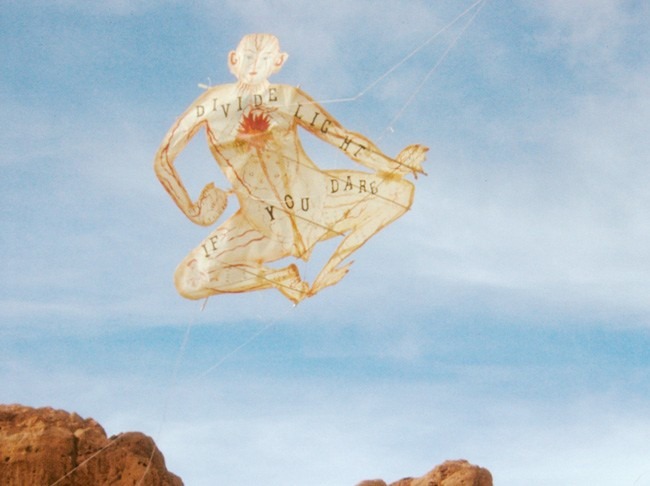
Drachen Foundation. From projects with artists, like the Lesley Dill/Scott Skinner kite shown, top, to bringing a massive kite archive online with the relaunched Drachen website, the Foundation has worked to disseminate kite knowledge worldwide.
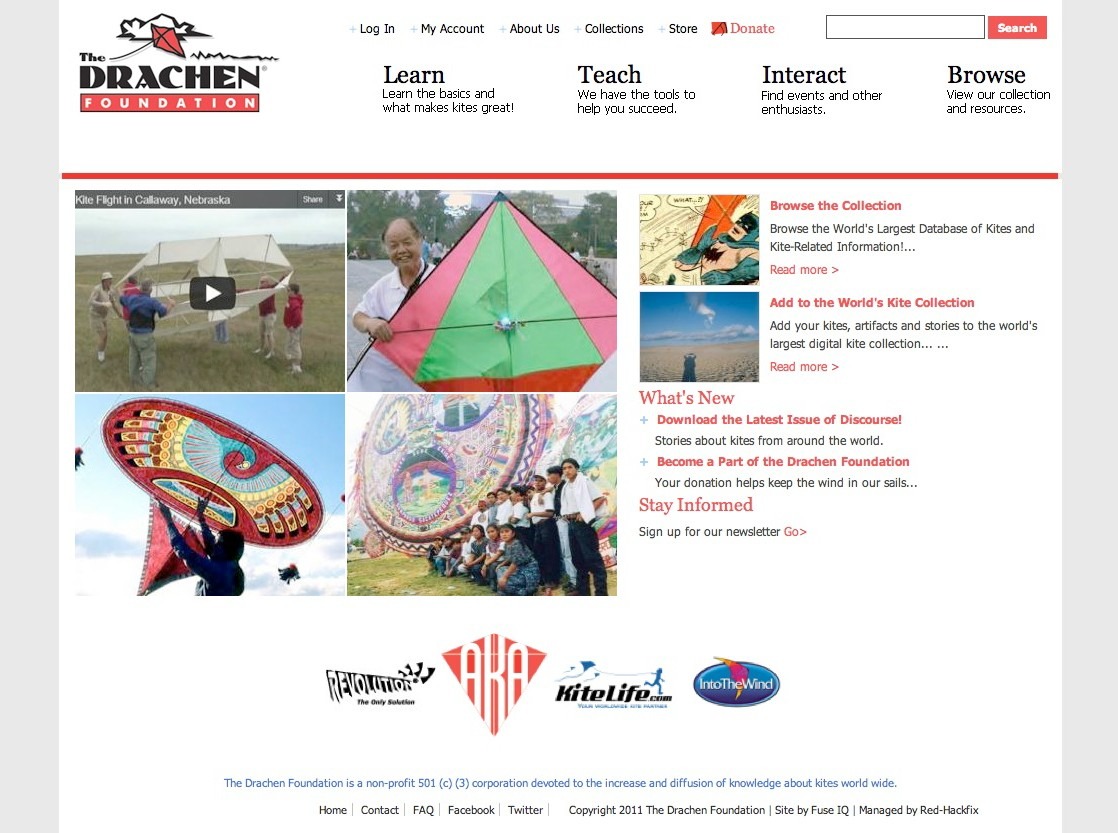
Drachen Foundation. From projects with artists, like the Lesley Dill/Scott Skinner kite shown, top, to bringing a massive kite archive online with the relaunched Drachen website, the Foundation has worked to disseminate kite knowledge worldwide.
Finally, we have collected this twenty years of work and have been able, with the help of today’s technology, to distill and organize it into a state-of-the-art website. Going forward, the Foundation will have no need for its physical collections as they have been rendered into online information. Articles, kite details, photos – all have been digitized and loaded onto the Drachen Foundation website where they are accessible to readers worldwide.
Our original mission of creating a working archive and sharing its information with kite enthusiasts and the public has become a reality. Our mission for the next twenty years is to manage the wealth of information that comes to the Foundation and to continue to share that information freely. It is exciting to think that with our active participation and contributions, the website will remain a viable and important resource for years to come. ◆