
 Share
Share Print
PrintJoe Hadzicki
Joe Hadzicki
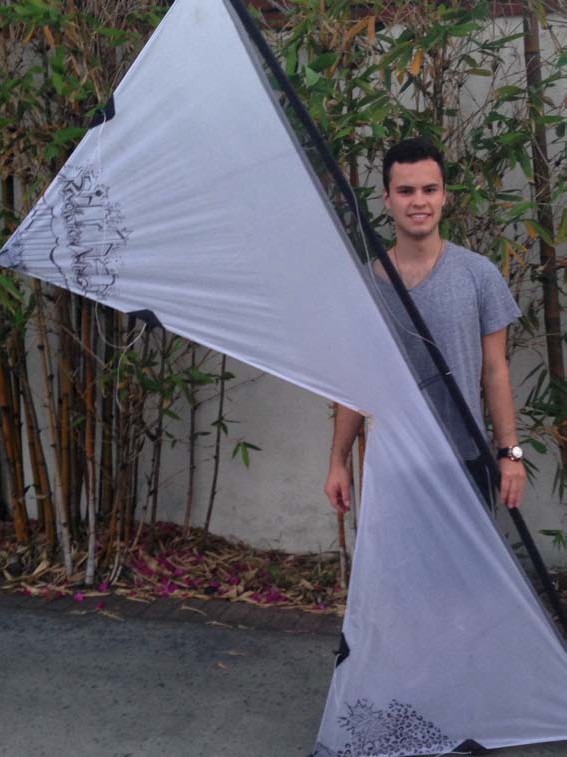
High school seniors like Tyler Hadzicki, above, intern at Revolution Kites to experience an engineering work environment.
Rube Goldberg. You know, the guy with the cra zy, ove r- e n g in e e r e d , m e ch a n ica l contraptions that do very simple tasks in very complicated ways. That’s what got me into this internship program with my high school alma mater. It all started during my son’s freshman year. The school puts on an annual open house event where the students display projects and activities they work on for a month during the winter break. Some go on trips to Europe, some do cooking classes, and some build things. As I walked into the gymnasium filled with the excited chatter of students explaining their projects to their parents, I saw one of the sophomore projects. This was, hands down, the most interesting display of the night. Taking up four banquet tables was a massive “Rube Goldberg machine.” I said to myself, “Wow, these kids are actually learning something useful.” I don’t say this just because I’m a mechanical engineer. Well, maybe that’s part of it, but…
All right, maybe there isn’t anything useful about the exercise, but its creativity and imagination gave me goosebumps. After getting over the initial excitement, I started exploring the details of the machine. From an engineering point of view, the most difficult challenge of this type of machine is repeatability. Will the ball roll down the same path and trigger the same levers to completion each time? This contraption was anything but dependable. Virtually everything was duct taped together, including the four banquet tables. As I walked around the gymnasium, taking in all the other projects, my mind kept
going back to the contraption. I’ve spent my whole life trying to create cool mechanical contraptions, and I started thinking, “Maybe I could help these kids out next year on their ‘Rube Goldberg’ project.” Surely I could teach them something about real engineering and expose them to tools, machines, materials, and basic engineering processes such as welding and machining processes using mills and lathes.
By the end of the evening, I was talking with the principal of the school offering my services. They couldn’t wait to accept my offer to help, but said the only area where they allow parents to participate is an internship program for the seniors. Long story short, I would spend the next three years offering an internship at my company waiting for my son to become a senior. But there was one more catch. Parents aren’t allowed to have their own children in their internships. So, to get around this little technicality, I had my brother Dave “teach” the internship during my son’s senior year.
This month-long internship ends with the school presentation. The idea is to give students considering engineering a chance to experience an actual work environment. We cover broad aspects of engineering and a lot of hands-on basic shop practices including welding and machining. We also cover aerodynamics in general, and specifically how it applies to kite design, focusing on the components of the “lift and drag” equations as a basis for their design.
Although every engineer would have his own way of approaching the subject, my brand of engineering is specifically oriented toward invention. My goal is to share my engineering experience and show the students how engineering can be exciting, and, dare I say, fun. During the internship, we touch on all aspects of my business i n c l u d i n g p r o d u c t d e v e l o p m e n t ,
manufacturing, quality control, sales, marketing, and worldwide distribution. Here are some thoughts of students from the last three years.
DAVID KUBERA, CLASS OF 2015
The internship at Revolution Enterprises allowed for a large amount of new skills and ideas to be taught in a short time. The first week was primarily teaching us about the basics of aeronautics and the work that needed to be put into creating a feasible design. From there we spent time designing new kites and testing with prototypes to see if it was worth the time to create a final version. If it flew, we would modify the kite to fly better. If it failed and modifying could not improve it, then it was set aside and a new design was chosen. In the third week, we started laying out and assembling final versions of all the kites. The last few days were spent assuring the final design had its flaws worked out and finding any areas to further improve.
During the entire month of working on kites, we learned about the different fields of work that are required to create the finished product. Beginning with spare shafts, we were able to see if the body was stable, and later we were shown how to create our own shafts from carbon fiber sheet for the final frame. Alongside the shafts, we were taught about the main techniques of welding and the basics of metal machining. The past month taught us that the final version of something, no matter how simple, takes large amounts of effort to develop.
ALEX LARSON, CLASS OF 2013
I am a sophomore computer engineering
continued on page 11
Joe Hadzicki
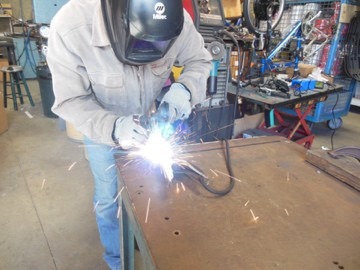
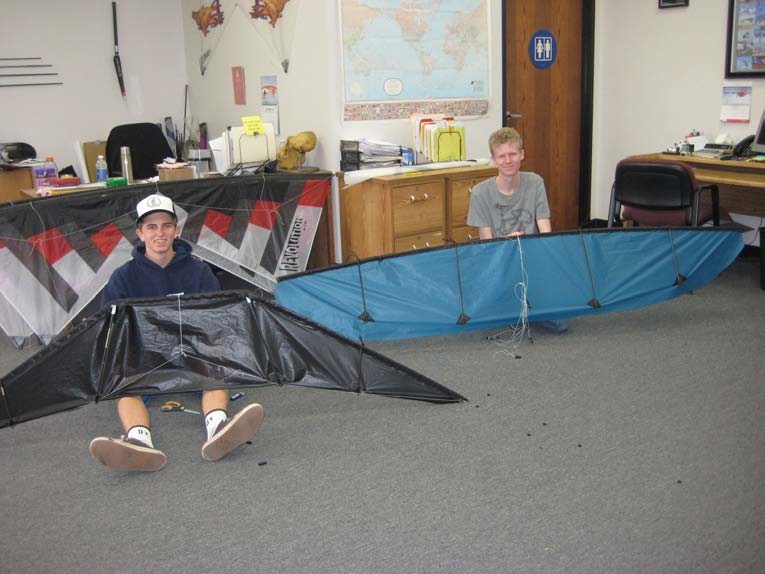
TOP: Intern David Kubera learns metal inert gas (MIG) welding. BOTTOM: Interns Alex Larson, left, and Kyle Mishky, right, at Revolution Kites.
student at the University of Alabama. During my senior year of high school I got the opportunity to intern with Joe Hadzicki at Revolution Enterprises. The internship was an incredible experience and made me certain of my choice to pursue a degree in engineering.
While many of my friends doing other internships complained how they were simply given busy work and then ignored by their employer, every day we were taught and given hands-on engineering experience by Mr. Hadzicki. Mr. Hadzicki taught us about aerodynamics and all about the carbon fiber manufacturing process. He showed us how to work with all sorts of heavy machinery at his shop and how his kites are made.
However, I would say the most important thing that I learned from the internship was how to work as a team with other engineers and how to take an idea and make it a reality. These general concepts have proved undeniably valuable in the pursuit of my degree and my involvement at school. I’m currently vice-president and co-founder of an unmanned aerial vehicle (UAV) design team at school working on building an autonomous aircraft to aid in disaster relief. I’ve been able to take a great deal of what I learned from Mr. Hadzicki to work with my team, and design and build a UAV from scratch.
I am very thankful I got the opportunity to intern at Revolution Enterprises. My hope is that one day I can use my engineering degree and some of what I learned to start a business of my own.
TYLER HADZICKI, CLASS OF 2014
Real life job experience is one of the most difficult things to find as a teenager. In most
cases, you have to wait until you’re halfway through your college career before you get offered anything better than pizza deliveryman.
Which is why I was so fortunate to have the opportunity to take an internship at Revolution as part of a high school course. Within four weeks, my fellow interns and I learned all about aerodynamics, stress loads, and even basic sewing as we took our kite designs from paper to reality. During the course of the project, I got a surprisingly comprehensive engineering experience considering the very short amount of time. I have no doubt that getting the same level of experience would take months at any other engineering firm. (Or perhaps a lifetime if all you could land was that pizza deliveryman job.)
The reason the program was so good was because Mr. Hadzicki worked with us the entire time. Not just ten minutes here and ten minutes there, but hours and hours everyday for a month straight. Now I might be biased because Mr. Hadzicki is my dad, but for the boss of a company to spend his time with a bunch of teenagers is exceptional. It had an impact on every one of us. Because of my time spent at Revolution, I now have a better idea of how a business is run, how a product is designed, and an overall confidence as I prepare to enter the modern workplace after college. But perhaps the best part, the thing I am most grateful for, is that I got all this experience without ever having to deliver a medium pepperoni with a side order of mozzarella sticks.
The Drachen Foundation is about disseminating kiting information to the public. This is, in some ways, an extension of the Foundation’s mission statement. Spread the word. I’m proud to be a part of it! ◆