

 Share
Share Print
PrintScott Skinner
Discourse-Issue-22
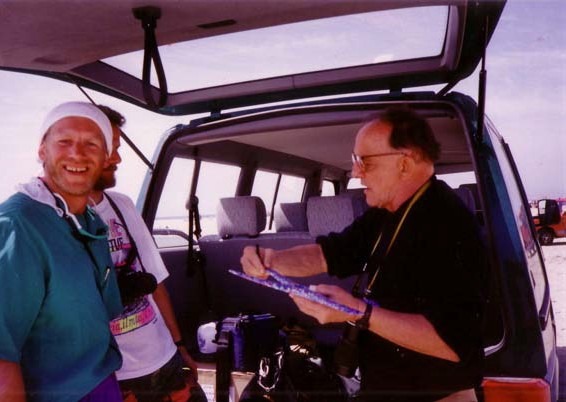
Ali Fujino. “We were in Germany doing a story for Drachen in 2008. We saw some students throwing boomerang, went over, and they said, “It’s Ben Ruhe!” and an autograph session started.” – Ali Fujino
INTRODUCTION BY ALI FUJINO
Ben was there for Drachen in the early years as the professional writer to research and document the world of kiting. As a world-class traveler, there was no place that Ben wouldn’t go to find a story, documenting the history and culture of kites. (Ben reports that he has visited exactly 84 countries!) It is his journalistic talents that have given the kiting world professional documentation in both written and photographic imagery.
He covered Asia, Europe, and Central and North America. Drachen could not give an exact number of interviews he conducted for us, but it is in the hundreds. His photo archive is in the thousands.
INTERVIEW BY SCOTT SKINNER
This article started with a simple premise; ask ten questions of Ben Ruhe for his memories about his work with the Drachen Foundation over the last 20 years.
As many of you know, however, a conversation with Ben often leads to places you had no intention of going, so what follows are “notes” from an hour on the phone with Ben. There may indeed be ten questions in there somewhere, but I think you’ll be happy to hear these thoughts and memories from Ben Ruhe.
Ben grew up in the country – a large property with lots of land and a swimming pool, a rarity in the days of the American Depression. Ben was the ninth child, and the 7th son. The family was highly educated with many of the children getting advanced degrees.
The first child in the family was a girl – a Depression child. She taught dance and married her piano player. He was a Colonel in the Air Force in WWII and in fact was heir to the Mack Truck family. He drove the company into the ground and was forced out of the business.
His eldest brother was a naval doctor in World War II. A second brother went to the Naval Academy and retired a Captain. Ben’s brother Joe was a veterinarian, and he flew the Hump in Burma – “had a very rough war.” Joe moved to Texas and bought a square mile of land!
Another brother was a musical genius, who died at age 21 of cancer. Another brother died in infancy. Brother Ed was marked by genius, turned down a scholarship to Princeton and went to Swarthmore.
Sister Judith was born as child #8, and Ben figured she is the reason he is around: the family had to have a seventh son. Judith felt disadvantaged as a female in a family of so many boys, but she still went to an Ivy League school and finished in just three years.
“That leaves me,” says Ben. Ben went to a variety of schools. At Columbia Law School, he roomed with an anthropology major. Ben found that all of his roommate’s friends were marvelous and all of his own were “dreadful,” so he figured law was the wrong profession for him.
He had worked earlier at The Allentown Morning Call, a medium-sized newspaper in the eastern Pennsylvania town. Ben’s father was editor for over 50 years. He lived through his sons and didn’t need to travel because he knew so many people from so many places – both from his own school days and from his sons’ travels.
After The Morning Call, Ben went to The Washington Star, a newspaper that had the highest advertising revenues of any paper at that time. But he saw it start to die as television changed peoples’ habits of finding news. Ben chose to “wander around” Washington, DC and write about what he wanted to.
Ben met S. Dillon Ripley of the Smithsonian in 1968 and saw the conflicts between Paul Mellon of the National Gallery and Ripley of the Smithsonian. Ripley hired Ben for the Public Affairs office, but Ben quickly started to spend more time at the Smithsonian’s National Collection of Fine Arts, something closer to his heart.
Ben became Public Affairs Director at the National Portrait Gallery, a place with old- fashioned rules set by Congress, and then managed to switch to the National Collection of Fine Arts, run by Dr. Joshua Taylor, a long-time professor from the University of Chicago. Enter Ali Fujino, who arrived as an intern and soon was interviewing for a job.
Ben made friends with the director of the National Gallery, Carter Brown, who was coming in as a new Director, and Ben was asked to become his Public Relations Director. He was about to start when the job offer was rescinded because Ben was seen by Mellon as a “Ripley man.”
So, getting a bit bored with the National Collection, Ben moved to the National Endowment Council for the Arts, an organization led by the very best in the arts. The NEA was then led by Nancy Hanks, who simply told everyone what to do. Nelson Rockefeller was an admirer, so Nancy had no lack of political clout.
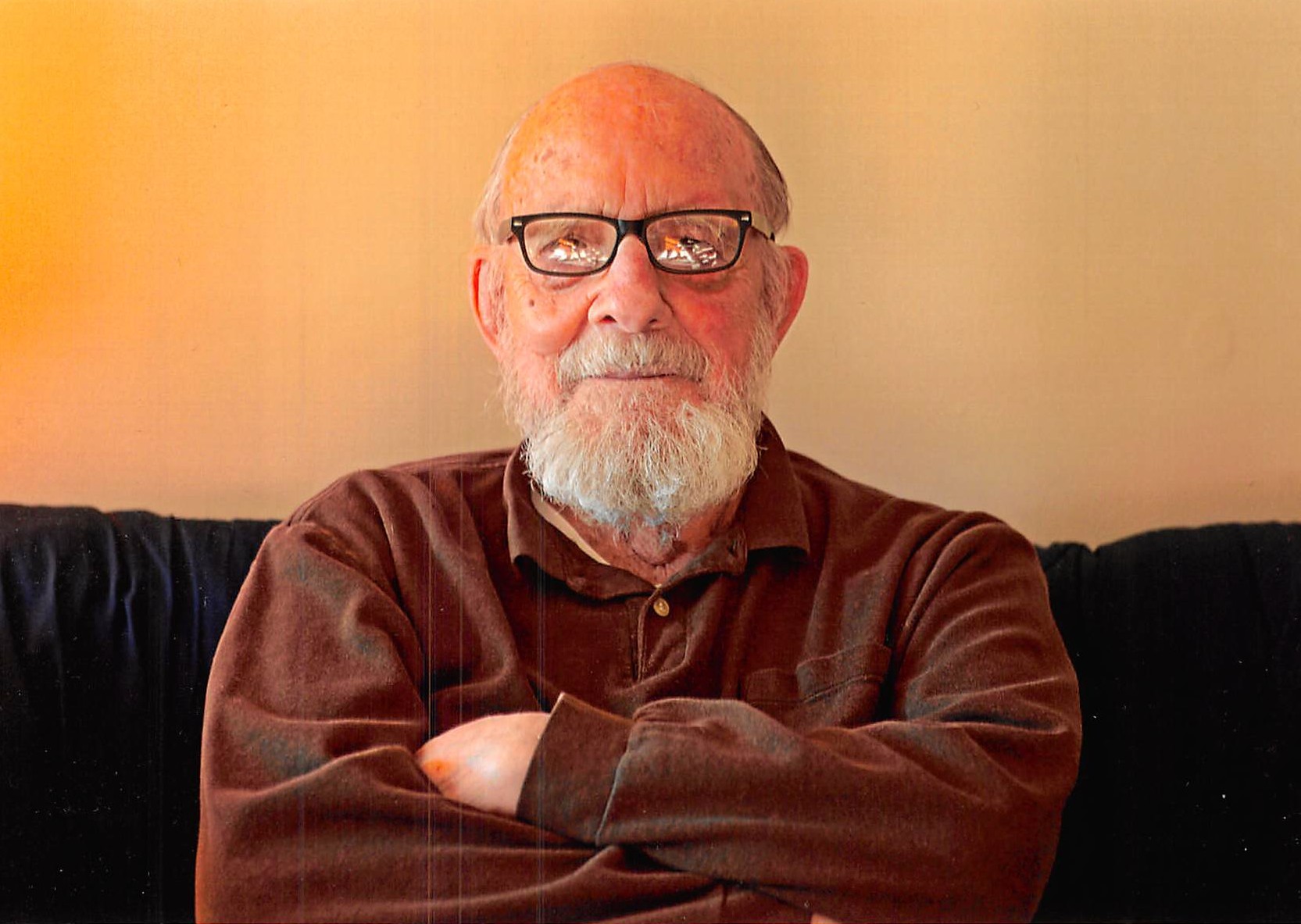
John Flynn. Ben Ruhe, winter 2015.
An avid traveler, Ben had traveled prior to his professional Smithsonian career. He discovered Australia, became enamored with boomerangs, and when he returned to D.C. suggested that perhaps a way to use the Mall would be to have a boomerang “Throw In.” The event mirrored a kite festival and was immediately successful. It quickly became a major competition dubbed “the Nationals,” and that took it out of the realm of what the Smithsonian did.
In 1981, Ben and Ali organized the Australian Boomerang Tour for three competitive matches and several demonstrations. The Americans won, probably through organization more than ability. Ben gathered an extensive collection of boomerangs and wrote extensively about the sport. Two years later, the Aussies came to the U.S. and won to save face. The sport took off right after this and Ben became “Guru Ben” in the Boomerang world.
Ben was familiar with kites through his friendship with Dr. Paul Garber, the leading kite expert at the National Air and Space Museum. But it was only after being introduced to the Drachen Foundation that Ben became truly interested in kites, and through Ali’s posting as director, he joined the staff as the chronicler of kite subjects.
With Ali Fujino, Ben wrote the first book of stunt kites, hysterically titled The Stunt Kite Book, even before his relationship with Drachen (he says quite seriously, “I had forgotten about that,”) and his growing interest in kites led to work with the Foundation. He authored and edited the Drachen newsletter, then moved to develop the tone and format for the Kite Journal.
On the articles he’s written for the Kite Journal and Discourse, he is most impressed with Jackie Matisse, “a splendid woman.” Also the kites of Curt Asker, especially his wonderful minimal sculptures that cast engaging shadows on background walls, and Istvan Bodoczky of Hungary as well, with his weird, asymmetric flying objects. The events of Betty Street and bill lockhart (the Junction Kite Retreats) were always interesting and inspiring as well as the wonderful people in Asia, where there is a higher reverence for kites.
“I’m not up on current developments,” says Ben.
Ben now resides in the serene coastal New England city of Gloucester, Massachusetts. In his late 80s, he is an avid reader and continues to edit Discourse for the Drachen Foundation. ◆
LINKS
Jackie Matisse Monnier www.drachen.org/bio/jackie-matisse-monnier
Curt Asker www.drachen.org/bio/curt-asker
Istvan Bodoczky www.drachen.org/bio/istvan-bodoczky
Betty Street www.drachen.org/bio/betty-street
bill lockhart www.drachen.org/bio/bill-lockhart