

 Share
Share Print
PrintEishin Iddittie
From Discourse 7
 Masaaki Modegi
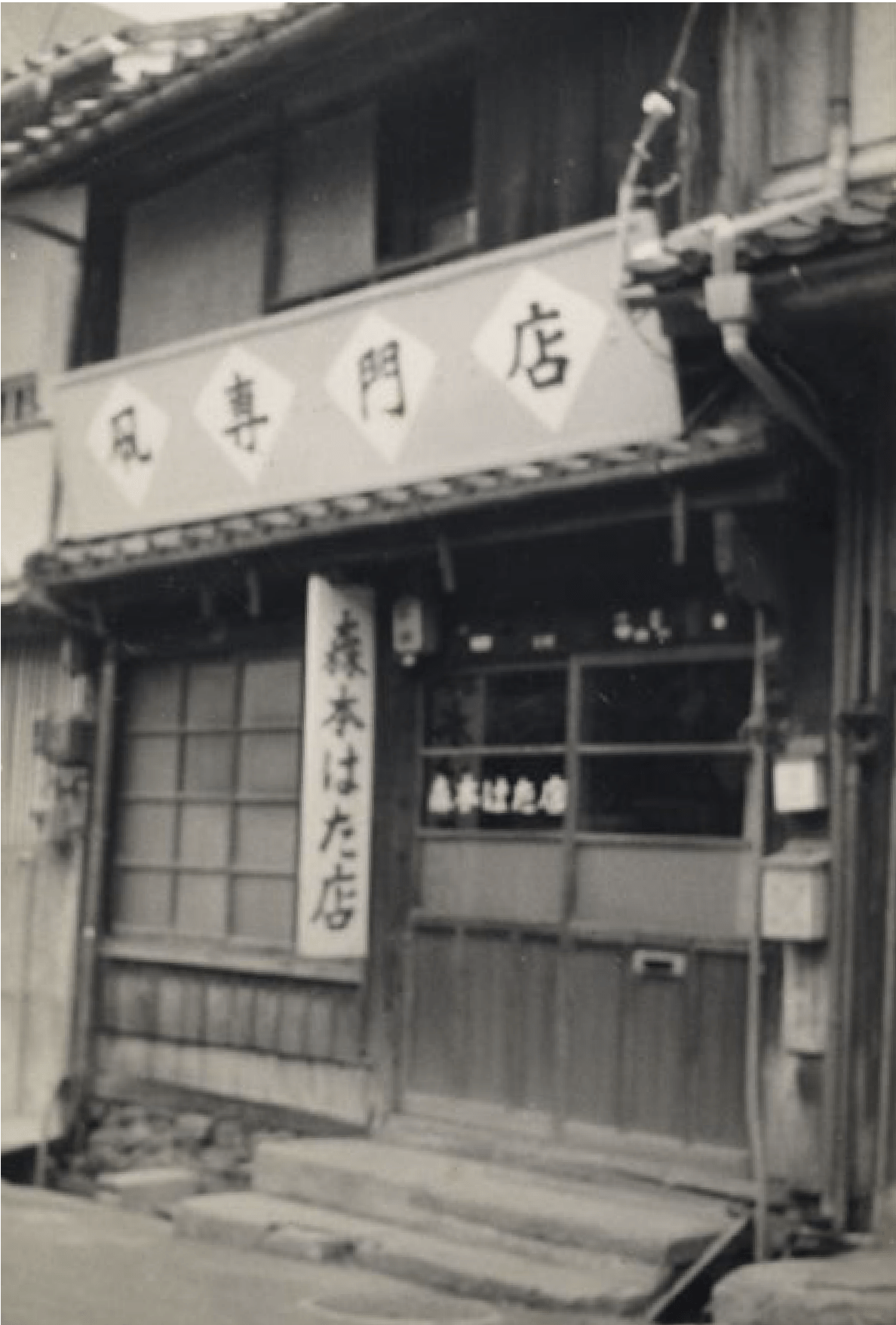
A kite store in Nagasaki, Japan opened after World War II.
ABOUT KIYO HASHIMOTO
The Japan Kite Association lost our oldest member during this New Year holiday season. It was Kiyo Hashimoto, the wife of Teizo Hashimoto, who was a worldly, well known Edo kite maker. Kiyo passed away on January 5th, 2009, right before her 106th birthday.
Kiyo helped Teizo on almost everything, except painting kites. She was in charge of nearly all his kite business deals, from buying materials to selling kites. Teizo and Kiyo had no children. When Kiyo married Teizo, his father was still healthy, and she took care of the two men. In Japanese culture, the oldest son lives with his parents, and the son’s wife takes care of the household chores.
When Teizo passed away in 1991, people thought it was the end of Edo kite culture. I think the death of Teizo’s wife Kiyo was the end of a great kite generation, but it doesn’t mean that Edo kite culture is gone.
During the Edo period, 300 to 400 years ago, Japanese kite culture started spreading into people’s lives. Over generations, kites slowly changed from an adult luxury to children’s toys. Popular kite painting subjects were kabuki heroes and characters. Japanese kite culture had its golden time from the Meiji Era (1868-1912) to World War II (1939).
Luckily, Teizo’s death didn’t lead Edo kite culture to extinction. Many times, a kite maker’s death leads to a kite culture’s death. Eighteen years after Teizo’s death, Japanese kite
tradition reached a critical phase. I would like to talk about that next.
ABOUT TEIZO HASHIMOTO
Teizo Hashimoto was born in Tokyo in 1904. Teizo’s father, Tomekichi Hashimoto, was a dealer in seasonal merchandise. He made kites, Koi nobori (Koi fish streamers), fans, lanterns with puns and paintings, and flags upon special request. Tomekichi worked at the Hasegawa Store, and his co- worker was a professional ukiyo-e master in the Utagawa style. Tomekichi learned ukiyo- e from his colleague.
When Teizo turned 13, he learned kite making from his father. Teizo became a kite maker when kites were most popular, and he died after kite culture was declining. He saw the whole kite culture from beginning to end.
After the war, Japanese kite culture fell for two reasons. First, Japan had rapid economic growth and many cities adopted modern societies. With so many new buildings, open spaces were filled quickly. Second, children were exposed to more options for play, and they lost interest in kites. With these changes, there was less demand for kite makers to produce kites.
Later, there was a craft revival movement. People tried to reconstruct traditional toys and provincial crafts. There were associations to research and collect them for archival purposes. Some stores started selling Japanese kites as traditional toys. Those kites were expensive collectors’ kites, and children couldn’t afford them. Sometimes the kites were just for decoration and didn’t even fly. People who bought these kites weren’t kite fliers. They were mostly kite collectors.
People wanted gorgeous kites rather than
simple kites. Kite makers had to adjust to the demand. Even retired kite makers started making kites upon special request. Under the new kite movement, Teizo kept making flyable kites, except for the miniature Suga- dako.
THE BEGINNING OF JKA
The Japan Kite Association (JKA) started as a beautiful coincidence. The father of current JKA president Masaaki Modegi, Shingo Modegi, started a western-influenced restaurant in Japan called Taimeiken. There is now a JKA office at the top floor of the Taimeiken building.
Shingo always had great ideas for his business. He started a tradition of making restaurant napkins, coasters, and wood block print calendars from washi paper to give away to his customers. Unfortunately, Taimeiken stopped making calendars, but they still use washi napkins and coasters.
The person who designed the calendars was Shingo’s friend, Keiichi Torii. One day, Keiichi was walking down a street in Tokyo. He saw a person with a yakko kite on his hand. Keiichi asked the person about the yakko kite and found that it was made by Teizo Hashimoto. Keiichi went to see Teizo immediately, and he called Shingo from Teizo’s house because he knew Shingo loved kites.
ABOUT SHINGO MODEGI
Kiyo repeatedly said, “Shingo rushed into our house in a chef’s uniform. And Shingo and Teizo talked about kites all night long.”
A kite lover, Shingo was always worried about the decline of Japanese kite culture, including the decreasing demand for kite makers. Both Teizo and Shingo were from Edo (old Tokyo). After they met through
Masaaki Modegi
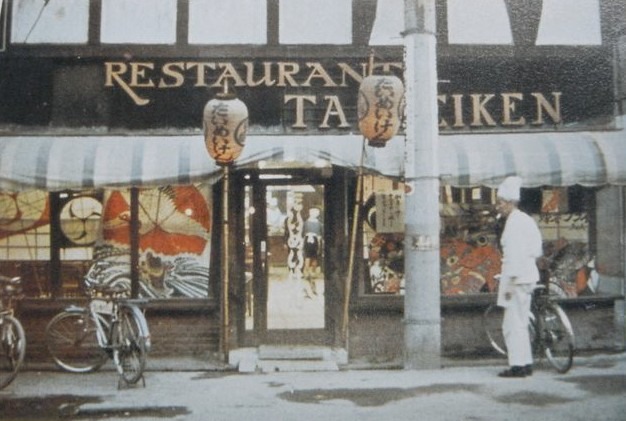
Shingo Modegi standing in front of his restaurant, Taimeiken, with kites displayed in the windows.
Keiichi, Shingo and Teizo were strongly connected for all their lives.
Soon after, Shingo established the Japan Kite Association with 10 founders in November 1969. In the beginning, there were about 100 members. There were no membership fees, no rules, and no president. Shingo devoted his personal time and money to running the JKA. Shingo’s motto was, “Everybody can be a member of the JKA, from kids to presidents to university professors.” All members thought Shingo was the president, but he supported the JKA from backstage.
Shingo’s personality was a typical Edo one. He had a great spirit. Everybody was fond of him. Shingo loved flying kites rather than making them. When people asked him about this, he always answered, “Home run king Babe Ruth didn’t make his own bats, did he?” Those were words from a kite flier in New York. Shingo loved that expression and adopted it as his own.
Shingo focused on preserving traditional Japanese kite culture, and he bought kites made by professional kite makers from all over the country at a higher that normal price. He was helping kite makers’ lives. Shingo also sold Teizo’s kites at the Taimeiken restaurant. He sold them for less than he bought them to help Tezio.
Taimeiken was decorated inside with lots of kites. Shingo wanted the customers to feel special and enjoy a gorgeous atmosphere with their meals. His efforts gradually led him to open a kite museum. Shingo passed away half a year after he opened the museum.
JAPANESE KITES BACK THEN
The Japan Kite Association had regular kite flying days on January 3rd for the New Year,
May 5th for Children’s Day, October 10th at Nikotama River, and they had annual meetings in April and November. Two-thirds of the members were avid kite makers, and the rest were kite collectors. Some members were fond of both making and collecting kites.
Other than kites, there were provincial craft lovers’ groups for crafts such as kokeshi dolls or mud dolls. Compared to doll clubs, collecting kites was less popular because kites were expensive, and it is difficult to preserve paper kites.
During that time, Shingo’s son, Masaaki, had graduated from university and was his apprentice. Masaaki worked at Taimeiken, wearing black suits on his thin body. He traveled everywhere with Shingo for kite festivals, but Masaaki rested and waited for his father in the car. Now JKA president himself, some members who knew Masaaki from the past were surprised and happy to see him working so hard for the JKA.
CRAFT SHOPS IN TOKYO
As I mentioned before, the JKA was established during the time traditional Japanese kite culture started to die. If you wanted to purchase a kite at that time, you had to order it directly from a kite maker and wait a few months before it was done – or buy a kite at a craft shop. But there were only a few craft shops in bigger cities.
You could find the following kites at a small craft shop in Tokyo during the 1970s:
- Tsugaru Dako made by Keizo Nakano
- Rokkaku made by Torasuke Wada
- Edo Dako made by Teizo Hashimoto through Hayashi store
- Tsugaru Dako made by Tatsusaburo Kato
- Sagara Dako made by Motoyoshi Matsushita
Masaaki Modegi
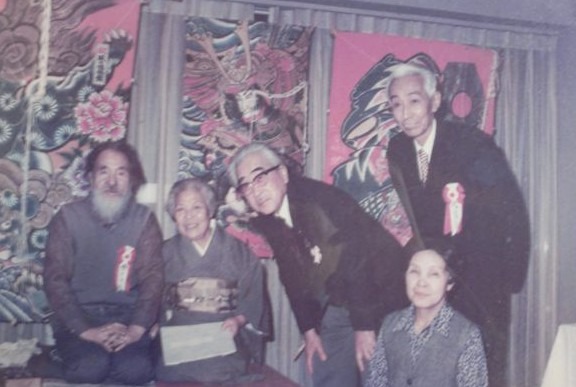
The kite museum established by Shingo Modegi. From left to right, Teizo Hashimoto and his wife, the painter Jyunkichi Mukai, and Mr. and Mrs. Shingo Modegi.
-
- Fukusuke/Sake kite made by Takosen
- Itsuwa Dako/Butterfly kite made by Takao Inoue
- Cicada Kite/Sumo kite made by Natsue Isozaki
- Tosa kite made by Hanzo Yoshikawa
- Magoji kite made by Magoji Takeuchi
- Yokanbei kite made by Saburo Fujiwara
- Hata by Daiki Morimoto and Keitaro Ogawa
- Baramon Dako made by Yoshiharu Sakai and Gontaro Nohara
- Onidako Ondako made by Hiroji Doi
The first professional Japanese kite book, Japanese Kite, was written by Yusaku Tawara. He owned two big craft stores, Echigoya and Sen, which no longer exist. These stores carried double or triple the varieties of kites than a small craft store.
DISAPPEARING KITE SCENE
The majority of Japanese kites were made by professional kite makers, but not all kites were made by professionals. Farmers used to make kites during the slack season on the farm, and grandparents made kites to celebrate a new born in the family. Kites made by regular people were not sold in a market. Kite collectors had to order directly from them.
The Kazusa Toji Dako is known as a special seasonal kite that is traditionally made by a family and not by a professional kite maker. One of the successful amateur makers of this kite was Umekichi, who had his own business as a farmer and fisherman. Another successful amateur kite maker was Gensui Tada from Yamaguchi prefecture, who made the Oniyozu Dako. Gensui started selling kites he made at home in his spare time, and he successfully opened up a market to sell them.
There are some intricate traditional kites
that even professional kite makers don’t want to make, unless someone places a special order. One of Teizo’s famous kites was the Mushae with Hasso Tobi (jumping over boat to boat) or Kamo Goe (fight at Ichino Tani cave) paintings. Both are lavish and intricate. Teizo sold quite a lot of these kites at the end of his kite life. Personally, Teizo was fond of simple kite styles such as the Nakabari, a small and stylish Kaku-dako style, or the Dai nimai, similar to the Nakabari but slightly bigger.
Teizo made 10,000 kites yearly and sold them to wholesalers until 1973. They were all great simple designs such as the Yuki Usagi (snow rabbit) or Yuki Daruma (snowman). Both were popular paintings. On the Yuki Usagi, Teizo made the snow rabbit’s ears look like the leaves of a daphniphyllum (flowering plants native to Asia).
Generally speaking, Japanese kites are flexible. They can be great decorations as well as being flown up in the air. Unfortunately, the Japanese kite tradition is dying, and only outstanding and gorgeous kites are surviving. The reality is that simple kites are disappearing, although they are very precious and important to the Japanese kite tradition and history.
Less people fly kites, and more people look for kites as decoration. The current kite culture is changing. It’s part of a natural generational trend. Teizo and all of his kite maker friends went through the same situation.
JAPANESE KITES FROM NOW ON
Of course, we still have professional kite makers who make a living on kites in Japan. But I think it’s only a matter of time. The profession will disappear someday. Does that mean Japanese kites will be gone?
Eishin Iddittie
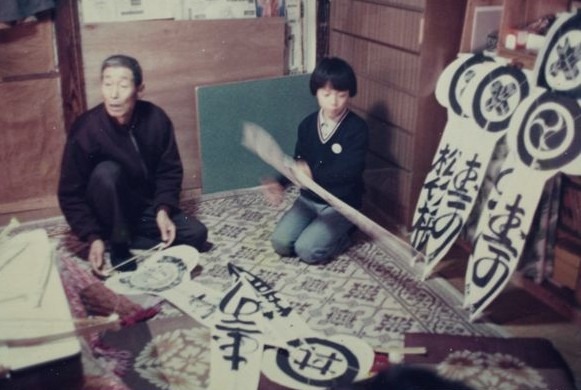
A Japanese craftsman who makes a local kite called the Kisarazu Toujin.
No, it won’t happen. Never. When we look back at the last 100 years of kite history in Japan, semi-professional or amateur kite makers have always been there. That is what will happen in the future. Semi-professional and amateur kite makers will keep Japanese kite traditions for the next generations. Some younger people and tako hachi (a nickname for kite makers) are even devoting themselves to making kites part-time.
Japan is still a country where many people live to an advanced age. After people retire, they have plenty of time. Some people devote their time to Japanese traditions, like regional festivals or regional cultural activities. A good example is Kazuo Tamura, who is a master of the big kite from Shirone.
Even the younger kite members of Yokaichi City – which is well known for big kites – keep and practice their tradition. They also have the technical skills to fly their big kites all over the world.
Many JKA members keep and practice their regional kite traditions and convey them to the next generation. Teaching old traditions to a new generation is not easy. You need to put in effort, and it takes time. Fortunately, kites are fun on both the teaching and learning sides.
As JKA members, our mission is to grow professional kite makers and support them, and to pass kite making on to the next generation with a new style. To do so, archival investigation, restoration/ reconstruction, and accurate historical descriptions are very important.
Successfully passing Japanese kite traditions with a new style on to the next generation is a true wadako (Japanese kites) revival.
Translation by Kiyomi Okawa