

 Share
Share Print
PrintFrits Sauvé
From Discourse 9
EDITOR’S NOTE: Historical kite enthusiast Frits Sauvé has done extensive research on L’Aigle Dragon kites. In March 2007, he published a report on his study of two L’Aigle Dragons, referred to here as kites number 1 and 2. This article is an update to Sauvé’s 2007 report. It documents his work on two additional L’Aigle Dragons, referred to here as numbers 3 and 4. Read the full report on all four kites on the Drachen Foundation website:
http://www.drachen.org/kite-french-bird.html
Frits Sauvé
L’AIGLE DRAGON KITE NOTES
Kite number 1 is owned by Drachen Foundation from Seattle, USA.
Kite number 2 is owned by Heinz Pieper from Bückeburg, Germany.
Kite number 3 is owned by Bernhard Dingwerths from Kassel, Germany.
Kite number 4 is owned by Frits Sauvé from Diemen, The Netherlands.
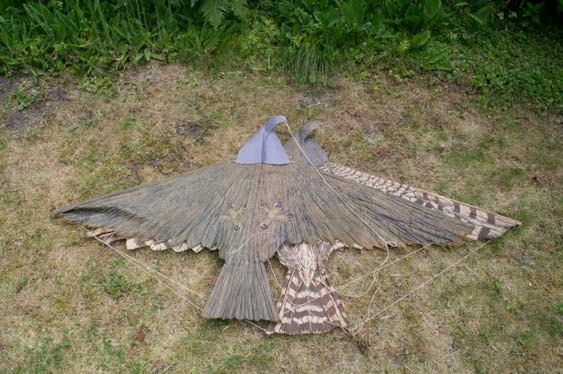
In November 2009, I was included in an email that reported the discovery of a kite that was shaped like a bird. It was Mr. Bernhard Dingwerths from Kassel, Germany who sent out this email.
He asked the receivers of this email: ”What should I do with it?” Bernard was directly aware of the fact that he found a unique kite, of which only a few are preserved.
The question he raised has been raised and will be raised many times by most of the (serious) kite collectors. What happens with my stuff when I am no longer here? We have not found a satisfying answer to this, and we continue speaking about it and searching for a solution to preserve kite collections in a professional way. Not only for the collectors of tomorrow but also for many years from now.
I was chosen to receive the kite for further investigation. Thank you, Bernhard. At the same time I was asked to find out if it was wise and possible to repair the kite and bring it back to its original construction. Although I dislike the idea of repairing kites and prefer to keep them as they are found, in this case an exception on my principle was made. Because it was the owner who asked me to do some basic repairs and make it possible to have the kite displayed.
I received the kite in December 2009. It is always a pleasant moment to receive a box in the mail, knowing a kite is in it. After opening the box, I am very careful and enjoy looking, smelling, and touching the material.
The general condition was:
- Cloth: Looked good – no stains – some small holes at edges – worn out at the bottom of the wings where the kite shows it has been flown for many hours.
- Frame: Still original – one broken wing stick.
- Head: Missing.
- Tension Lines: Replaced and incorrectly mounted.
- Bridle: Missing.
- Packing: The kite came with an old green tube – not the original that came with the kite – in fact, the kite was not sold in a tube but in either a kite bag or a cardboard box. The green tube was for papers, not for kites.
I contacted Bernhard and we agreed upon repairs that would allow the kite to be able to be on display again.
REPAIRING
As in kite number 1 and kite number 2, the wing spars in kite number 3 are glued into the upper edge of both left and right wing. The right wing was broken, the remainder still in place. The break has also damaged the cloth and made a small opening in the front.
Since the glue was completely dried out, it took a careful job to open the glued tunnel and make the fracture of the right wing spar visible. With a surgical knife and patience, I managed to open the cloth over a distance of 10 centimeters without damaging or tearing the cloth. The broken spot was actually a good fracture: not many loose splinters and the remaining parts fit well together. I decided not to replace the stick, but repair it by means of a splint. The splint was made of very thin wood. I made two suitable pieces to be glued on both ends of the fracture. No extra bindings to re-enforce as it was not supposed to fly again.
After that, the repair was still thin enough to fold the cloth back over the stick again and fix it with special glue for textiles. The result even pleases me. If one does not know, it is hardly visible (see page 20, top left).
I still had on loan kite number 1, the Drachen Foundation kite. This is the only kite that still had its original head. With that as an example, I was able to make a new head. I decided to make three heads – one for kite number 3, the one we are working on right now; one for kite number 4, the Dutch version; and one for kite number 2.
For that, I made a digital file of the feather pattern of the cloth on the head. This pattern was then printed on a piece of cloth. The printed cloth was then glued on a piece of ecru, somewhat thicker quality cotton, including a piece of twill edge banding. This twill edge banding is needed to slide the head over the vertical middle frame piece. All this together is the best way to recreate the original head (see page 20, top right).
Digitizing and printing a cloth pattern is impossible without having differences in the original color and the final result. The colors always fade away somewhat. In this project, I find that acceptable, since we do not want to give future watchers the impression that the head is original. It was added later on and should look like it was added later on.
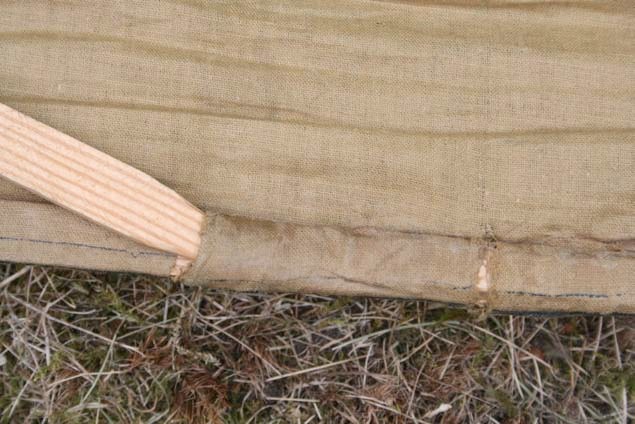
Frits Sauvé. Images of kite 3. You can see the damage in the cloth caused by the broken stick – the repair itself is hardly visible.
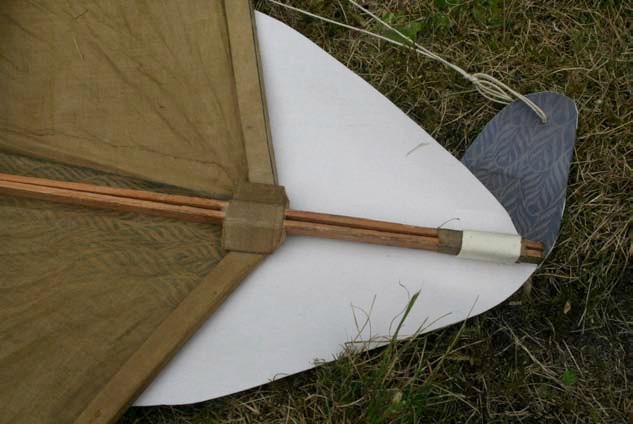
Frits Sauvé. Images of kite 3. The new head seen from the back side – the white cloth is ecru cotton.
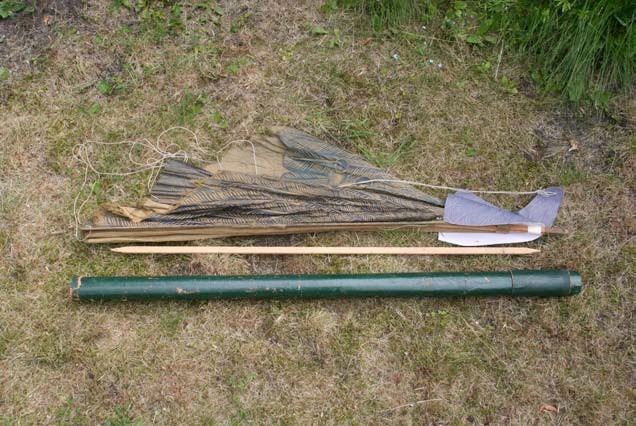
Frits Sauvé. Images of kite 3. Kite with green tube – the kite does not fit in after the repairs.
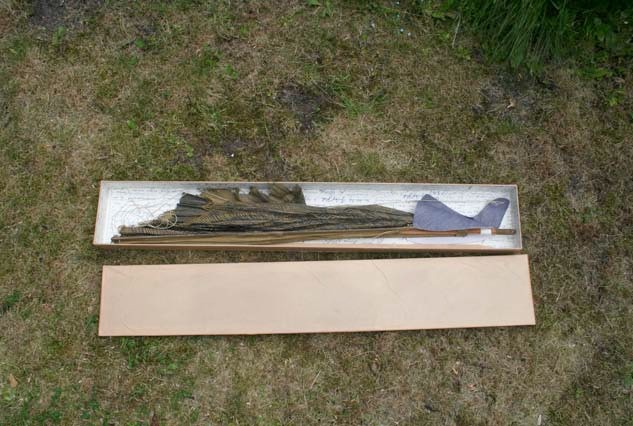
Frits Sauvé. Images of kite 3. Kite in the new cardboard box – fits perfectly and looks good.
In kites number 1, 2, and 4, the right and left upper wing spar have extra holes to fix the head with brass split pins. This kite has no such holes. I kept wondering why not. I did not dare to drill extra holes in it. I decided to fix both lower corners of the header with a piece of hemp line to both middle tension lines.
The next step was looking into the tension lines and bridle lines. I used a 1910 advertisement for the L’Aigle Dragon and kite number 1 as reference points. I am also familiar with this type of kites, which are well described in detail in older kite books and magazines.
For this kind of repair, I use old hemp line. In my collection I have old kite line winders that have good quality hemp of different thickness. The 1 millimeter looked suitable. I removed all tension lines and replaced them with the old hemp. I also put them in the right place. Now when the kite is stretched, the tension lines shape and support the kite in the right way.
The new head made it impossible to put the kite back in the green tube again without the risk of damaging it. It was very common in those days to sell a kite in a suitable bag or a cardboard box if the kite was exported. I have kites in my collection still in the original box.
I asked a box maker – my wife Inge also makes boxes – to make a box that would be strong enough and big enough to store the kite in a proper way. The box shouldn’t look too new and modern.
The box was made with a lid, and finished on the outside with old-fashioned packing paper and on the inside with a special grey/ white paper also used for book repairs. According my standards, the results are very good and this box completes the repairs (see page 20, bottom left and right).
The kite has exactly the same dimensions as on the enclosed drawing. No need to make a new drawing. I just added one detail, the cross section of frame and spreader.
The frame is original and is smaller and thinner than kite number 1. The dimensions of all fixed sticks are 12 millimeters wide and 3 millimeters thick. The spreader that can be taken out for transport and storage is 13 millimeters wide and 4 millimeters thick.
All wood looks like pine. KITE NUMBER 4
More than 5 years ago, I was walking through one of the eldest parts of Amsterdam when I noticed a shop window showing old toys. I rang the bell and shared my curiosity with the house owner. The house used to be an old toy shop, bought by the present owner, who used it as his house to live in. He kept the shop window in its original design, giving the house a nice look from the street side.
The house owner also mentioned what he found when he was cleaning the house: a kite. The owner did not want to sell it. It was supposed to be in his shop window one day. He asked an extremely high price for it. I was permitted to take pictures of it, nothing more at that time. I told him I would come back from time to time and ask him again if the kite would be for sale.
A couple of years later, I met the same man at a book market. He told me he still owned the kite and that he now focused on selling second hand books only. The kite never made it to the shop window. He did remember me well and offered me the kite for sale. For a very reasonable price this time. I told him it was too cheap, but he found the price okay to him.
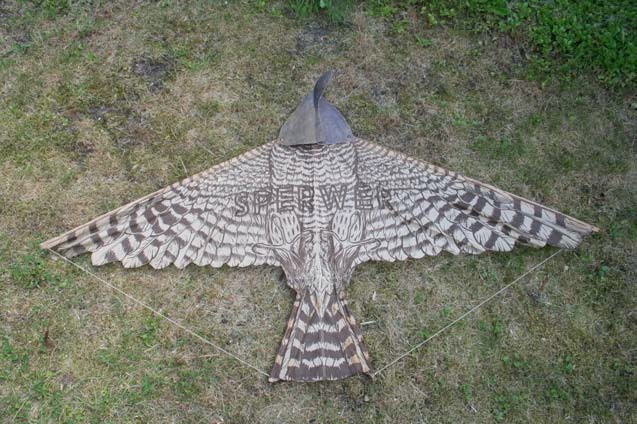
Frits Sauvé. Images of kite 4. Front side overview – head is new.
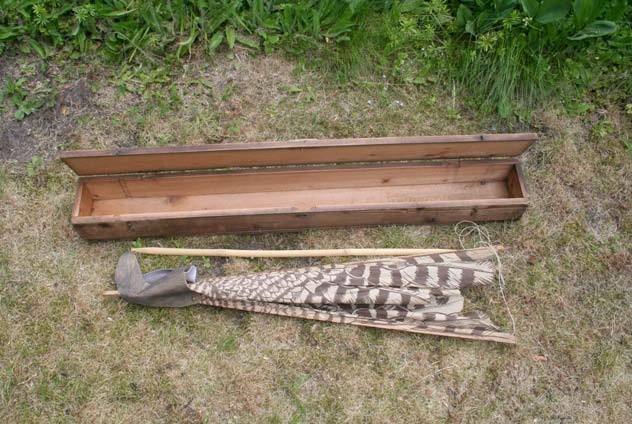
Frits Sauvé. Images of kite 4. Old wooden box and repaired kite with new head and spreader.
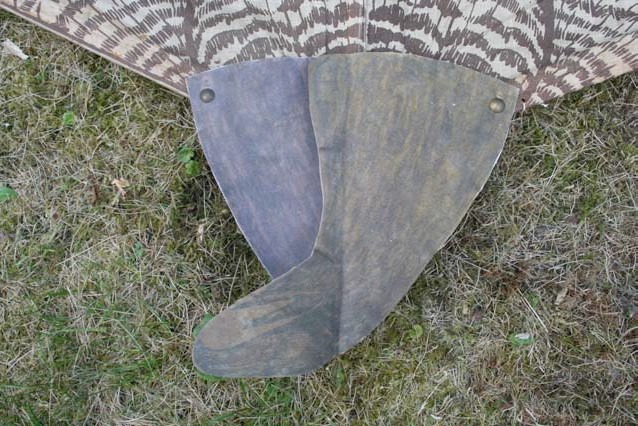
Frits Sauvé. Images of kite 4. Front view of the head attached with twill tape and brass split pins.
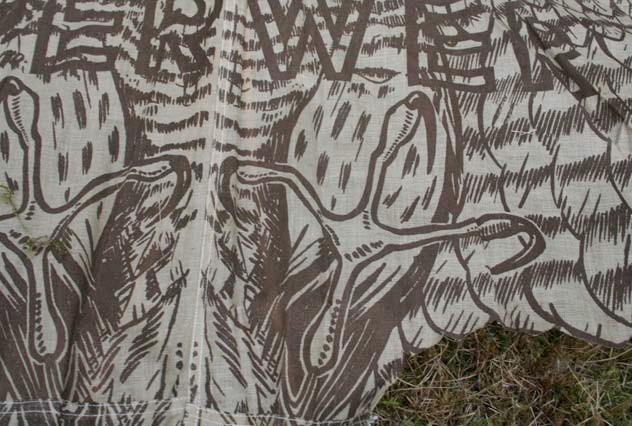
Frits Sauvé. Images of kite 4. Detail of right and left claw print.
That is how I came to posses the Dutch version of L’Aigle Dragon. This kite has exactly the same size, shape, construction, and frame dimensions. The only difference is the cloth and the printing pattern.
The cloth is much stiffer, compared with the three other kites. The printing is much lighter, and on the front side the word SPERWER is printed. SPERWER is the dutch name for a bird of prey called sparrow- hawk.
The kite came with an old wooden box with a metal grip and closing hooks. Not its original transport case, but very good to store the old kite. Dark and dry storage (see page 22, top right).
The kite itself had no head and, like in kite number 3, the tension lines were incorrectly fixed or missing. The spreader was also missing. The fixation of the head was still there, two brass split pins – one in each of the wing spars.
I made the same head as I made for kite number 3 and was able to fix it like the original head was once fixed, making use of the two split pins that I could open, remove, and put back again without breaking (see page 22, bottom left). Old metal usually breaks when it is bent – lucky me, I guess!
I also used the same 1 millimeter hemp line as I used for kite number 3, to bring the tension lines to their original position. For this kite, I decided not to add the bridle lines.
I cut out a new spreader, made out of bamboo, to be able to put the kite on display.
Since the kite is exactly the same, apart from the cloth and the printing on it, I assume it was made in The Netherlands with the L’Aigle Dragon as reference point. Or made by the same French company for the Dutch market. It can be roughly dated between 1913 and 1930. The printing cannot be done by an amateur kiter; a kite producing company must have been the manufacturer. Which one is for now a question mark.
CONCLUSIONS
A report is never complete, even after it is finished. More investigation and new discoveries will add information to what has been described here.
The reader is free to correct the contents and send me additional information on the subject described.
Frits Sauvé: sauve.lief@chello.nl