

 Share
Share Print
PrintScott Skinner
From Discourse 9
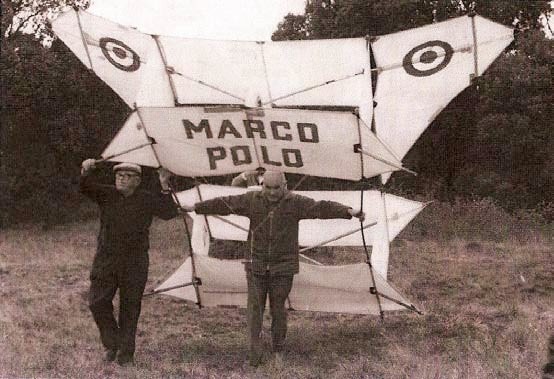
Courtesy Thierry Nénot. Images of Robert Devautour and his kite plans, featured in the exhibition’s catalogue.
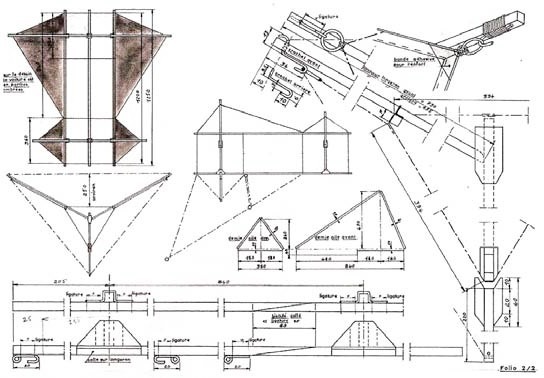
Courtesy Thierry Nénot. Images of Robert Devautour and his kite plans, featured in the exhibition’s catalogue.
View the full Devautour exhibition catalogue online (in French): http://www.drachen.org/pdf/DevautourCatalogue.pdf
View the catalogue’s English translation: http://www.drachen.org/pdf/DevautourCatalogueTranslation.pdf
With a festival that has run for over thirty years, one that emphasizes the worldwide cultural importance of kites, it is appropriate that Dieppe, France is front-and-center as a kite festival that must be seen. But this year, at Dieppe, a more powerful legacy of kites was found six blocks from the flying site. It was the wonderful collection of Robert Devautour kites in an exhibition organized by Thierry Nénot. Here were two generations of Dieppe kite builders, fliers, and researchers, bound to each other and to the rich history of French kite making.
Robert Devautour (1921-2001) came to kites in a vacuum, it seems. In this remote town, much of his work was done before any serious correspondence or contact with other French kite makers. He was secure in trusting his childhood kite memories and in using his construction skills to make new, original kites using contemporary materials of the day (wood, plastic, double-sided tape, polyester string). With a lifetime devoted to flying objects, notably model airplanes, he began a systematic exploration of kites. He numbered his kites consecutively as he built them, so it is easy to follow his progress from simple to more complex forms. As he discovered new forms, he made variations that were, in fact, “new” kites: winged box kites, swept-wing boxes, deltas, and birds.
Devautour’s construction techniques can be overlooked because of materials that we might now call “primitive.” But a close examination reveals brilliant uses of the materials and an economy of usage that is second-to-none.
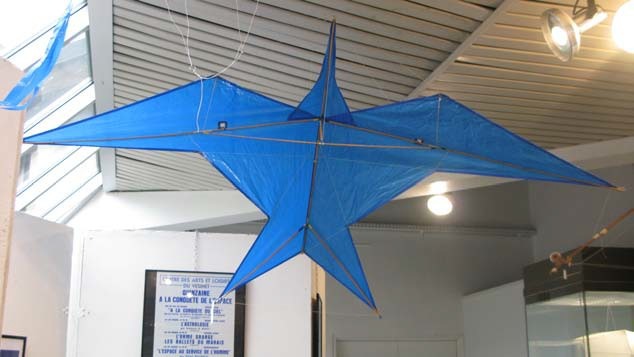
Ali Fujino. A collection of Robert Devautour kites organized by Thierry Nénot. Thierry spent hours restoring kites that had become damaged in storage or were victims of neglect.
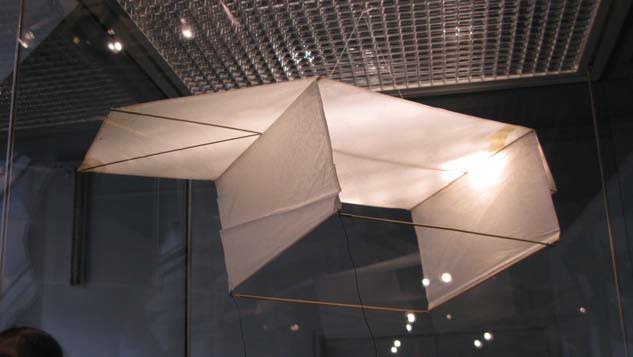
Ali Fujino. A collection of Robert Devautour kites organized by Thierry Nénot. Thierry spent hours restoring kites that had become damaged in storage or were victims of neglect.
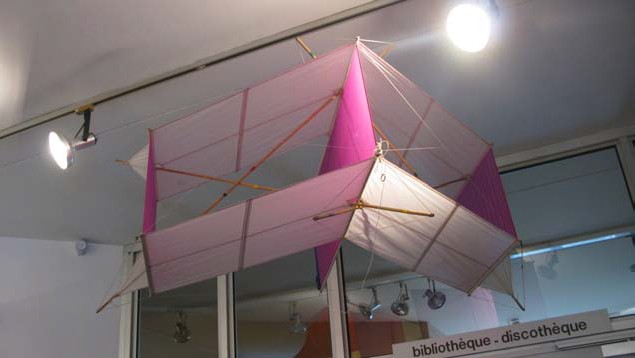
Ali Fujino. A collection of Robert Devautour kites organized by Thierry Nénot. Thierry spent hours restoring kites that had become damaged in storage or were victims of neglect.
Sticks are light, but are trussed with line for strength. Line is used to limit and control stretch of the plastic sails – as well as to change and control the lifting surfaces of wings. In one of his early ferries, he used cardboard, plastic, tin, and, it seems, every other material he had on hand to fabricate the climber. In a later aerial camera mount, we find a sophisticated leveling mechanism (two handmade pistons) and an aluminum frame. As he became more interested in kites, he studied kites of the early 20th century and made wonderful reproductions of Cody and Saconney kites. As modern kite flying and kite fliers gained momentum in France, Devautour was noticed and embraced by the community, and his detailed plan-work for a number of kites was published in French kite journals.
But this exhibition could only have taken place because of Thierry Nénot and the new generation of Dieppe kite enthusiasts. Thierry’s background makes him an ideal member of the European historical kite flying community. He was instrumental in building the Musee de l’Aire’s Clement Ader “Avion” airship. His knowledge of turn-of- the-century building techniques, materials, and literature make him one of a handful of experts in the field. Thierry saved the collection and has spent hours restoring kites that had become damaged in storage or were victims of neglect. In restoring the collection in the exhibition, he went so far as to fly and photograph every kite, producing a new archive of Devautour’s work.
We were on the Dieppe Festival kite field when Thierry did the unimaginable – he broke a spar in one of the kites! Fear not, having restored the entire collection to flying condition, this broken spar will be easily, and accurately, replaced by Thierry.
There is little doubt that many of the kite fliers who were invited guests of the Dieppe Festival spent many hours preparing kites for flight and display. But think of the time spent by Thierry: researching Devautour’s life, repairing neglected kites, flying and photographing, preparing illustrative panels for the exhibition, and, finally, actually mounting the entire exhibition (two full rooms) for the pleasure of Dieppe’s kite- fanatic attendees. This was a monumental effort that makes a significant contribution toward the understanding of French kite making in the mid-20th century. Like American “old timers” Stormy Weathers, Harold Writer, and Neil Thornburn, Robert Devautour was a serious student of kites in the 1950s and 60s, when most other “adults” had better things to do. He was a bridge to the past, brought lovingly to the present by a new generation of enthusiasts. The Drachen Foundation applauds the efforts of Theirry Nénot, pictured below, a true caretaker of Dieppe’s legacy of kites.
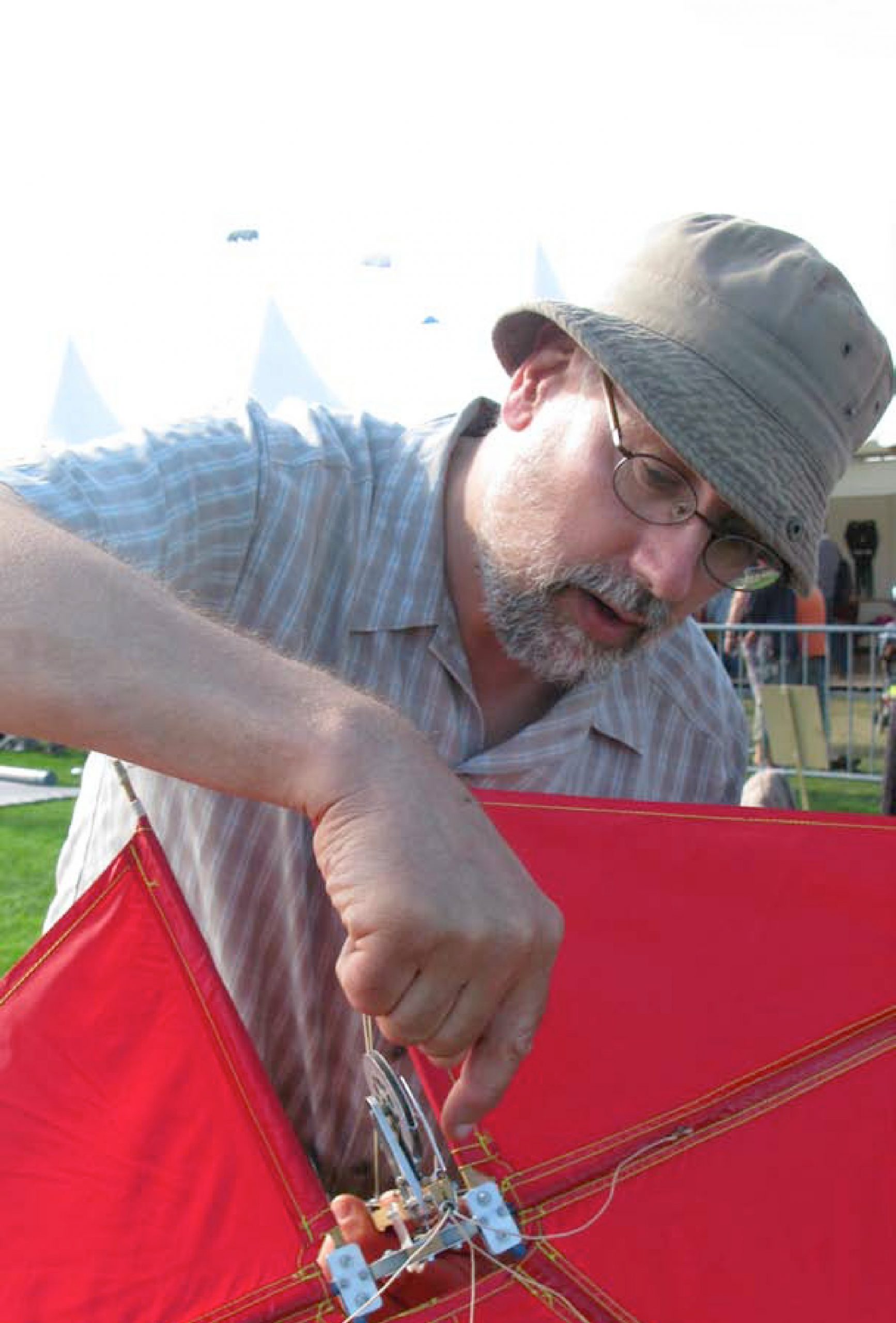
Ali Fujino. Historical kite enthusiast Thierry Nénot at work.