

 Share
Share Print
PrintJoe Hadzicki
From Discourse 17
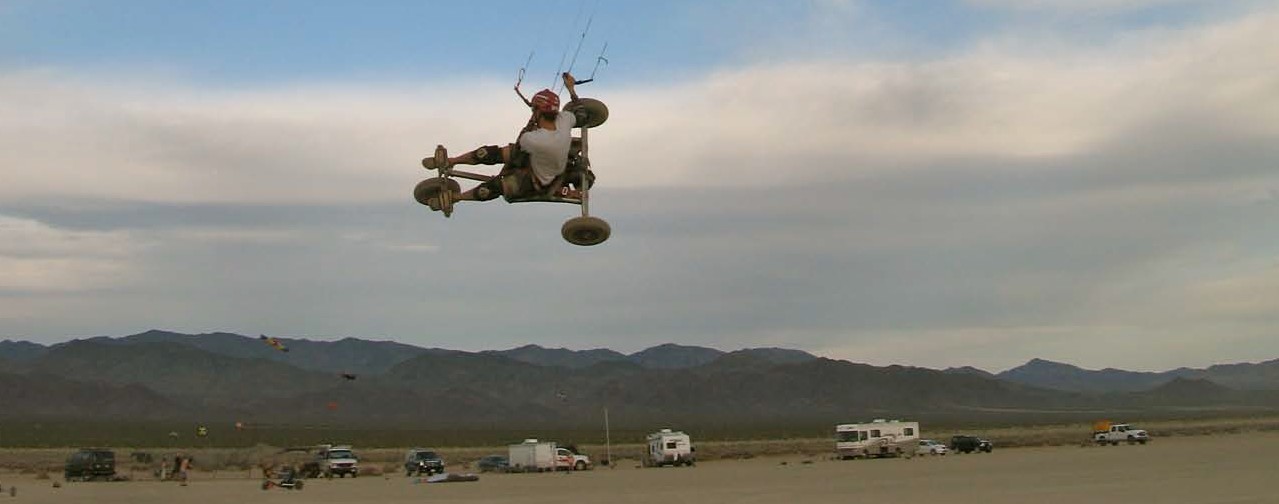
Jose Sainz. Just one form of power kiting, a kite buggier flies above the desert, attached to a kite that pulls him into the air.
As we look at all the facets of kiting from single line to four line, from flying with your grandkids on the beach to 800-man mega team flying, from fighter kites with glass- studded string to the art of aerial photography, nothing brings more excitement and adventure than power kiting.
In over 20 years of kiting, I have tried out virtually all forms of power kiting, including kite flying from the back of a paraglider.
Most people enter the sport of power kiting with either kiting experience or some kind of board experience, for example snowboarding, wake boarding, or mountain boarding. My strengths lie on the kite control side of the sport, which you will see influenced my approach to power kiting.
In the next few paragraphs I’d like to share a couple of my personal experiences in power kiting, along with the path that I took when I got started.
Power kiting is extreme fun, but as with anything that includes nature and its awesome power, there is an element of risk and danger. My advice is to spend an afternoon taking a lesson f rom a professional to see if it’s right for you.
It’s easier to talk about the details of power kiting with specific examples. So let’s take a closer look at kiteboarding and, in particular, kite surfing.
I use kiteboarding and kite surfing interchangeably in this article, although kiteboarding is a much more inclusive term. Kite surfing has a lot in common with all the different board sports. In other words, if you have personal experience with skateboarding, snowboarding, wind surfing, wakeboarding, etc., you have the basic board skills necessary to kiteboard. But board skills aren’t the only skill set you need. Equally important are the kite skills. Unlike wake boarding and water skiing, where the boat and driver are in charge of power, direction, and speed, kite surfing requires you to do it all. Wind surfing is probably the best all-around comparison to kiteboarding since you are controlling the power of the wind with your sail while riding a board. Sailing or wind surfing experience can be a great help in understanding the basic principles of kiteboarding, but in some ways it can hinder. What I’ve noticed is a tendency for people to focus on what they know. So if you know wind surfing or wake boarding, you tend to focus on the board. With kiteboarding, controlling the kite is as important as controlling the board.
One of the main differences between wind surfing and kite surfing is when you fall while wind surfing, the sail falls with you, thus shutting down the power. With kite surfing, and power kiting in general, the normal condition is that the kite continues to fly and generate power even though you are no longer on the board. In many cases, especially when first learning, you could end up face first under water while the kite powers up and drags you through the water like a submarine.
My first experience with power kiting began with a trip out to the El Mirage dry lakebed in Nevada with my old friend Corey Jensen.
He set me up with a two-line foil, about one square meter in size, and a three wheeled “kite buggy” that you steer with your feet. Then he said something along the lines of, “Go for it.”
After 20 minutes of flying around in very light winds with no chance of being pulled anywhere, I told Corey I needed a bigger kite. He gave me a funny look and thought about it for a minute and then handed me a four-meter foil. I was thinking to myself, “This probably isn’t big enough either,” and right then a gust of wind kicked up a little sand just past the sagebrush, and I thought to myself, “This kite is probably too big…”
Within moments, I was racing down the lakebed at 30 MPH with no idea what to do. I knew if I kept running downwind, I would overrun the kite and get the wheels all tangled in the lines, but every time I started to turn upwind, the kite became more powerful and accelerated me faster and faster. This is one of the basic laws of sailing. It’s called apparent wind. As you begin to turn upwind, your speed is added to the wind speed. This “apparent wind” that the kite experiences increases the power significantly.
It was starting to get a little scary with no obvious solution. Running out of options, I figured I’d take a page from Fred Flintstone. I yanked my boots off the foot pegs and slammed them on the lakebed hoping to drag myself to a stop, but before my boots could have any effect, the front wheel snapped left and then right, flipping the buggy over. Before I even realized what was going on, I was rocketing down the lakebed on my back with the buggy riding on top of me! This takes us back to one of the key problems of power kiting: after you’ve been thrown off your mode of transportation, the kite is often still powered up and raring to go!
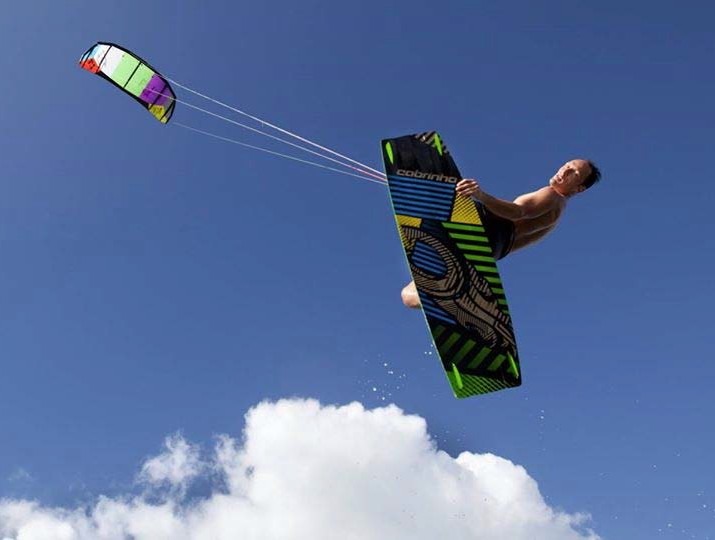
Dmitry Kraskovsky.If you would like to take the next step in power kiting, the safest, most convenient way is through kite surfing. Kite surfing is mainstream enough that there are many locations that offer lessons for beginners as well as experienced kite boarders.
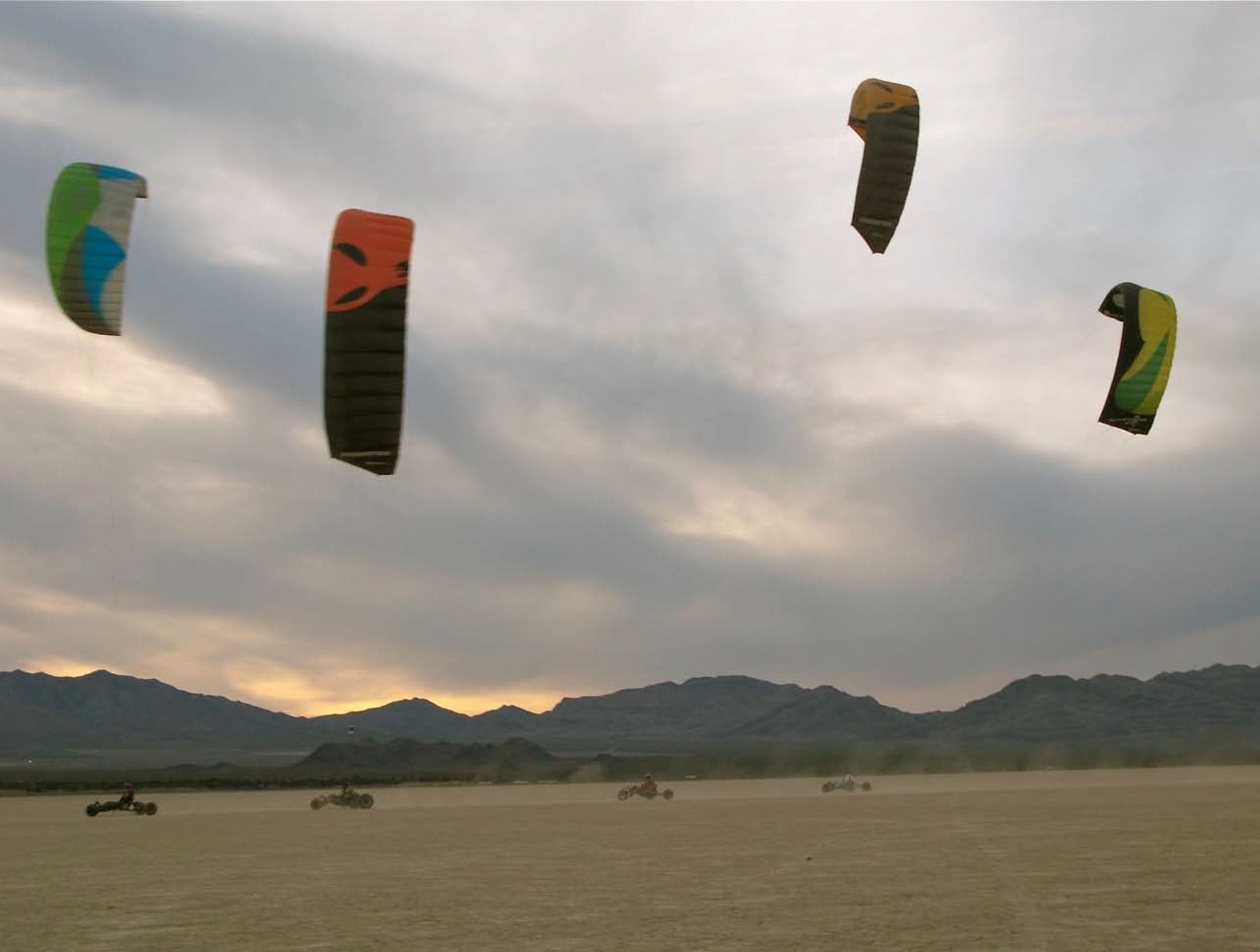
Jose Sainz. Kite surfing has the advantage of a relatively soft landing compared to buggying, but buggying requires less power and less balancing skill The kite buggy is probably the easiest vehicle to power; the problem is you need a lot of space, specialized equipment, and someone to show you the ropes.
My second story of power kiting took place in San Diego with my old friend Dave Britain. He had a new quiver of quadrafoils that he wanted to try out. As I headed across the bay on my directional board (basically a small surfboard), I hit a boat wake and hit the water face first. Since my boot bindings didn’t release, I was slowly being dragged under water while being stretched, as the kite pulled me forward and the board acted as a water brake holding me back, which caused the kite to pull harder!
As my head resurfaced, I saw the kite turning, diving, and gaining power. At this point, I had to make a quick decision: crash the kite and end the abuse, or fight to regain control. I hate the tedium of water- relaunching a kite, especially foils that quickly take on water, so I decided to fight on. I redirected the kite back up overhead, and a few minutes later I was back up on the board, cutting across the waves.
The moral to the story: nature is very powerful and unpredictable, so show some respect.
Everyone has their own learning curve and experiences to draw from. The following account outlines my personal approach to power kiting.
I learned the basics of power kiting by taking a kite I was very experienced with, the Revolution 1.5, and coupled it with a skateboard. I went down to the beach and found a small space in a parking lot to experiment. This had several advantages. First, the kite was small, just over one square meter, making it easier to control. I used a very small kite because a skateboard on hard pavement has very little resistance. Also the Rev 1.5 is designed for control, not power. This allowed me to focus precisely on technique without worrying about being over-powered.
Using the precision control, I hovered the kite overhead, then dipped it down ten feet into the power window and straight back up. This gave me a small, measured pull and then a release of tension. I used this small pull to move me ten feet, then rolled to a stop. Then I would use the same technique to pull me in the opposite direction back to my starting point. This, in a way, would separate the kite control and the board control since I would dip the kite into the power window for just a second. After this, the kite would hover overhead while I focused on steering and controlling the board.
I did this over and over, focusing on balance, kite position, and board position and direction. As I got the hang of it, I would go longer distances with more sustained power. As your skill level increases, you develop new skills such as sensing kite position, direction, and speed without constantly watching the kite. The direction the board travels is also critical. As I rode across the parking lot, I would ride along a curved path, 45 degrees downwind to start, perpendicular to the wind at mid- path, and 45 degrees upwind as I slowed to a stop. Then I would follow the same path in reverse to return to the starting point.
IF YOU’RE JUST GETTING STARTED, WHAT IS THE BEST APPROACH?
There are advantages and disadvantages to the different types of power kiting. For example, kite surfing has the advantage of a relatively soft landing compared to buggying, but buggying requires less power and less balancing skill. The easiest form of power kiting is to grab a powerful kite on a windy day and get dragged down the beach, hopefully on your feet.
The kite buggy is probably the easiest vehicle to power kite with since it has very little rolling resistance, and balance is not a problem since you are sitting very low on a three-wheeled base. The problem is you need a lot of space, specialized equipment (the buggy), and someone to show you the ropes.
If you would like to take the next step in power kiting, the safest and most convenient way is through kite surfing. Kite surfing is mainstream enough that there are many locations that offer lessons for the beginner as well as the experienced kite boarder. Just Google “kite boarding lessons” near your location.
IF YOU’RE JUST STARTING OUT, WHAT’S THE BEST GEAR FOR YOU?
The Internet is an incredible resource. I suggest you spend a half hour checking out gear and reviews on the Internet before taking your first lesson. This will give you an idea of what’s available. Then after your lesson, your instructor will have a good idea of your skill level and your goals, allowing him or her to guide you toward the best gear for you. The best that can happen is you will open up a whole new world of fun and adventure, and the worst that can happen is an excellent beach adventure to tell your friends about. ◆