
 Share
Share Print
PrintPeter and Anne Whitehead
From Discourse 4
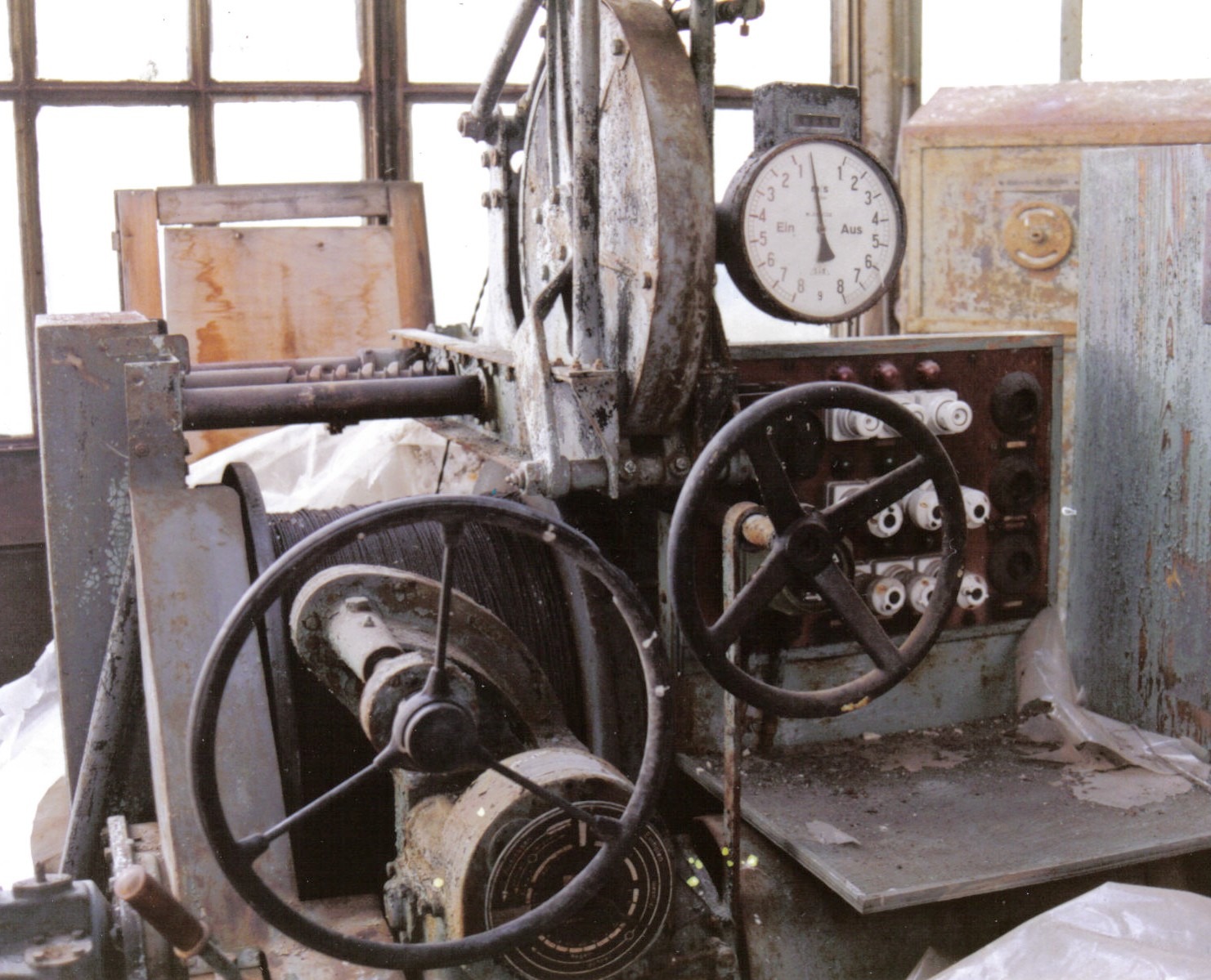
Peter and Anne WhiteheadIn Lindenberg, an old winch house sits on a shaft and bearings so that it could be rotated to the direction of the wind.
September 1989, West Berlin. This is two months before the wall was torn down. A thought that was inconceivable to most East Germans in their lifetime. But the wall coming down is another story. We are lucky enough to have small pieces from both sides of the wall: a smudgy, shitty, yellow piece of wall from the East and a wonderfully colored piece of the wall from the West.
This is a time before most people had heard of the internet (or its predecessor, ARPANet) or cell phones. And cell phones had not become the thing that you can’t live without. Both sides of the Cold War were still cautious of the other, especially the East Germans. We were told that people in the East had phones but did not know what their phone number was until someone called them and told them what number they had dialed. This was so that people could say they had a phone. It was similar to the jokes about the Trabant car. You had to order the car at least 10 years in the future, but the question always was, would it be ready by two o’clock of the assigned day?
Now back to the story of a visit to Lindenberg in these times.
We flew into Berlin to attend a kite festival in Halle (East Germany) and visit West Berlin the following weekend.
As we were going into East Germany for more than a day, we had to have a visa for the trip to Halle. Kite festival director Michael Stelzer had kindly arranged these for all of us. I do not know how much trouble he had to go to to obtain these, but I know that some of the phone calls still expressed frustration with the East German authorities. The visas arrived just before the appointed date. On the Saturday morning, we left nice and early, as we did not really know the state of the roads in East Germany or how long it would take to get through border control with a car with lots of kites in it. The roads were of autobahn quality and better, as some were able to be closed and used as a runway for fighter aircraft.
We made good time to Halle and as we arrived we realized that there were not many people around the area. For a start, we put this down to not having our clocks right from all the travel, but it transpired that this was the first morning of the change from summer time. Daylight savings had just ended that morning and it was an hour earlier than we thought it was. We found the race course that was to be used for the festival and started introducing ourselves to people. A few other fliers had come over from the West to join in.
The East German kites were characterized by the use of fabrics and spar material that would be considered old fashioned, with innovative use of objects to solve problems. One of the kite makers was using waste brass to make ferrel type joints to the square wooden spars. Another maker was using buttons to hold fabric on to the spars, where I would have used fancy end caps.
The interesting thing about this festival was the commentary and background music. Jorg Kopec had a large collection of LP records that were from the decadent West. I remember Pink Floyd being played and I think also The Kinks. This was a bit of a no wind day, so duly a large parafoil was brought out and towed around the race track. We had not brought our largest kites as we were not sure if the authorities would allow the kites in. People in the East had tried to escape using less than our 9-meter delta-conyne, and it could have been converted to a hang glider with a little work.
Even though the East Germans did not have the best materials, there were interesting kites and graphics. One kite I remember had pictures of shadow men. When I asked what this was referencing, I was told this kite was the “vanishing man,” relating to people trying to get out of East Germany.
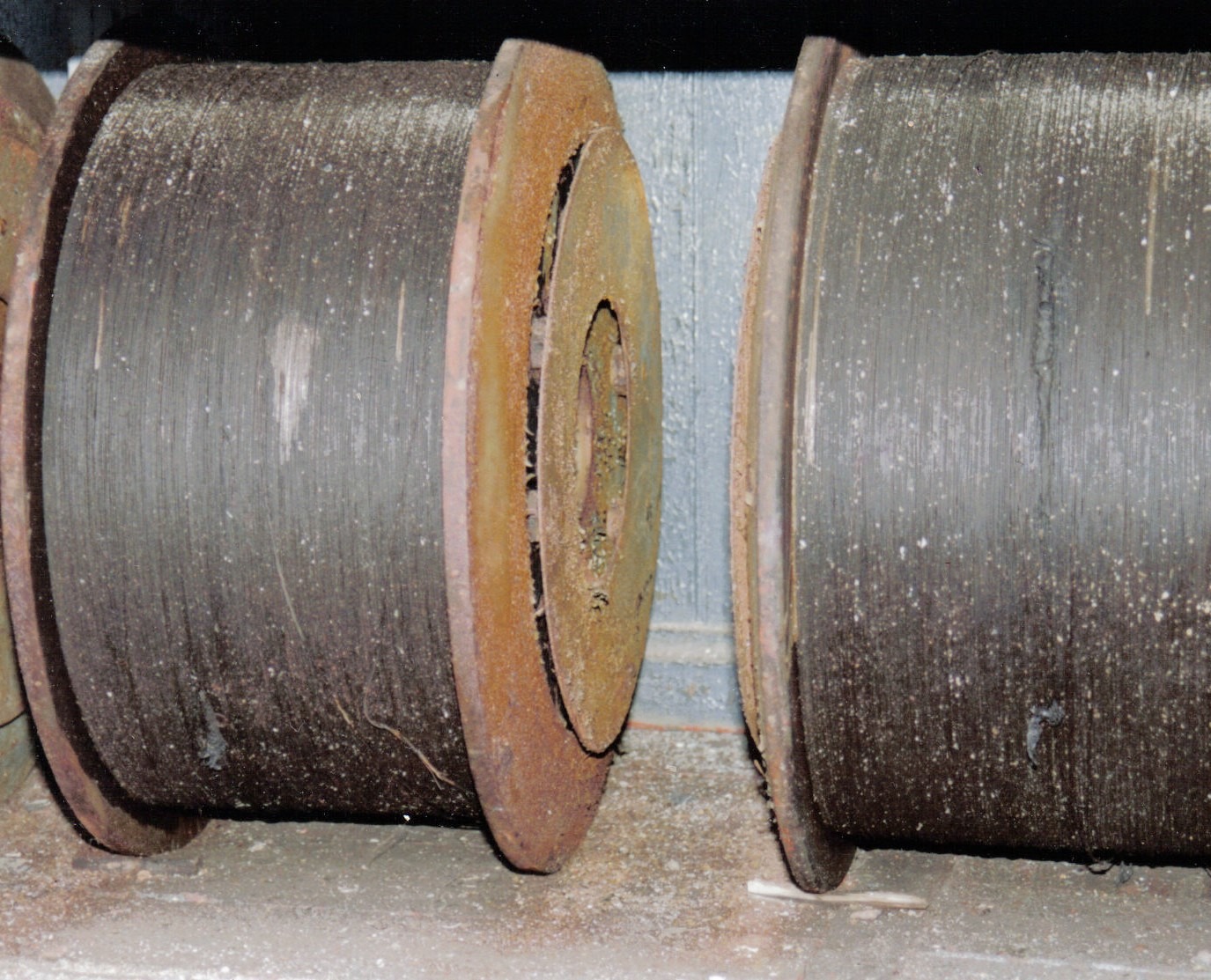
Peter and Anne Whitehead. In a large shed, crates contain old kite parts like this steel wire used to fly kites.
If you went into East Germany, you had to exchange 50 Deutchmarks per day you were there, and to make matters worse you could not exchange them back at the end of your trip, so you really had to spend them. And there was nothing much to spend them on.
We bought lunch, and as it was extremely cheap, treated three others. We still had not spent all our money. (And lunch included a beer as well.) At the end of the festival, the locals had booked us all in at a popular local restaurant.
Because we had been in the East so long, we had to report to the local police station. This is a little worrying as they asked us to push our passports through a small letter box opening in a rather foreboding wall. Other travelers have always told me not to let my passport out of my sight. Luckily, Michael is allowed in with us when we have our interviews, as at that stage our German is limited to about 20-50 words and making a sentence is frustrating, to say the least.
We got through this ordeal and head back to West Berlin.
At the border we sail through after a full inspection, including mirrors to look under the car, and so head off into no mans land. As we approach a large levee with tanks on top, a large steel beam is rammed out, closing the pass. This is used to stop advancing tanks or cars that have failed to stop at the border controls. So we are stopped in no mans land while they test their beam. Nothing happens and eventually the beam is withdrawn and we go on our way.
Later, Michael informs us that he had forgotten to bank the shop takings and we had thousands of Deutchmarks on us while we were in East Germany. Very illegal.
Monday and Tuesday there are many mysterious phone calls, and eventually on Tuesday night Michael says he has a surprise for us. We can go back into East Germany again. Just as I was getting bored with Berlin.
We are told that Jorg, the commentator from Halle, has asked us over for the day and wants to show us something. Michael says we must take lots of photos for him, as he can’t come.
Early on, we embark for East Berlin on the S-bahn and end up at a check point. Having to resort to a dictionary frequently to explain what we were doing and that we were actually going to see someone who we had just met three days ago seemed to amaze the border control. They seemed to be most anxious about some pamphlets we had with us about an upcoming kite festival in New Zealand. Though they claimed not to read English (or that’s what I think they said), they spent a lot of time poring over the documents. We finally convinced them to let us go and we went through.
It was early in the day and Jorg took us back to his place for breakfast. This is where we learned some of the things about East German life and experienced Hake-Peter (raw steak mince and egg). We also saw Jorg’s large collection of LP records. East Germans were paid a reasonable wage, and the staples of life – rent and food – were controlled and kept cheap. The food might not have been abundant or necessarily good.
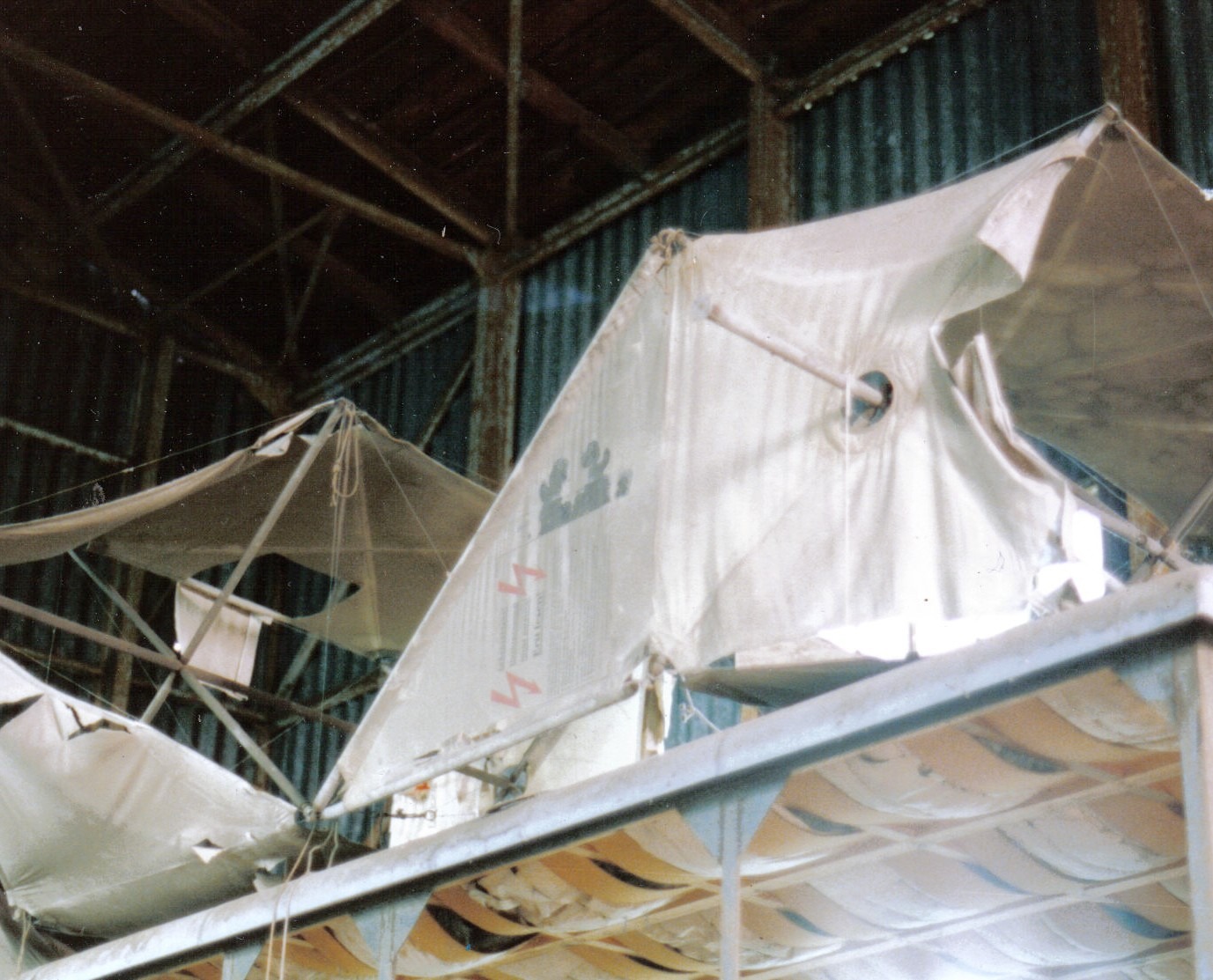
Peter and Anne Whitehead. These kites by Grund were made of cotton skins and aluminum frames.
There was a good savings record built up, as there was little to spend money on. Video recorders had gone on sale a few months previously at 7,000 Deutchmark and there had been queues to buy them.
So off we went on our little adventure to Lindenberg.
We first went to the local Intershop – these were the stores where you needed foreign currency to buy goods – to get some whiskey to bribe someone. We weren’t sure who at this stage. We were being coached to say we were white Russians if anyone asked us. With our grasp of languages, I don’t think we could have pulled that one off. We took off in Jorg’s Wartburg, not the most reliable of cars, but better than a Trabant.
We then took off for the countryside and were told that we were going to a weather station at Lindenberg. We then worked out we were going to see something very unique and important.
Once we got to Lindenberg, we went to see the Director and dutifully handed over the whiskey and were then taken to a large shed. This contained a lot of crates covered with Russian writing, but in the corner were two piles containing kites and kite parts.
The kites consisted of cotton for the skins, aluminum tube as the frame, and some steel springs held together with thin steel wire and washers to help join some of the spars to the skins. We were informed that these were kites by Grund. The spring was used as a device to change the attitude of the rear sail.
After looking at the kites and taking photos, we went up to the winch house. This was on top of a small grassy knoll about 200-300 meters from the storage shed.
The winch house was on a shaft and bearings so that it could be rotated to the direction of the wind. It had a backup of all the systems with large winches on opposite sides of the winch house. They used small flat steel as the wire to fly the kites from.
After visiting Lindenberg and getting photos for Michael, we returned to East Berlin. We managed to get ourselves photographed standing outside the Stasi headquarters and then managed a quick trip to Pergamon Museum to see some of the splendors.
Read more about the kites of Lindenberg in the Spring 2006 Kite Journal online at: http://www.drachen.org/journals/a21/no21-Werner-Schmidt.pdf.