

 Share
Share Print
PrintYour Content Goes Here
CONTRIBUTORS
SCOTT HAEFNER
Currently working for U.S. Geological Survey in Palo Alto, California, Scott Haefner has photographed the San Andreas fault lines and uses kite aerial photography to capture the earth from a different point of view.

CHRISTOPHER ORNELAS
A graduate of Yale University in Latin American Studies and Fine Arts, Christopher Ornelas has something to say even at this early point in his life. After living in Central America for the last six months, he returned to his San Antonio, Texas hometown to set up a studio and create art.
 PIERRE FABRE
A talented graphic and fine artist, Pierre Fabre makes his home in Paris, France. Intuitive in his ability to research kite cultures, no one else has as extensively photo- documented kites worldwide.
PHOTO CREDITS
Cover: Ali Fujino Logo: Kiyomi Okawa Page 5: Scott Haefner Page 6, left: Scott Haefner Page 6, right: Ali Fujino Page 7: Scott Haefner
Page 9-11: Christopher Ornelas Page 12: Ronan Quéméré Page 15: Marc Ginisty
Page 18-22: Skysails GmbH & Co. KG.
Page 24: Stefanie Krücke
CAPTURING SAN FRANCISCO 100 YEARS LATER
Scott Haefner
Scott Haefner
RECREATING GEORGE LAWRENCE’S PHOTOGRAPHIC FEAT
According to the New York Times, the Magnitude 7.9 earthquake and fire that destroyed San Francisco on April 18, 1906 was the first widely photographed disaster. Of all the photos documenting the devastation, perhaps none are as striking as George Lawrence’s famous kite aerial photograph, “San Francisco in Ruins,” taken 950 feet above San Francisco Bay.
A few weeks after the disaster, Chicago- based photographer George Lawrence saw an opportunity to capture a unique image of the sprawling ruins using his “captive airship,” a hand-built, 49-pound panoramic camera suspended from a series of Conyne kites. The result was a negative measuring 22 x 55 inches, capable of being enlarged to wall-sized prints with astonishing detail. Lawrence’s foresight earned him a small fortune of $15,000 (more than $300,000 today) selling copies of his achievement.
POSITIONING THE CAMERA
In typical re-shoot photography, a photographer can compare the original photo to the camera’s viewfinder and continually shift the camera to obtain a similar view. Because our camera was hanging from a kite, we did not have the luxury of looking through the viewfinder and comparing the view to Lawrence’s photograph. Instead, we had to rely on computer software to pinpoint the exact location before going out to shoot.
Although it is possible to determine where George Lawrence positioned his camera 100 years ago, this would not be sufficient because we were not using the same camera and lens. George Lawrence shot his panorama using a 19-inch lens and a 55” wide negative, yielding a field of view of approximately 145 degrees. We shot the contemporary photo using a Hasselblad XPan II 35mm film-based panoramic camera with a 30mm lens, which yielded a field of view of 94 degrees. Therefore, to obtain a similar view of the city, we would have to shoot the photo from further away.
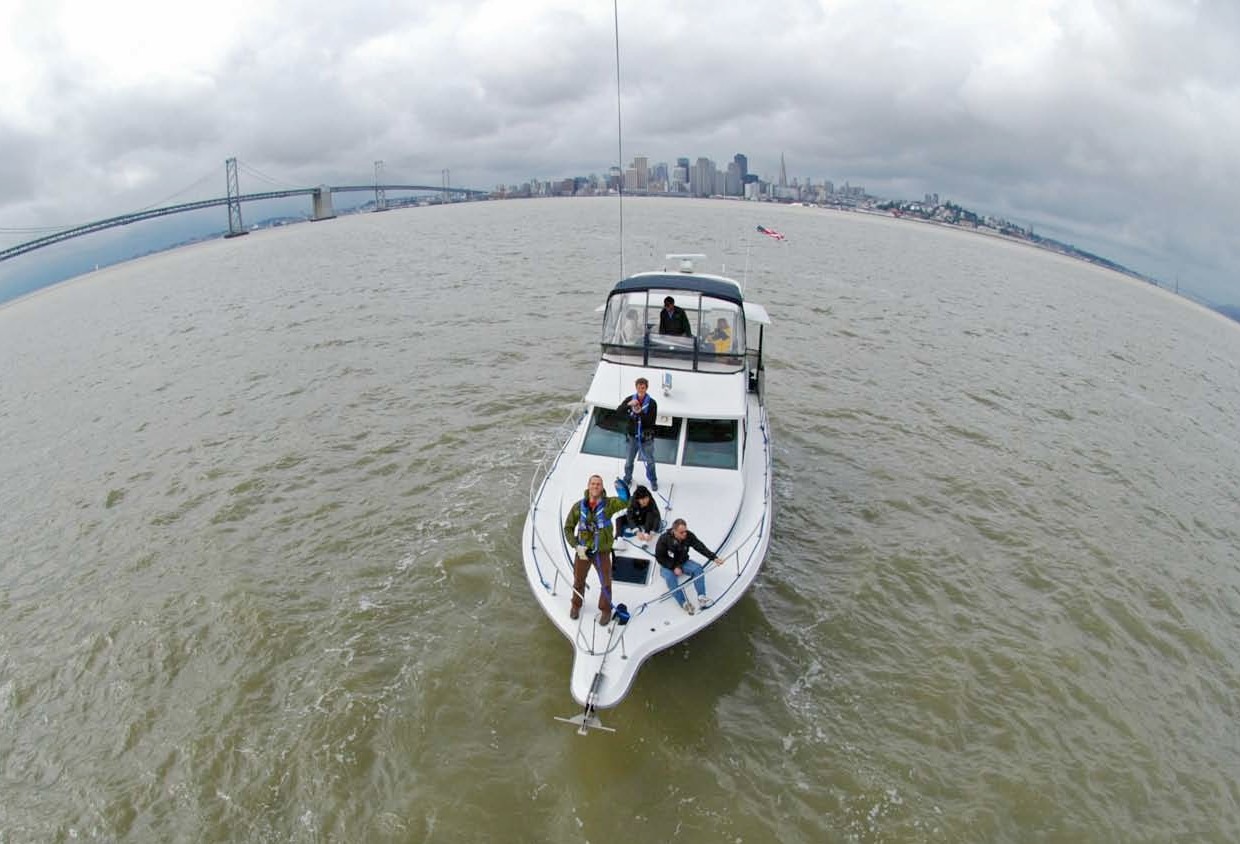
One of the defining characteristics of Lawrence’s photo is that his camera was positioned so that the viewer can look past the Ferry Building, straight down Market Street. Our aim was to capture this same awe-inspiring view of the city. While it is fairly straightforward to key in GPS coordinates and position the boat on top of the shooting location, we had the additional challenge of estimating the camera’s position, which was several hundred feet from the boat. Malcolm Johnston, USGS scientist and boat captain, did a marvelous job of putting the camera in the correct position.
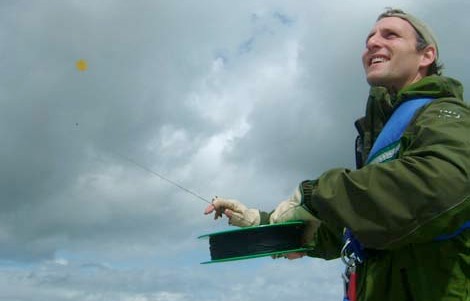
Using a custom-built rig from Brooks Leffler, who designed a kit-based system that almost anyone can assemble, we lifted the camera to a height of approximately 300-feet in light winds under a single Dopero kite based on KAPer Ralf Buetnagel’s design. Although the tilt angle had to be set before launching the camera, the rig allowed me to pan the camera and trip the shutter remotely from the bow of the boat. The rig and camera weighed approximately 3 pounds.
THE RESULT
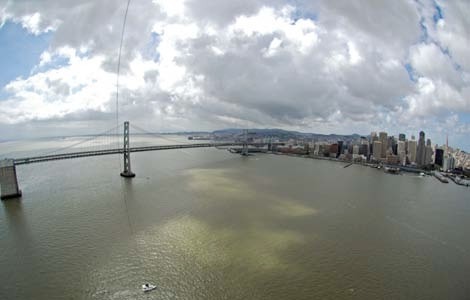
The resulting photo, a remarkable achievement in its own right, leads the viewer’s eye west down Market Street, just like George Lawrence’s stunning photograph did a century ago. Although it was not shot as close to the city or as high as Lawrence’s photo, it captures the essence of modern day San Francisco, documenting how it has grown and changed since 1906.
Scott Haefner
Ali Fujino

Scott Haefner

Scott Haefner
LOS BARRILETES GIGANTES
Christopher Ornelas
EDITOR’S NOTE
These entries are a snapshot in time from Christopher Ornelas’ blog, an online account of his research on collective kitemaking in Guatemala.
We include them as an introduction to his unique work, and we invite you to read more on his blog at: BARRILETESGIGANTES.BLOGSPOT.COM
Christopher will present an essay on his findings in a future issue.
OCTOBER 2, 2007
My brain is a little bit fried right now after talking with Melanie, who is here in Guatemala writing her dissertation. The woman knows everything there is to know about Guatemalan politics. She talked and talked, and as she talked, she made me realize how much of a beginner I am. I feel like I am just scratching the surface of a very deep and bloody history.
Today was long but very productive. I now have good standing with Frederico and Luis thanks to Drachen Foundation. It is very reassuring to know that I am not simply walking into this as a complete outsider. Everyone knows everyone here.
Finding out the history of the Kite Festival is going to be tricky. It seems that neither Frederico nor Luis know the origins of the kites. However, they did lead me to some interesting hypotheses.
Theory 1: The kites are Aztec.
Evidence: The name Sumpango is a transliterated word for Tzompantli, the Aztec name for sacrificial skull racks. Supposedly, there is reference in the Dresden codex to a special kind of weather device made of the leaves of papalot trees and used to determine wind patterns. It is most likely some kind of kite, which would explain the Mexican word for kite, papalote. The Aztecs might have also used kites as part of their religious rituals. The town of Sumpango existed before the Spanish conquest and it is possible that the town was a far-flung post of the Aztec empire, which would explain the name and the religious importance of the kites.

Christopher Ornelas

Christopher Ornelas
Theory 2: The kites were introduced by Spanish priests in an attempt to convert Mayan children. That is about all there is to this theory, but it is entirely probable. The Franciscans employed all kinds of overt and covert ploys to convert the Indians.
This at least is a good starting point. I am going to meet with them again on Tuesday to create a plan of action and to set up a schedule for interviews. Wish me luck.
OCTOBER 16, 2007
This afternoon I am hunkered down at my computer wrapped in a blanket. It is pouring outside and my clothes are soaked from walking in the rain.
Last weekend I walked up to the soccer field with Luis’ high school class to fly kites.
Wednesday was their last day of class, and for their final project everyone had to make a kite. When I got to the top of the hill there were some fifty-odd kids waiting on the bleachers. Unlike the strictly Mayan adornments seen on the giant kites, there was many a Tweedy-bird and several Pooh- bears. Some boys had Spider-man and others Guns n’ Roses.
The soccer field is the same field used to fly the giant kites. It is on top of a hill over looking the city and right next the cemetery. It is not very large, and as I stood watching the kids fly their miniature Pooh-bear kites, I had difficulty imagining how they can possibly fly the giants. Some of the boys had relatively large two-meter kites. Without success they tried to lift them up in the air. It took four of five boys to hold the string, all running like crazy to try to keep it afloat.
Soon the dark clouds gathering overhead delivered their promised goods. Rain started pouring hard and everyone scrambled to get under the bleachers. It only lasted a short while, but it was enough to damage several of the kites whose struggling navigators couldn’t bring them in fast enough. Unfortunately, this is a very real threat for the giant kites as well. Some years all of the kites have been ruined by a sudden down pour. Months of hard work and many sleepless nights can be washed away in a matter of minutes. When this happens it is truly a crushing defeat for the barrileteros.
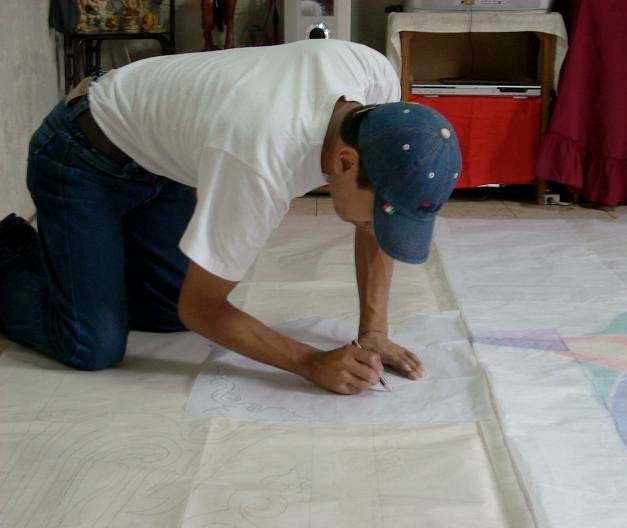
Christopher Ornelas

Christopher Ornelas
However, the threat of destruction is somehow part of the artwork. All of the barrileteros know that with even a small amount of rain all the intricate details and the precise color arrangements can be easily smeared. A large gust of wind at just the right moment while the kite is being lifted can rip it in two.
There are less than seventeen days left before the Feria and the kite making is progressing forward with a hurry. This last Saturday I stayed up until three in the morning with the group Agrupación Barrileteros, helping them with their design. Around one in the morning, the Barrileteros stopped for a break to drink hot chocolate and eat ham sandwiches smothered in mayonnaise. Everyone was tired but in good spirits, laughing and making jokes. Eduardo, the main coordinator for the group, asked everyone if they could pitch in twenty-five quetzales to pay for team t- shirts. Most people agreed, but a few people could not afford the cost (about three dollars) and shook their heads. A list was written down of who could contribute and how much. This is how most money finances are resolved, with the whole group, and people contribute what they can.
There is no government funding for the barrileteros. Each group shoulders the majority of the costs themselves. The Municipality distributes a small amount of funds to each group depending on the size of the kite. A 13-meter kite might get Q 1,500, but this is a pittance compared to the estimated Q 44,000 to Q 60,000 spent on making just one kite. Everyone in the group is expected pitch in their part to cover this enormous cost – but this is no small feat. Many people in the group are students and depend on their families for their income.

Christopher Ornelas

Christopher Ornelas
Others are working and perhaps can afford to contribute a little more, but few people make hefty paychecks.
Most groups have said that the greatest difficulty in making the kites is paying for them. Some of the more established groups are able to buy the materials in bulk months before the kite making begins. However, most groups cannot afford this luxury. They buy the tissue paper and the glue piecemeal as needed. This way is more expensive and more risky, because toward the end of the month tissue paper is a scarce commodity.
On the day of the Fería, prizes are handed out for the best design, best use of color, best use of traditional Mayan imagery, and best flying capability. But the prizes are more symbolic than anything else. The winning team is awarded Q 1,500, which is almost nothing compared to the time, effort, and expense put into making the kite. Most barrileteros say what they do is a sacrifice to show people the beauty that exists in Sumpango and Guatemala. They don’t earn any money from the kites. Their one moment of glory is to see the look on people’s faces as their kite is lifted up for the first time for everyone to see.
The Barriletes Gigantes are works of art with a life span: they are born, they live, fly, carry on, and die. Despite the love, hours of labor, and money put into their creation, everyone knows that they will only live for one day. They are given one day of glory, to fly and to show to the world the beauty and culture of Sumpango. But they are not intended to live forever. Sometimes they are destroyed by wind and rain. Others die in a brilliant kamikaze dive-crash to the earth. Still others find gradual death in a truja, a dusty room used to store corn after the harvest. There they are stored and forgotten. Their radiant colors fade with time, and rats rip out holes in them to build their nests.
But for one day they live. In my own artwork I know that once the work is complete it is no longer mine. If it is destroyed by the elements, then so be it. Perhaps the barrileteros feel a similar sensation when their kite is lifted into the air – that somehow it is turned into a living creature and they have to let it go.
KITES ACROSS THE OCEANS
Pierre Fabre
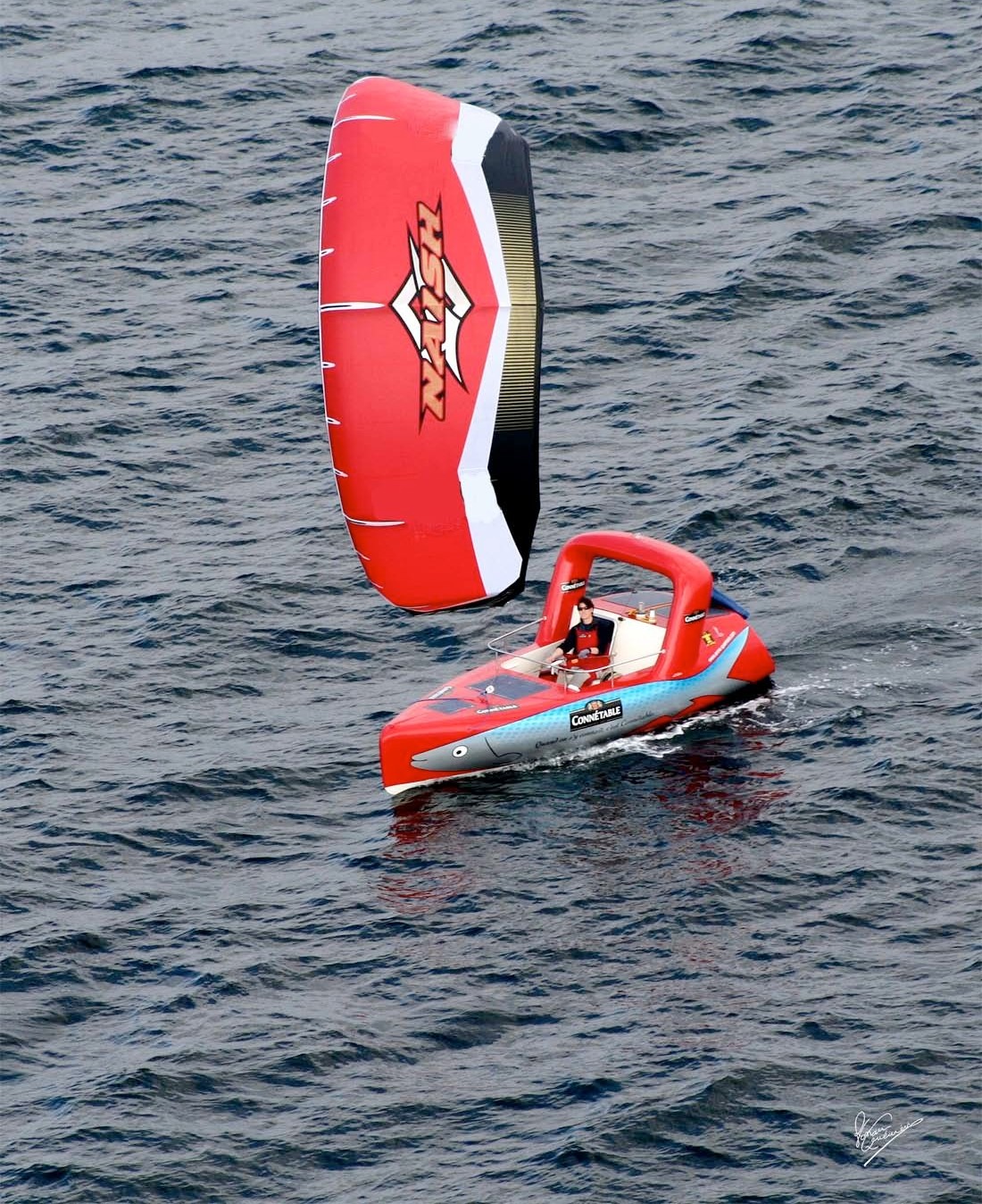
Ronan Quéméré
THE BEGINNINGS OF A NEW SAILING ERA
A millennium ago, daring Polynesian sailors made use of kites to tow their canoes between nearby islands. This was the prehistory of kite navigation, an unusual means of transportation that has not been able to show its full potential until very recent years.
As the energy crisis and global warming urge us to find alternatives to oil, high-tech synthetic materials, computer assisted steering, and satellite observation of the earth now allow for brand new developments in kitesailing.
French navigator Anne Quéméré prepares a solo crossing of the Pacific while German company SkySails gets ready to make its elaborate kite towing system a common feature on thousands of cargo ships. This is the beginning of a new era both in sports and commercial navigation, kites becoming a reliable means for powering most boats, from the smallest dinghy to the largest cargo ship.
PART ONE:
CHALLENGING THE OCEANS
Crossing one ocean hasn’t been enough for Anne Quéméré. After succeeding the first transatlantic from New York to France on a minuscule boat solely powered by kites, she is ready for a new challenge. Next October, the multiple record breaking navigator will get a taste of the Pacific along an unprecedented kitesailing route from San Francisco to Tahiti: 3,800 nautical miles through the largest ocean, with the all too famous doldrums to cross on the way.
BRITTANY: A LAND OF NAVIGATORS
Anne Quéméré is one of the authentic seafarers, those who have saltwater running through their veins. She grew up in a family of sailors in Brittany, a peninsular region of France, which has produced so many of the best navigators. Spending ten years in the U.S., and traveling through South America and Asia, she worked as a tour guide and lecturer, until she decided to settle back in her native land, in the harbor city of Quimper, to become a fulltime adventurer of the seas.
Since her return to France, Anne has created new challenges for herself every other year: two solo crossings on a rowing boat without assistance, one each way in 2002 and 2004. After having tried kitesurfing, she traded her oars for a kite and took off from New York for the first kitesailing crossing of the northern Atlantic during summer 2006.
She eventually succeeded, but the 55-day- long trip turned out to be challenging. An extreme heat wave turned her cabin into a baking oven. Most of the time, there was not enough wind for the kite to take off, leaving her nothing to do but read over and over the few books she had brought along. The scariest parts of her trip were multiple encounters with non-communicative, seemingly deaf and blind, giant cargos that once missed crushing her tiny boat by just 50 yards.
MAKING IT SMALL
Anne Quéméré is the first to benefit from a specifically designed transatlantic kite boat. Decorated with a sardine fish, emblem of her 2006 sponsor, “Connétable” canned fish, this boat indeed inherits some of the features of a sardine can: extreme compactness and minimalist comfort.
Imagine yourself having to live for 2 months between a cabin of one cubic yard and a cockpit of 20 square feet, just long enough to stretch your legs when steering the footrest that controls the rudder.
This unique boat has been designed, built, and tested over one year by Marc Ginisty, a naval architect who also supplied Anne with the rowing boats she used for her two previous ocean’s crossings. Marc has earned a reputation as the best specialist in the world for this type of raft.
To find the best positioning of the centerboard and kite towing point, he first built a prototype to test at sea. Then the actual boat was made with all the special features required for crossing an ocean safely. Weight being the worst enemy, Marc reduced the dimensions to a minimum, 18 feet long and 7 feet wide. The boat weighs a mere 660 pounds when fully loaded, half the weight of an ocean rowing boat or sailboat of equal size. Using a range of standard kitesurfing sails, the skiff remains light enough to cruise at 15 knots, with a top speed of 25 knots. Knowing that an ocean rowing boat averages 2.5 knots, Anne didn’t complain about the change from rowing to kiting.
Anne chose to keep her gear simple, safe, lightweight, and cost effective. Everything is operated manually: there is no winch and no motor. Solar panels power only the desalinator, computer, radio, and satellite phone for her daily call to her router, Jean François Bonnin, a renowned specialist in marine weather forecasts.
MAKING IT SAFE
High sea navigation has very different requirements than sports kitesailing along the shores. The equipment has to cope with high swell and withstand raging storms.
The “Connétable” was designed and constructed to provide maximum safety even in the most adverse conditions. It is unsinkable and self-righting thanks to the thick hoop above the rear deck, eliminating the need for a safety raft onboard.
The boat is free of any protruding element to prevent the kite lines from getting caught or wrapped around something. The solar panels are perfectly flush with the front and aft decks, and there is no keel, but a retractable centerboard instead.
There are so many cargo ships thundering around the planet nowadays that the risk of a close encounter is much higher than one would think, particularly when there is no wind and you find yourself stuck on a busy marine channel. Despite her radar transponder, a safety system that detects, amplifies, and reemits the signals sent by bigger boat’s radars, Anne could have been sunk by an ocean giant that did not respond to her VHF radio calls and missed her by a few dozen yards. When there was swell and no kite in the air to make it more visible, Anne’s boat was at times totally hidden by the water, both for the eyes and the radars, as their signals are blocked by water.
In case the worst happened, Anne carried a Guy Cotten TPS survival suit, a lightweight, thermal, and floating dry suit which has become compulsory for ocean sail-racers.
THE FIRST TRANSATLANTIC KITES
In 1995, Nicole Van de Kerchove, who sadly passed away last February, was the first person to cross the Atlantic solely by means of kite traction. Anne and Nicole actually knew each other quite well. After having both spent years around the globe, they ended both being based in Bretagne, only a few dozen miles apart.
For her first, Nicole had followed the easier trade winds route from the Canaries to the Caribbean. Although they eventually got her to her destination, her kites were far from suitable. They were actually dual line foils modified to fly on a single line and did not prove to be steady enough. With a fully open leading edge, they were also prone to turn into anchors whenever they fell in the ocean, filling up with water. On a few occasions, Nicole had no other option than to cut the sinking kite loose, as she just could not retrieve it.
Despite her successful crossing, it was clear for Nicole that none of the kites available in those days could allow a lone-sailor to kitesail upwind across an ocean.
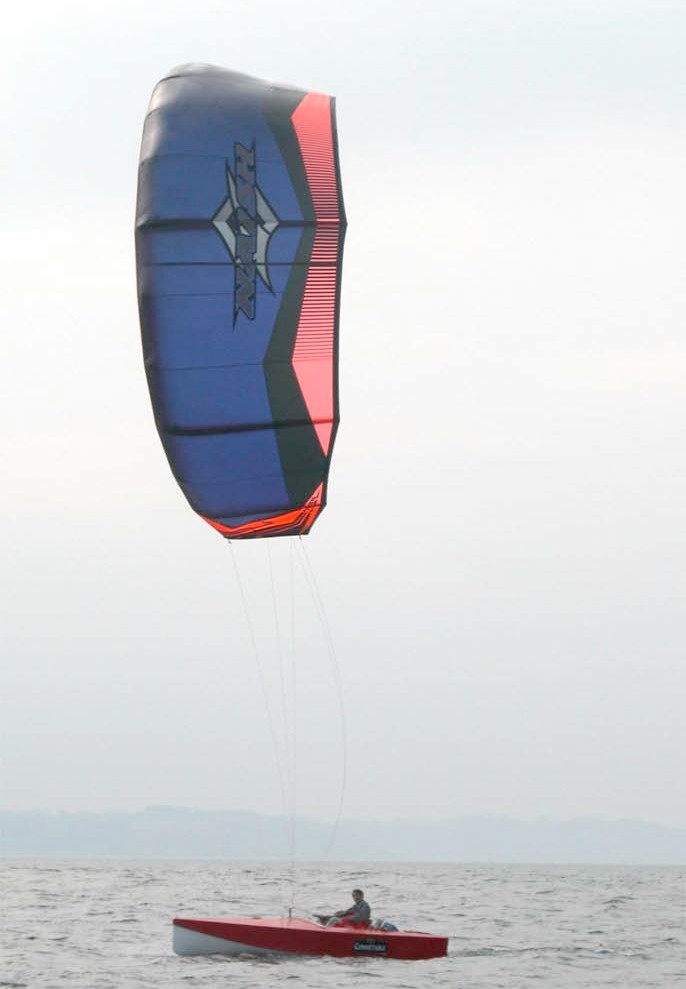
Marc Ginisty
SAILING INTO THE WIND
Ten years later, this is the challenge Anne Quéméré was getting ready for. Because she chose the more difficult Northern Atlantic route, she had to be able to sail against the wind.
In 1984, the Legaignoux brothers, two young sailing champions, invented an unsinkable arch kite stiffened with air- inflated bladders that they began using with water-skis. It took them a long time to have their patented design put into production, but after a few expert windsurfers went kitesurfing with it in Hawaii, it gave wings to a trendy new sport.
In 1997, under the name of Wipica, the Legaignoux brothers marketed their new design. Also know as the C-Kite, it quickly became the industry standard, and most windsurf manufacturers added kites to their trade. Shapes and bridling have been refined over the years to widen the wind range, improve upwind performance, and ease use for board riders requiring more power.
However, the inherent stability of the earliest C-Kite design has been lost along the way of this evolution. With the notable exception of the twinskin kites developed by Peter Lynn, the current kitesurfing wings inevitably crash when you take your hands off the control bar for too long.
Although these kites were designed for kiteboarders, they are incomparably more efficient than what was available for kitesailing a decade earlier. Thanks to developments in kitesurfing, it became possible to sail upwind, to launch a kite from the water, and to have unsinkable kites.
CHOOSING HER KITES
Anne Quéméré wasn’t able to find a manufacturer to produce custom kites designed specifically for her needs. She had to choose among the available marketed kites. Having to launch and pilot the kite as well as the boat all by herself and without any chance for assistance in case of a major problem, Anne chose the most reliable equipment and simplest launch procedures.
She decided to use C-Kite wings with individually inflated bladders in the leading edge and ribs because they are totally unsinkable. Naish, the biggest manufacturer of kitesurfing gear, with Don Montague then still heading its design department, supplied her with the complete range of kites she needed: 5 sizes from 85 to 270 square feet (8 to 25m2). As her boat was too small to be used as a launching platform, she relied on the ability of these kites to take off from the water.
Spare kites were packed away fully deflated, but to save time when getting a kite ready, all the ribs of the kites in service were kept inflated inside the front compartment of the boat. First, the partly inflated kite was taken out and attached to the front of the boat by its trailing edge. Then the 4 steering lines were pulled out through the pulley on top of the front deck and attached to the kite. At this point, Anne would set out a sea anchor to slow down her boat and also to pump air into the leading edge bladder of the kite. After that, it was left to float on the water, drifting away from the boat until the flying lines were stretched out. Finally, the aft and front lines were attached to the steering bar that Anne maneuvered to get the kite to fly off the water and begin towing the boat.
Because her kites were not stable enough to leave to flying on their own, Anne had to always keep at least one hand on the control bar secured to the boat. When sailing 10 hours a day non-stop, one can imagine it not an easy task.
Takeoff was also not always easy, particularly in low wind conditions. The kites tended to stick to the water surface and, as Anne found out, it was impossible to get them up in the air when the wind speed was below 8 knots. There would also be occasional tangles in the lines, but that wasn’t really a big problem; she was never in a rush as the kite could float forever.
THE IDEAL SAILING KITE IS STILL MISSING
According to Marc Ginisty, all the knowledge to produce efficient boats with near perfect hulls is there, but there is still much research to be done on the kite side to develop automated launching, steering, and retrieval systems. For solo high sea navigation, the ideal kite should be totally unsinkable, water relaunchable even in the lightest winds, fully depowerable, and perfectly stable when set up at the zenith. It should also incorporate radar reflective parts. No such kite exists yet on the market and it is unlikely that windsurfing kites, which currently tend to become smaller and flatter, will ever match the needs for ocean kitesailing.
PREPARING THE PACIFIC ADVENTURE
As this article goes online, Anne Quéméré is testing several kites from various manufacturers before choosing which she will use to navigate across the Pacific. None perfectly suiting her needs, she hasn’t made her mind yet, and the windless May in France was not quite suitable to conduct proper tests.
Her line winding system has been redesigned and improved, and a set of single line parafoil type kites designed by Stéphane Blanco will be used when the wind is too light to launch the steerable ones or when she needs a rest. These can be useful, for instance, in order to prevent the boat from bobbing and drifting in adverse currents. An emergency high visibility kite, capable of lifting a radar reflector up in the air, is also planned in order to make her tiny boat easily noticeable by large ships, both with eyes and radars.
Her boat having proved its efficiency, it will remain unchanged, but it will bear the colors of a new sponsor. Anne is still looking for the main sponsor of her new challenge, a company ready to contribute $235,000 (€150,000) to cover the expense of shipping her boat by container to California and then back to Europe from Tahiti, among other things.
PART TWO:
A REVOLUTION IN MARINE TRANSPORT
It all began with the simple idea of a kiteflying schoolboy: why not use a big kite to tow cargo ships and save on fuel? Looking back on the history of kitesailing, this may not look like a brand new idea; but more than ideas, it is real achievements that matter. The grown up schoolboy is now a 34-year-old engineer and manager, heading one of the biggest and most promising kite related high-tech businesses ever, SkySails.

Skysails GmbH & Co. KG
Since it was established in 2001, the company, now employing a staff of 26, mainly engineers, has raised €13 million to develop the project, 10% of which was public funding. After six years of development, SkySails had last year already finalized and successfully tested a full-scale prototype of their remarkable automated device, which can launch and steer a very large kite from the front deck of any cargo ship.
The kite is a twinskin foil, a thick curved wing with straight trailing edge. Designed in partnership with Aerolabs AG, it has been optimized for the widest wind range. The heavy strain it has to sustain is distributed over more than 130 bridles. A strong, telescopic, 50-foot tall vertical mast is installed on the deck to hoist the kite out of its container and hold it up into the wind for inflation. There are only a few square air intakes (4 to 6 depending on the size of the wing) located close the center of the leading edge. The kite is held from a stiff rod running along part of its central rib, allowing it to stay oriented in the wind’s direction. Once the kite is fully inflated, the lock mechanism holding the tip of the rod is released, but the leading edge is still held by a leash. Once that leash is released, a powerful winch unrolls the single flying line, made of Dyneema heat-set under tension, until it reaches the desired altitude up to 1,000 feet.
Up there, winds are noticeably stronger than at sea level. To increase the relative wind speed of the kite and generate even more pulling strength, it is flown in a wide flat figure 8 pattern, steered from left to right by an auto-pilot attached at the bridling point, which acts on the outer bridles by means of a cranked belt. It is controlled by a computer, connected to it and powered by a cable running inside the main flying line.
The towing strength supplied by the kite is 2 to 3 times that of a regular sail of equal size. The system is not meant to operate permanently nor in all wind conditions, but it can be used even when the ship is heading into the wind, up to 50 degrees. To optimize the kite’s performance, SkySails supplies a weather-based routing system that indicates the best route to follow.
THE MAIDEN TRANSATLANTIC VOYAGE OF A KITE CARGO SHIP
In order to convince its future clients, SkySails needs to prove the efficiency and reliability of its system in real sailing conditions.
In January 2008, the MS Beluga SkySails, a 430-foot, newly built, 10,000-ton cargo ship, fitted with automated kite towing system, left Bremen for the first test voyage on a transatlantic crossing, inaugurating a promising collaboration with the Beluga Group, a very fast growing and successful German company specializing in multipurpose heavy-lift carriers for transporting huge structures by sea.
The first leg of the journey was from Germany to Venezuela. When the 1,700 square foot (160m2) kite was set up along the favorable trade winds route, it saved 15- 20% on fuel consumption and over $1,000 a day. The kite system did not slow the ship, and its trip took the usual 14 days.
The ship then left Venezuela to load freight in Mississippi and continued testing the kite on its route back to Denmark across the northern Atlantic. Over 12,000 nautical miles, the kite was periodically test-flown up to 8 hours in a row, supplying up to 5 tons of towing force in force 5 winds. When projected onto an entire day, such performance would allow the MS Beluga SkySails to save 2.5 tons of fuel per day.
So far, no part of the system has shown any sign of failure or excessive wear. The expected lifetime of the towing kite in normal use on a cargo ship is 2 years. North Sails in New Zealand is currently manufacturing the kites for SkySails, and they plan to implement a much larger and powerful kite, twice the size of the current one, later in the year as this testing period continues. Fuel savings should then be doubled.
After this journey, SkySails can now confirm the actual efficiency of the system with precise data. Tests show that, depending on the route and weather conditions, 10-35% savings can be made on the fuel bill. Some didn’t believe savings would be this high because suitable wind conditions would be too seldom.
Peter Lynn, as well as Marc Ginisty, had pointed out to me that today’s cargos cruise at such high speeds (14 knots on the average) that kites will hardly ever meet adequate weather conditions for the ship to maintain that speed. SkySails’ kite system cannot operate if the boat’s speed is above 16 knots.
The best way for kites to become really efficient would be to noticeably slow down the cargo’s speed, which may not be an option for the ship-owner. Savings on fuel thanks to kite power could be completely outbalanced by the extra cost of journeys lasting longer. With the current craze, there is no doubt that kite power has already become a profitable option.
ENVIRONMENTAL CONCERNS
The worthiness of the towing kite system should not be evaluated only through a purely financial point of view. Wouldn’t it be a great relief for the planet if many of the 50,000 ships navigating the oceans could lower their CO2 and sulfur dioxide emissions thanks to kite towing?
As anti-pollution regulations become tougher and more strictly enforced over the years, kites may become a standard feature on most cargo ships. Because it can easily be fitted onto any boat, the SkySails system could well be one of the few options for existing vessels to make a step towards a better fuel efficiency and meet future emissions standards.
GERMAN EFFICIENCY
SkySails’ strength lies in the efficiency the company shows not only in developing the needed technological breakthroughs but also in marketing the system through a carefully planed integration into the real business world of maritime transport. Confident in its performance and fully supportive of SkySails, Beluga Shipping has already planned next year to install even larger kites reaching 6,400 square feet on two new carrier boats which are still under construction.
Stephan Wrage’s target is to have equipped at least 1,500 boats by 2015. It is also part of his company’s plans to reach other markets, such as those of fishing trawlers and superyachts. After participating in the Monaco Yacht Show in September 2007 in collaboration with Humphrey Yacht Designs, a first contract was signed with 30 Metres Plus Yachts, a business owned by an American enthusiast who plans to fit the kite system to a new 40-meter, eco-friendly superyacht, the Valbella, to be built in Rochefort, France. Launch is planed for 2009. However, the construction facility itself having not yet been built, the project is still quite a long way from completion.

Skysails GmbH & Co. KG

Skysails GmbH & Co. KG
In May, ever-rising oil prices put French and Spanish fishermen on the edge of bankruptcy. The cost of oil is now so high that it is no longer profitable for boats to go out at sea. The French went on strike, blocking several harbors and fuel storage facilities, even after the government promised to distribute $74 million (€47 million) by the end of 2008. France will give a total of $310 million over a period of two years to help the fishing industry.
SkySails is negotiating with fishing vessel owners and operators from all over Europe. Their SKS 160 system (with a 160m2 kite), which sells for $785,000 (€500,000), is suitable for medium-size trawlers and can pay for itself within 3 years. The use of a towing kite system is particularly well suited for fishing boats because they trawl at low speeds, usually 2 to 4 knots. Under optimal conditions, it can temporarily cut down oil consumption by 50%. In the years to come, SkySails plans to develop systems suited for slightly smaller boats, at least 80 feet long, as well as for the largest fishing trawlers, which can reach 500 feet.
A MAJOR STEP IN KITE HISTORY
The evidence is there: we have stepped into a new era of sailing. Oil is so costly and causes so much damage to the environment that there is absolutely no doubt that most boats will be using the wind’s energy again. It is there, readily available, everywhere above the oceans.
Now that we know how to reliably steer kites with computers 24 hours a day, flying high enough to catch stronger winds, and now that we have the technology to automatically launch and retrieve huge inflatable kite-wings large enough to provide tons of pull, there is no obstacle left for kites to become a major feature on virtually all boats that run across the oceans.
The need for transporting goods from continent to continent is ever increasing. It has now become not only more environmentally friendly but also more profitable to use the wind’s energy, at least as a complement to oil-based technologies.
With the remarkable and successful developments introduced by SkySails’ team of engineers, Stephan Wrage’s boyhood dream of oceans filled with boats towed by huge kites will come true. Along with other developments, such as those underway for producing electricity from high altitude winds, kites of this millennium will play their part in the field of renewable energies.
What an incredible destiny for that light and fragile object we used to know as a simple flying toy.
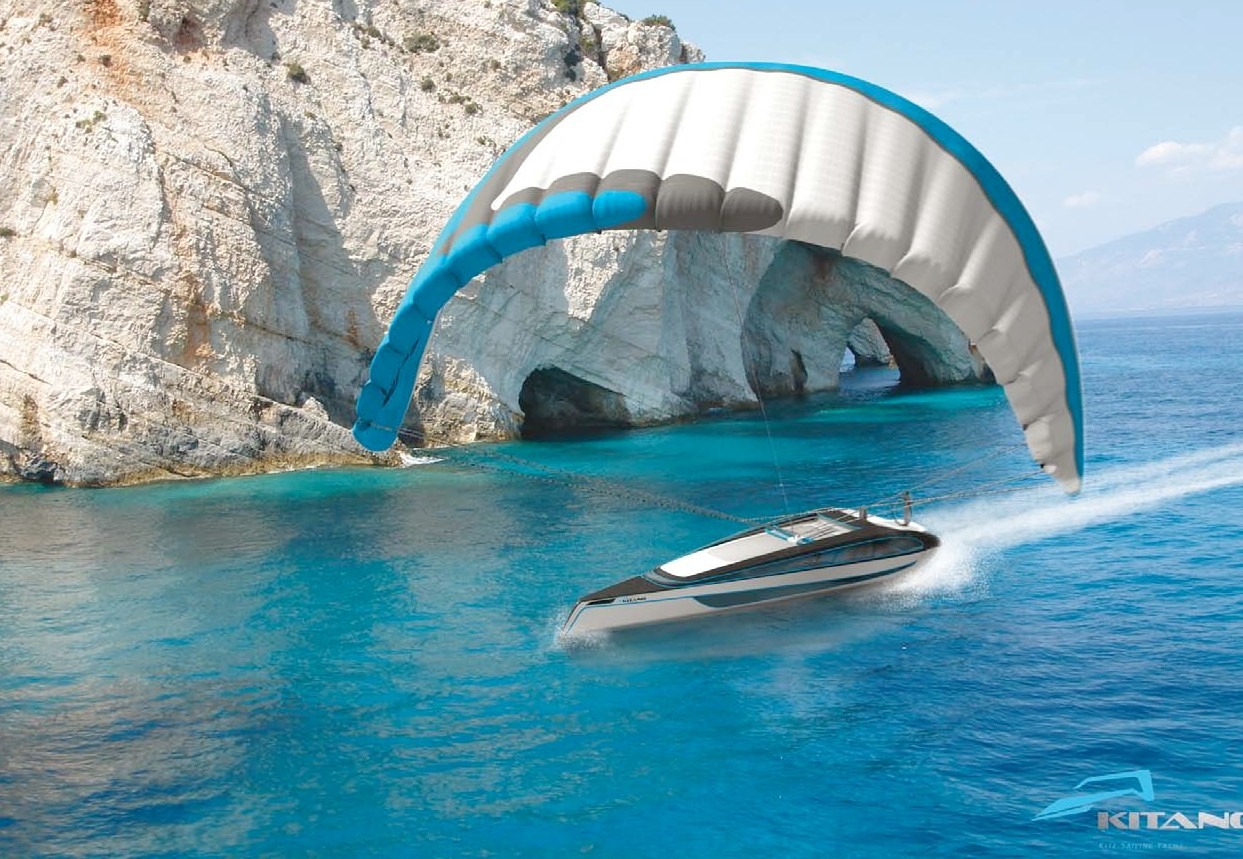
Stefanie Krücke
AFTERWARD
2008: A PROMISING YEAR FOR KITESAILING
In JANUARY, Braunshweig University of Art student Stefanie Krücke wins the Concept Boat Award at the London Boat Show for her “Kitano” design, a 60-foot kitesailing hybrid yacht concept.
Anne Quéméré flies to San Francisco to prepare for the departure of her next solitary Pacific endeavor in October.
A kiteboarder from Germany, Tilmann Heinig, claims to have made a run at an average speed of 50.1 knots. His record remains unofficial as he measured using a GPS system. The official high is Alexandre Caizergues at an average 47.77 knots set in Namibia in 2007.
In MARCH, the MS Beluga SkySails completes its journey across the Atlantic as the first commercial cargo vessel to use the towing assistance of an automated kite.
Peter Lynn and Don Montague still hope to convince the owner of a large racing catamaran to take kites onboard and compete in the Jules Vernes trophy, the famous round-the-world sailing challenge.
