

 Share
Share Print
PrintMichael Brooks
New Scientist Magazine
From Discourse-2
INTRODUCTION BY DAVE LANG
In 2002, the Drachen Foundation awarded me a grant to perform some basic explorations in the use of kites to generate useful electrical power. This grant was originally predicated on furthering explorations of the LadderMill invention of Professor (and one time astronaut) Wubbo Ockels. The LadderMill was envisioned to have the potential to supply industrial levels of power. My grant proposal came about through simulation-related liaisons between myself and Professor Ockels.
As my work proceeded on the grant, it became ever clearer that this was but one idea in a potentially vast subject extending well beyond our original focus, and a subject worth examining in a more general fashion. To this end, the grant effort was somewhat re-focused on surveying the entire field of kite power generation. This resulted in a report summarizing our examination of potential schemes for generating power, along with an attempt to categorize and evaluate the pros and cons of known schemes.
While this original report is now beginning to show signs of aging, it nevertheless has stimulated extensive dialog between the Drachen Foundation and numerous people around the world pursuing kite power generation; furthermore, Drachen upon finding itself as a point of contact between many individuals, has been able to function as a hub of connect amongst those of like-mind who seek liaisons to form larger and more consolidated efforts.
As a result Drachen has witnessed and encouraged efforts that have encompassed many of the schemes presented in that original report, as well as new ones. With the advent of the current rising world consciousness of the crisis of fossil fuel dependency, this field is becoming ever more active, with many new people entering into the fray, ranging from the individual entrepreneur to large and significantly funded organizations.
Drachen, working to further this field, organized and convened the first international “Kite Sailing” conference in Seattle, well attended by world leaders in the practice and design of power (i.e. “traction”) kites. The symbiosis between the recreational kiter and electrical power kite communities was obvious and profitable for all; the attendees represented the entire spectrum of participants ranging from the highly theoretical ”academicians and engineers” to the highly accomplished “thrill seeker.” Likely in the future, such an event will be repeated.
This field is wide open, exciting to both the individual (who may brilliantly visualize the next great breakthrough), as well as the highly developed organization (methodically moving towards a goal). The rewards are potentially very high, both in remuneration and satisfaction of making a profound contribution to the people of the world by moving away from fossil fuel.
The following article is presented because it represents a concise summary of many of the efforts currently underway.
DAVE LANG
“There are territories traversed by this invisible power rarely explored, where sail was never unfurled, where mechanism was never introduced, and where invention never spread a successful pinion. These are the higher regions of the atmosphere where, when the winds sleep below, there are powerful and steady currents of air rapidly floating. These have hitherto passed almost unnoticed by the dwellers upon earth, because their lofty career placed them far above human subjection.”
Not any more. When the English inventor George Pocock wrote those words in an 1827 treatise called The Aeropleustic Art, the idea of drawing power from the unfailing winds of the troposphere was a dream. Now, thanks to technological innovations, it is emerging as a multimillion-dollar business replete with industrial secrets and fierce rivalries. Despite that, there’s little in this nascent industry that Pocock would not recognise. The only thing that has changed is the availability of sophisticated materials and computer-control technologies. “The ideas are quite old,” says Saul Griffith, CEO of Makani Power, based in Alameda, California, whose aim is to produce cheap power from high-altitude wind. “The history of kite power is so rich, there are no substantively new concepts out there.”
That’s right: kite power. While green campaigners push for ever more wind turbines, a new wave of environmentally motivated engineers is already considering turbines to be a little old-school.
One of the pioneers of the concept of a kite as a renewable energy source is Peter Lynn, a New Zealand kite designer. Lynn grew up with kites: his father, also called Peter, is a kite designer with a global business in producing stunt, performance and outrageously flamboyant designs.
In 2003, Lynn the younger, who is now a consultant for Makani Power, posted his vision for “tethered free-flying wings” and their uses on the online discussion group sci.energy. He pointed out that a kite liberates the part of the wind turbine that generates the most power – the tip of the blade – from the burden of the infrastructure, such as the hub, the tower and the gearboxes. The tip is so efficient because it is moving fast, as a kite would, but whereas a turbine’s blade turns heavy and expensive gearing, the pull of the kite is used to spin a dynamo. Put simply, a kite takes the best bit of a wind turbine and puts it where the wind is strongest.
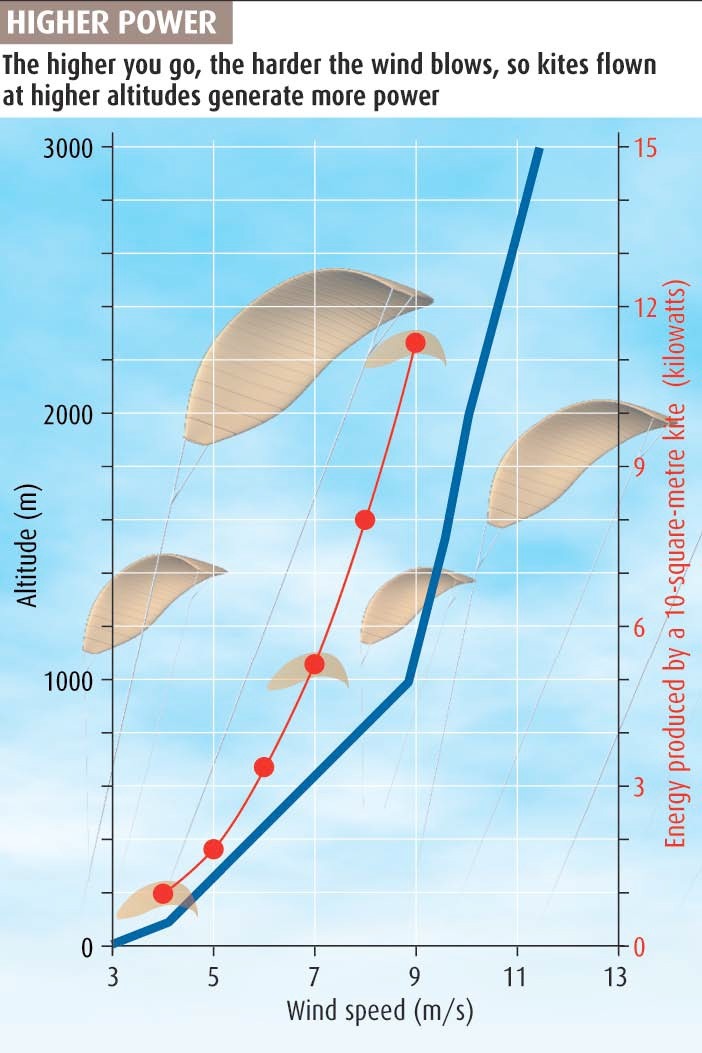
At the height of the average wind turbine, 80 metres above ground, the wind typically blows at around 4.6 metres per second. At 800 metres, this rises to 7.2 metres per second. The dependability of the wind – how often it blows above certain speeds – also increases with altitude. It turns out that the power available from wind is tied to the cube of its speed, so the higher of these altitudes is a far more attractive option, giving you almost four times as much power as that available at turbine height. Go up to 1 kilometre, and you can harness nearly eight times as much power (see Graph). All you need is a kite – with a very long string.
On paper, at least, it is a simple recipe for clean, cheap energy, one attractive enough for Makani Power to have received an investment of $10 million from Google last November. But crafting the reality is no easy task. Griffith is tight-lipped about the company’s schemes, but admits that they are only generating power in the 10- kilowatt range at the moment, hardly the stuff of green dreams. For comparison, a large turbine can generate 5 megawatts. Makani’s goal of generating electricity that costs less than that from coal-fired power plants will take some time. “The question remains of how amenable these systems are to scaling up and whether the ultimate cost of electricity will be competitive,” Griffith says.
FLY BY WIRE
Kite power developers in Europe have the same goal. Bas Lansdorp and his colleagues at Delft University of Technology in the Netherlands are developing a system involving kites, cables and generators. It produced its first power in a demonstration last year. During earlier tests they flew a 10- square-metre kite which generated 3 kilowatts of electricity. That kite was remote-controlled by joystick, but the team is developing the software, electronics and ground station to automate it. Combining automation with a 20-square-metre kite should produce around 20 kilowatts.
“We now know that the concept works,” says Lansdorp, who is confident his team’s system will scale up. He is cautious about making any claims for its future place in the energy markets, though. “There are many reasons to believe it will be cheap, but the energy market is a complex thing,” he notes.
Another kite-power team on the scene is Italian company Kite Gen. Last September, the company spent three days at a Milan airfield testing its prototype kite system at an altitude of 400 metres. The results were extremely good, according to the science director of the Kite Gen team, Mario Milanese of the Polytechnic University of Turin. With a 10-metre-square kite flying in winds of 4 metres per second, they generated an average power of 2.5 kilowatts. The system performed much as simulations predicted. “We think that the key technological issues have been sufficiently assessed,” says Milanese. “With the right financial support we plan to have an industrial prototype in 2 to 3 years.”
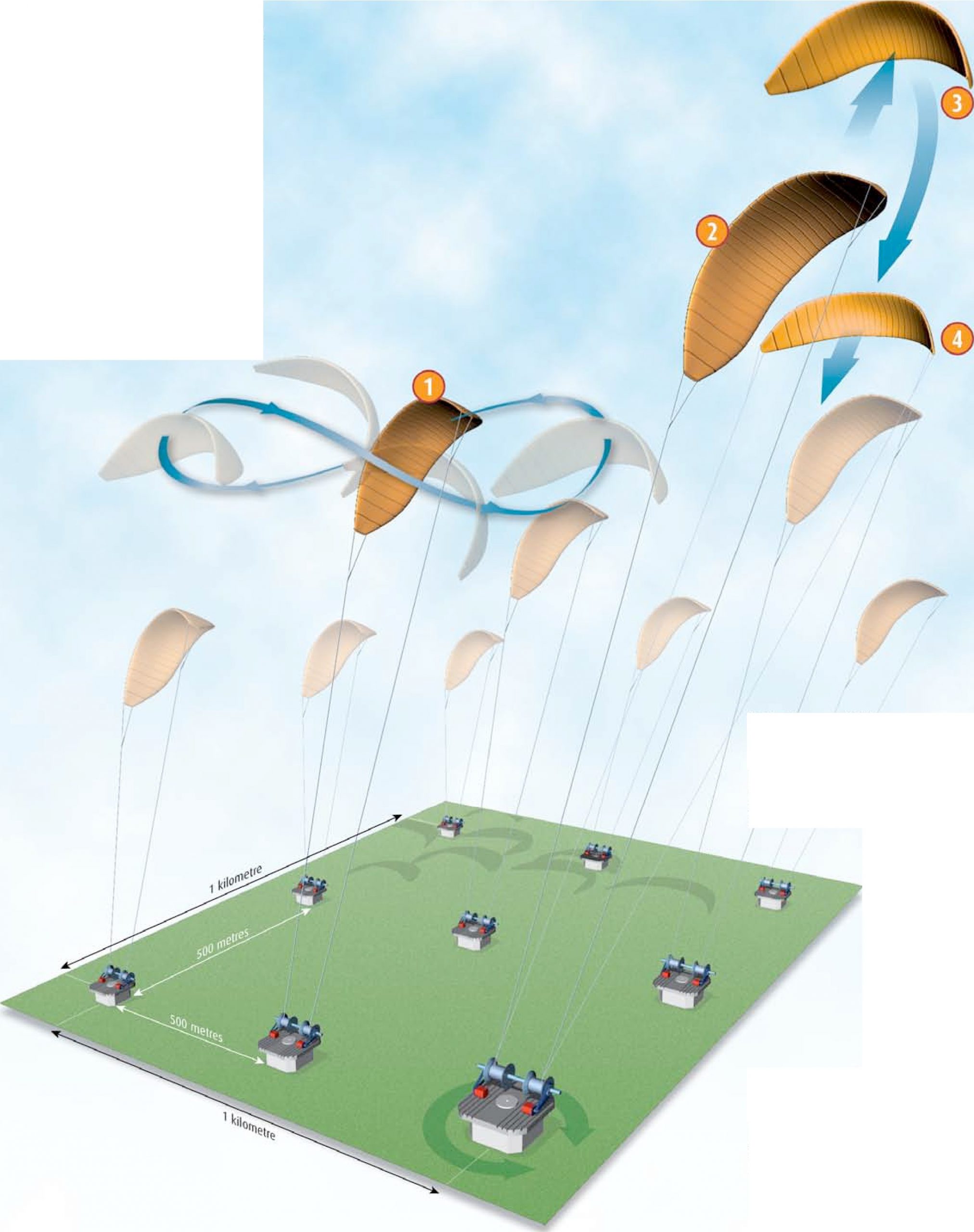
ABOVE FIGURE:
PULLING POWER: The higher you go, the stronger and steadier the wind becomes. Kite-farm energy could be up to four limes cheaper than that from conventional wind turbines.
- Kite is flown in “figure of 8” pattern for maximum stability and lift.
- Winch is released and the tethers unwind, spinning the electric generators
- With tethers fully unwound, a lightweight computer-control mechanism adjustst he kite’s aerofoil, minimising air resistance
- Tethers are immediate wound back in, returning kite to original altitutde
A kite with an area of 100 square metres can create a force of about 2 tonnes on the winch, and generate about 100 kilowatts. Stacking multiple kites onto each pair of tethers would provide units capable of generating megawatts. Base units incorporate kite-control software, winches and electric generators, and can rotate to follow the direction of the wind. A radio link provides communication between the base unit and its kite’s aerofoil adjustment mechanism.
So what will these systems look like when they are deployed? Makani, for one, is keeping mum about its plans. All Griffith will say is that their designs are looking less and less like what anyone would recognise as a kite. The Dutch and Italian groups are more candid, and seem to be converging on similar designs.
The basic idea is that, just as a yo-yo spins when its string unfurls, so an electrical generator can be driven by the pull of a kite’s aerofoil (see Diagram). In Kite Gen’s configuration, the kite is flown on two tethers, each one held on a separate drum attached to a computer-controlled winch. Once the kite is launched and in stable flight and pulling on its tethers, the winches are released. The tethers then reel out, spinning the generators. When nearly the entire length of the tethers has unspooled, the winches are engaged to haul them back in, returning the kite to its original position.
Milanese calculates that Kite Gen’s electric winches will consume only about 12 per cent of the total generated power. The difference between power generated and power used can be maximised by taking advantage of lulls in the wind and also by using a mechanism that adjusts the kite’s aerofoil in-flight to reduce lift, he says. By repeating this cycle again and again, the kite acts as a wind turbine.
The Delft researchers envisage a similar system that they call a “laddermill”. Rather than a single kite, they plan to stack kites on a single tether. These could change their tack or configuration depending on whether they are being pulled out by the wind or reeled in by the winch. This way, they can maximise lift as the tether unspools and reduce wind resistance as it is reeled in. The team says a full-size unit could generate about 50 megawatts, almost 10 times the power generated by today’s largest wind turbines.
There are still plenty of problems to overcome, however. What is the most efficient way to maintain and maximise lift during lulls in the wind? How do you keep the kite aloft for as long as possible should the wind die completely, or prevent it crashing? Another key technical challenge is how to minimise air resistance during the “retraction” phase, as the kite is reeled in. “When people fly kites, they don’t care about the retraction phase, but we do,” Lansdorp says. “We don’t just want to generate as much power as possible when the kites are pulling. We also want to consume as little power as possible when we’re retrieving the lines.”
This is why all the groups are developing computer algorithms to keep their kites flying in the most efficient ways. The Delft group are working with researchers at the Catholic University of Leuven (KUL) in Belgium to work out the best kite-control methods. Their results so far seem to support what many kite enthusiasts already know: to keep the kite aloft and maximise lift, it should travel in a figure of eight.
This conclusion was also reached by kite-power researcher Allister Furey and his colleague Inman Harvey at the University of Sussex in Brighton, UK. The pair put neural networks in charge of virtual kites, and combined those networks that kept the kites in flight the longest in order to produce even better solutions. Eventually the networks became adept at keeping the kites aloft and keeping the line tension maximised, even when there were gusts and lulls in the wind. Furey and Harvey are now working with Kite Gen to turn their algorithms and simulations into real-world mechanisms for kite control.
It is this goal of automated kite control, and not simply the scaling-up, that will determine the economics of kite power, says Lansdorp. “Scaling it up is not difficult in principle; it’s the automation that is the challenging part,” he says. “We don’t yet know to what extent we’ll be able to automate the process.” The Delft-Leuven plan for this year is to create algorithms to control a kite-and-winch system capable of generating 20 kilowatts and of operating without supervision or external control once the kite has been launched.
Whatever the algorithms used, the actual mechanism which controls the aerofoils will probably need to be located on or near the kite – at altitude, in other words. “If you pull from the ground on a very long line, you get no reaction,” Lansdorp explains.
Even with potentially complex control systems, Lansdorp is confident that the economics make kites a desirable technology. “When you can be so much cheaper than wind turbines and generate more power, there’s going to be a really big push for it,” he says.
The European Commission has already recommended that high-altitude wind power be among the green technologies contributing to its target of supplying 20 per cent of energy needs from renewable sources by 2020. So should makers of traditional wind turbines be losing sleep?
Not yet: traditional wind power is booming. Figures released in February by the Global Wind Energy Council revealed that the installed capacity of wind turbines increased by 27 per cent last year, and this growth shows no sign of easing off. Nonetheless, if kites live up to their promise, it should be possible to replace a large proportion of all forms of conventional energy with kite energy, Lansdorp says. He doesn’t see why anyone would buy a traditional wind turbine over a kite-powered system. Turbines are fine on the coast, he says, but land in these areas is often expensive. And you can’t put wind turbines on low-lying ground inland, he says, because there just isn’t enough wind to make them economical. But high-flying kites can work here since the wind at altitude is hardly influenced by the land beneath it.
One kite is all well and good, but Kite Gen has been busy dreaming up a futuristic grand design that they hope might tip the scales in favour of kite power stations. They envisage scores of kites tethered to a single generator that can spin around the vertical axis, like a 3-kilometre-wide carousel. Kite Gen reckons that 60 to 70 kites flying at an altitude of 800 metres, with a total area of around 500 square metres, could be mounted on such a carousel unit and that this set-up could generate several hundred megawatts. The company claims that the cost of generating power in this way would be around ¬15 per megawatt-hour, compared with ¬100 per megawatt-hour for a turbine-based wind farm and around ¬60 per megawatt-hour for fossil-fuel energy. Placed on the site of a decommissioned nuclear reactor – which would already have an aircraft no-fly zone above it – a kite- driven carousel could generate the same amount of power as its predecessor, Milanese claims (see “Kite-flying hotspots”).
Lansdorp, too, has a new idea: using fixed- wing gliders instead of kites. A kite’s aerofoil has a very limited lifetime because the thin nylon fabric degrades in UV light, he says. Besides lasting longer, a fixed-wing plane is more efficient, providing more power per square metre. “Although a fixed- wing plane will be more expensive to purchase, over the lifetime it would be cheaper per kilowatt-hour,” Lansdorp says. He and several colleagues are working on a project called Aeolus, named after the Greek god of winds. They hope to develop a 100-kilowatt generator within a year, and a 1-megawatt generator a year after that.
Of course, these schemes remain unproven until any significant power is generated. For now, it’s all pie in the sky, and Griffith warns not to expect too much too soon. Harnessing the power of the atmosphere will be expensive and difficult, he says. “I wouldn’t expect to plug your house into kite-powered generators next year.” Nonetheless, the pay-off is worth pursuing. “We believe that there is fabulous potential for electricity that will compete with coal on cost,” Griffith says. “It won’t be next week, but it looks possible.”
NEW SCIENTIST MAGAZINE
KITE-FLYING HOTSPOTS
Should the technology take off, there will be plenty of room in the world for kite farms.
Researchers at the Delft University of Technology in the Netherlands analysed wind power and population patterns and concluded that space is not a problem. “Even in a populated country like the Netherlands, there’s plenty of places you could build them,” says Bas Lansdorp, one of the Delft team. “Spain has much more room and a big appetite for renewable energy, for example. Then there’s places like China and Australia, where space is not an issue at all.”
A frequent objection to kite-power plans is that, at an altitude of 1 kilometre, the kites will intrude on aircraft flight paths. “People say it’s dangerous for aeroplanes, but that’s just rubbish,” says Lansdorp. “It’s no more dangerous than other aircraft: all you need is a good transponder and a light beacon.”
There are already no-fly zones for aircraft that would be ideal for kites. Aircraft are kept away from airspace around nuclear power stations. When those plants are decommissioned, they provide the perfect site for kite-based power generators, says Mario Milanese, a researcher and kite developer at the Polytechnic University of Turin in Italy. In that space, a kite system could generate up to 1 gigawatt, he says – the same as the nuclear plant. Airspace may not be a big problem in Italy anyway: Milanese has already carried out tests in collaboration with the Italian aviation authorities and they are working together to find future test sites. “We are confident that there is enough political will to authorise new sites,” Milanese says.
Dutch researchers, too, report no problems in getting clearance for their tests. Lelystad, a city in the Netherlands, has already offered airspace for testing.