

 Share
Share Print
PrintScott Skinner
From Discourse 4
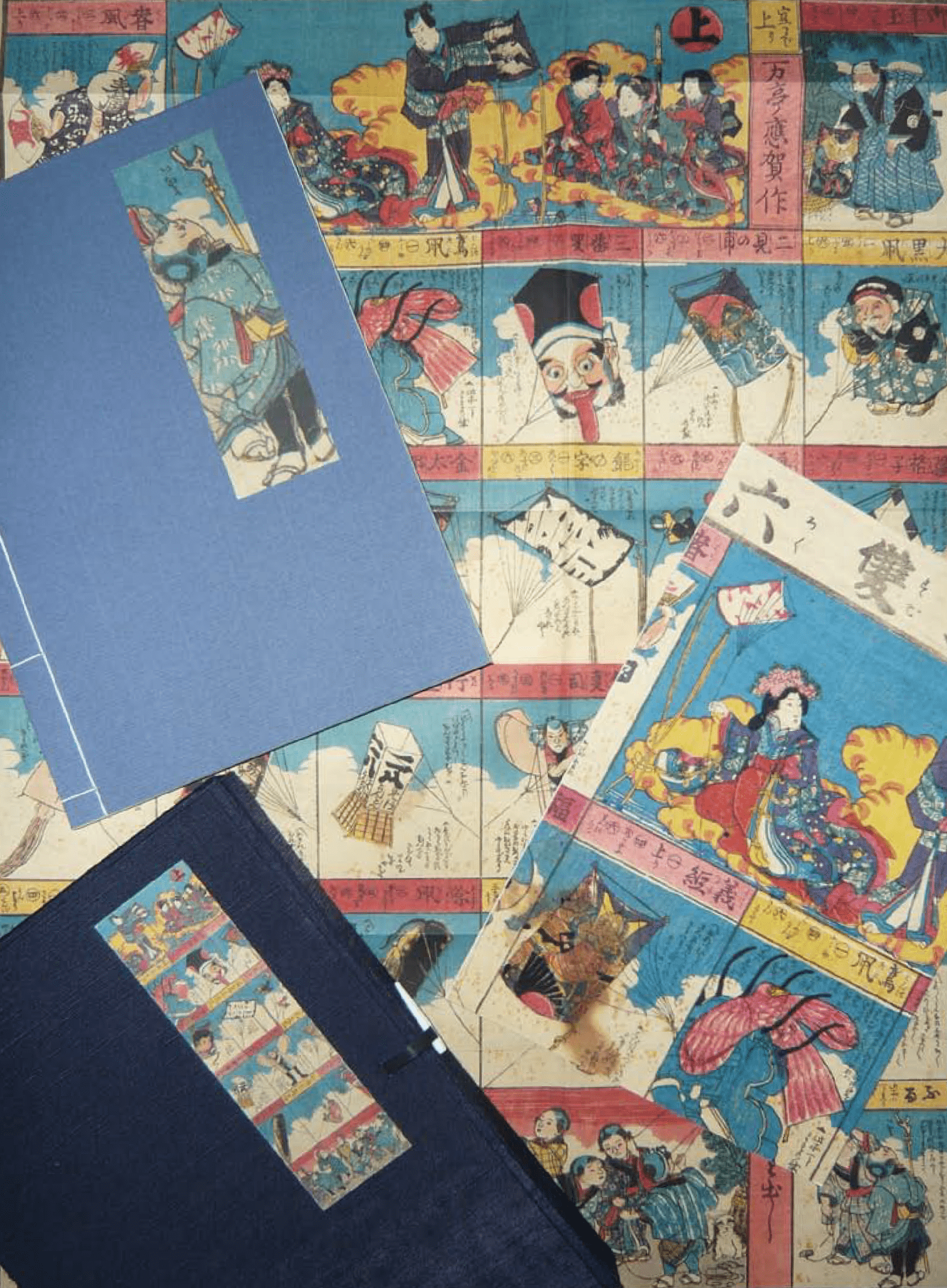
Scott Skinner. Soaring Kite Sugoroku, a special art project commissioned by Scott Skinner, with the helping hands of Ali Fujino, Matthew Stubbs, Keiko Yamaguchi, Zach Hooker, Brynn Warriner, Sharon Vonasch, Elizabeth Hanson, and Ed Marquand.
A sugoroku is a Japanese woodblock print meant to be used as a game board. They were usually produced to be New Year’s gifts and depicted popular subjects to make them appealing to parents and children: scenes from the Tokaido Road, views of Mt. Fuji, neighborhood maps of old Edo districts, and so forth. The game was much like “Chutes and Ladders” with a die to send players to sugoroku squares on which instructions would send them forward or back. Like the New Year’s kites that this particular sugoroku depicts, I suspect they were ephemeral objects, probably worn out within a year or two and replaced with a new edition.
This is what I wrote in the introduction of Soaring Kite Sugoroku:
This book is the result of a 20-years collecting-mania. I walked into a Japanese antique store in Newport, Rhode Island and found a Hokusai ukiyo-e that happened to have a kite. Thinking that these would be an obscure but interesting addition to the rest of my kite collection, I began in earnest to search them out. Timing is everything, and it turned out that that trip to Rhode Island took me to Japan for the first time – I won a trip to Nagasaki, courtesy of the Blackships Kite Festival. Through the nineties I was lucky to travel to kite festivals almost a dozen times, and each became a quest for new ukiyo-e. With a few free hours, I could always find a store specializing in the prints, and with an hour’s work would often find one or more. As with any collection, these took on a life of their own in the late 1990s, as dealers solicited my business and more and more prints came my way.
The sugoroku herein is likely the “Hope Diamond” of my collection; it is exceedingly rare, surprisingly specific, and subtly beautiful. It was produced at a time when kites were exceedingly sophisticated and beautiful and is of an ukiyo-e genre that is just as ephemeral as its subject, kites. These New Year’s games were meant to be played – just as kites were – and in so doing must have been worn out by the next New Year’s edition. Many of the kites and their decorations are seen often in ukiyo-e, yet some of the scenes reflect the artist’s humor and attention to the pastime (I have never seen the line- climbing monkey depicted in an ukiyo-e!).
I created the book expressly for people that have inspired me in my journey through the world of kites. Creating the package, box, game board, Japanese-style book, and Western-style book took an active process of approximately two years, with time before that considering the possibilities of such a project.
Inspiration for the project was the unique sugoroku itself. Over the years, I have acquired perhaps a half-dozen sugoroku. They are an interesting subset of ukiyo-e and are usually made in large format so that a family could gather around them and play the game. Usually, a sugoroku of a city- scape, or popular area might have a single kite depicted. Soaring Kite, though, is a sugoroku with every panel depicting a kite or kite activity. Amazing! Additionally, the starting area is a wonderful depiction of boys playing with kites, while the goal area shows immortals in clouds manipulating the high-flying kites.
Another amazing aspect of the print became apparent as the project moved forward. Every square has “game directions” – jump ahead two squares, go back to start, etc. – but each also has a poem. Through the efforts of accomplished translator Keiko Yamaguchi these poems make up the body of the Japanese volume. They are charming, unexpected, and illustrative of the passion toward kite flying in mid-19th-Century Japan.
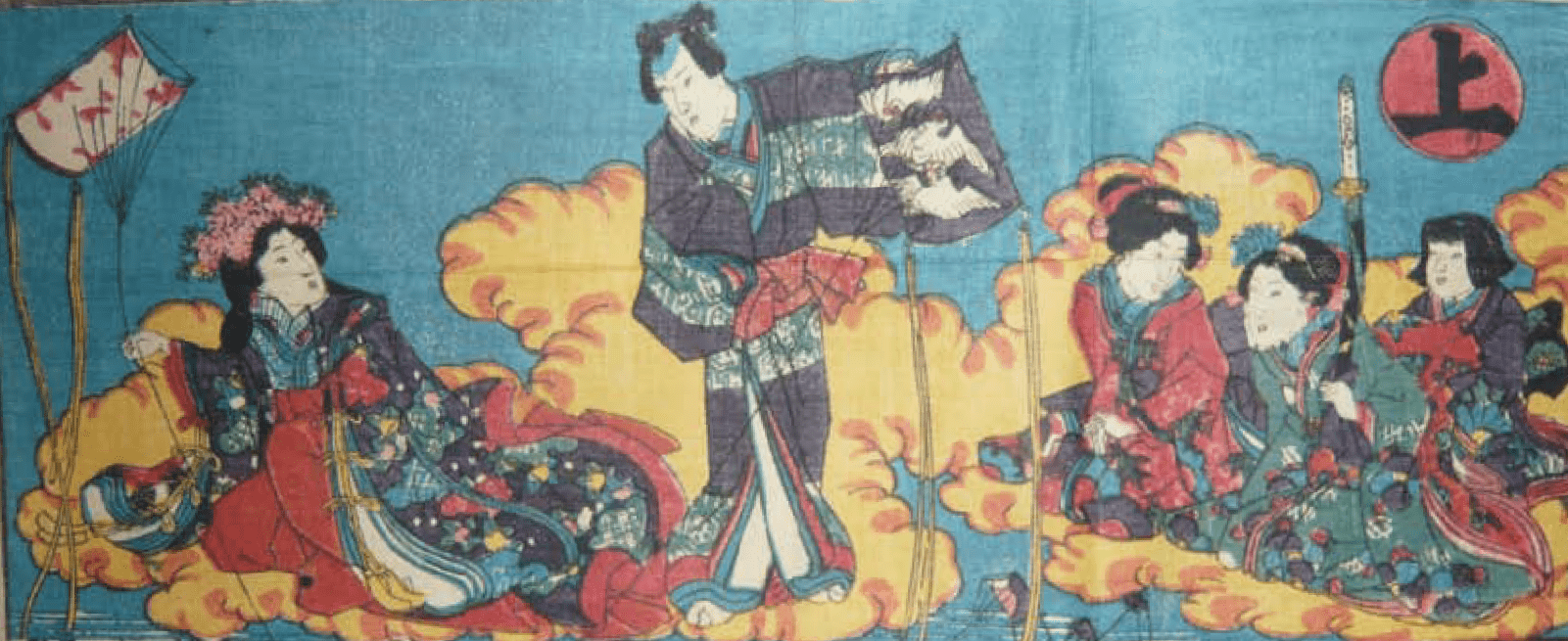
Scott Skinner. The game board’s goal area shows immortals flying kites in the clouds. Its starting area depicts boys playing with kites.
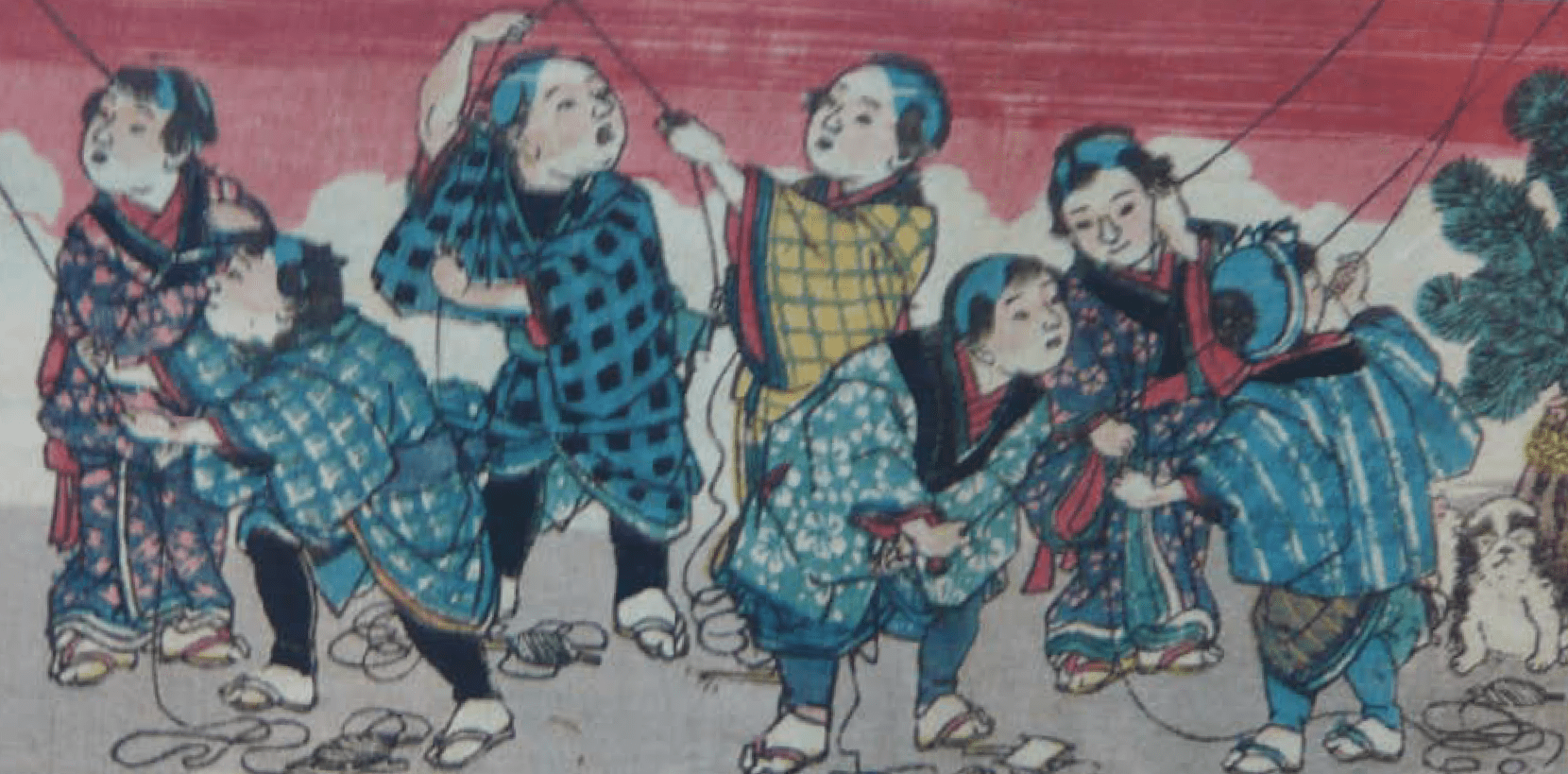
Scott Skinner. The game board’s goal area shows immortals flying kites in the clouds. Its starting area depicts boys playing with kites.
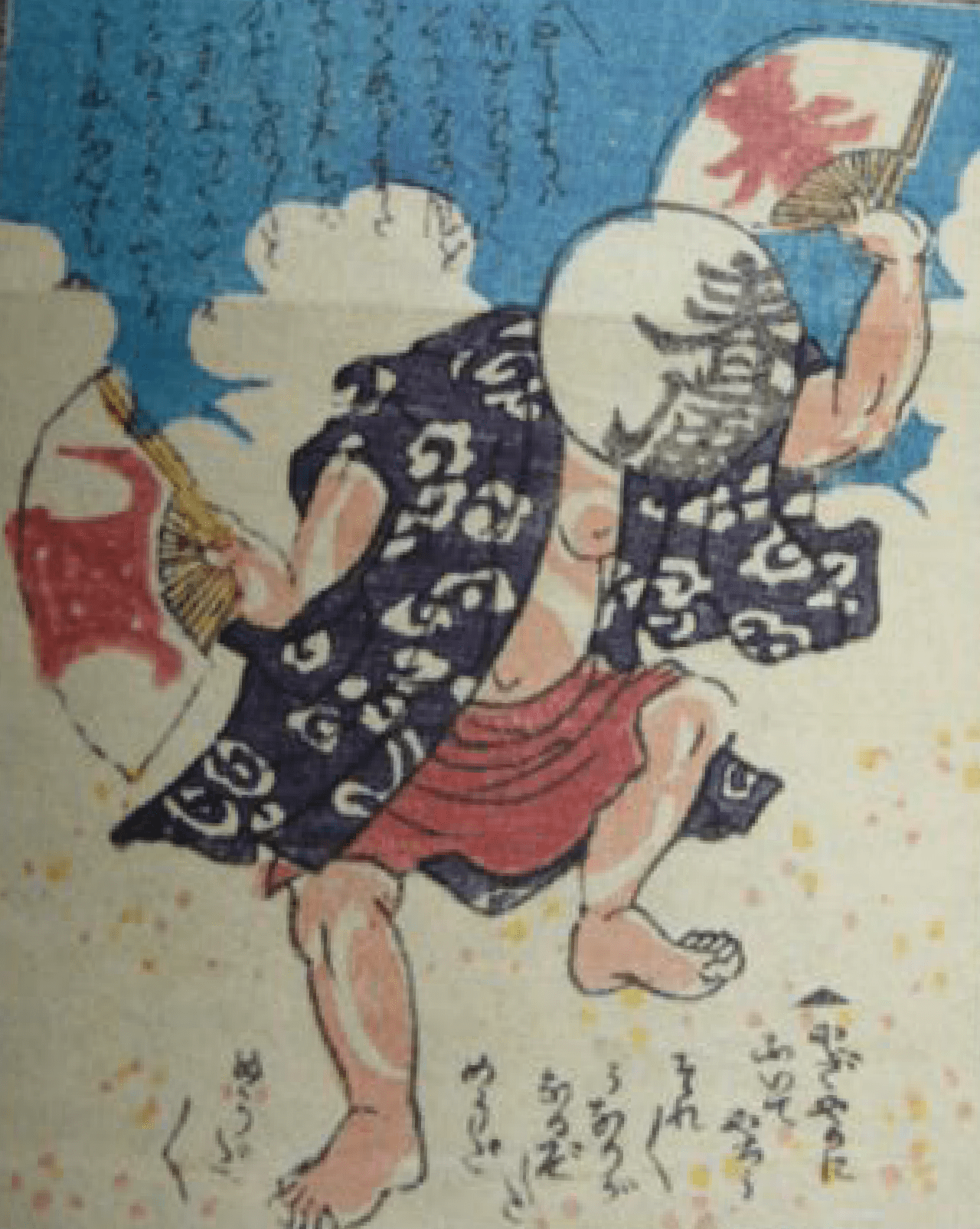
Ali Fujino. The game board’s Harukaze square.
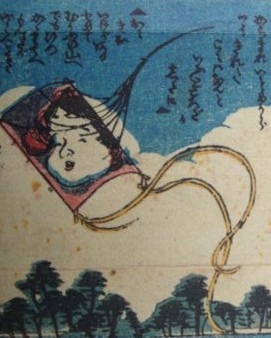
Ali Fujino. The game board’s Chigire Tako square.
HARUKAZE – SPRING BREEZE
Old folks blame the spring breeze for scattering the flowers.
Youngsters urge me to blow on! Blow on! Shall I blow or shant I blow?
I’m completely at a loss.
No matter, I will blow heartily.
Hear, hear the hummer is calling
O grand! Grand! Grand!
CHIGIRE TAKO – LOOSE KITE
Just when I was beginning to soar
That kite comes along and tangles with me.
Righting myself with my control line it snapped.
Where am I now? Below lies a large pond.
Perhaps at least I’ll come to catch on that mountain.
So it goes for an aimless wandering kite.
In Volume II, presented in a Western style, I tried to comment about each of the kite panels in the sugoroku. Facts about some of the kite-styles, stories behind the imagery, and personal remembrances of kite-travel to Japan are all included in this edition:
Five kites flown in a “ branch train” (one in which each kite is attached at a different point to the central flying line) show the sophistication of Japanese kite flying in the mid-1800s and serve to remind us that there is very little “new” in 21st Century kite flying, simply variations on very old themes and ideas. All five kites must fly stably and independently or an impossible knot – one that all kite fliers are familiar with – will result.
This simple “T” shape, seen in tombi- dako, yakko-dako, and sode-dako (hawk-, footman-, and sleeve- or kimono-kites, respectively) may be the earliest kite shape in Japan. It is forgivingly aerodynamic, with forces of lift and drag balanced, and also is the perfect platform for bird, insect, or human representations.
Long time curator, Terauki Tsutsumi of the Tokyo Kite Museum, who has since passed away, made beautiful and complex tombi-dako that are testaments to the kite maker’s art: perfectly balanced and scrupulously crafted, but so life-like in flight that local tombi – the real ones! – always came quickly to investigate the paper intruder. I’ll never forget seeing Tsutsumi-san flying his tombi-dako high in the hills of Nagasaki and the agitation of the local tombi as they circled, dived and postured at the tombi-dako.
Like many kite projects that I’ve started over the years, this one took far more time, people, and money than I thought it might, but having the final product in my hand makes all of that worthwhile. This is a special edition that might, like the original sugoroku it depicts, find its way through many hands in coming years. It will be a record of Japanese kite flying in the 19th Century, it will imply the popularity of Japanese kites in Western kite flying culture, and it will show my passion for kites and their preservation.
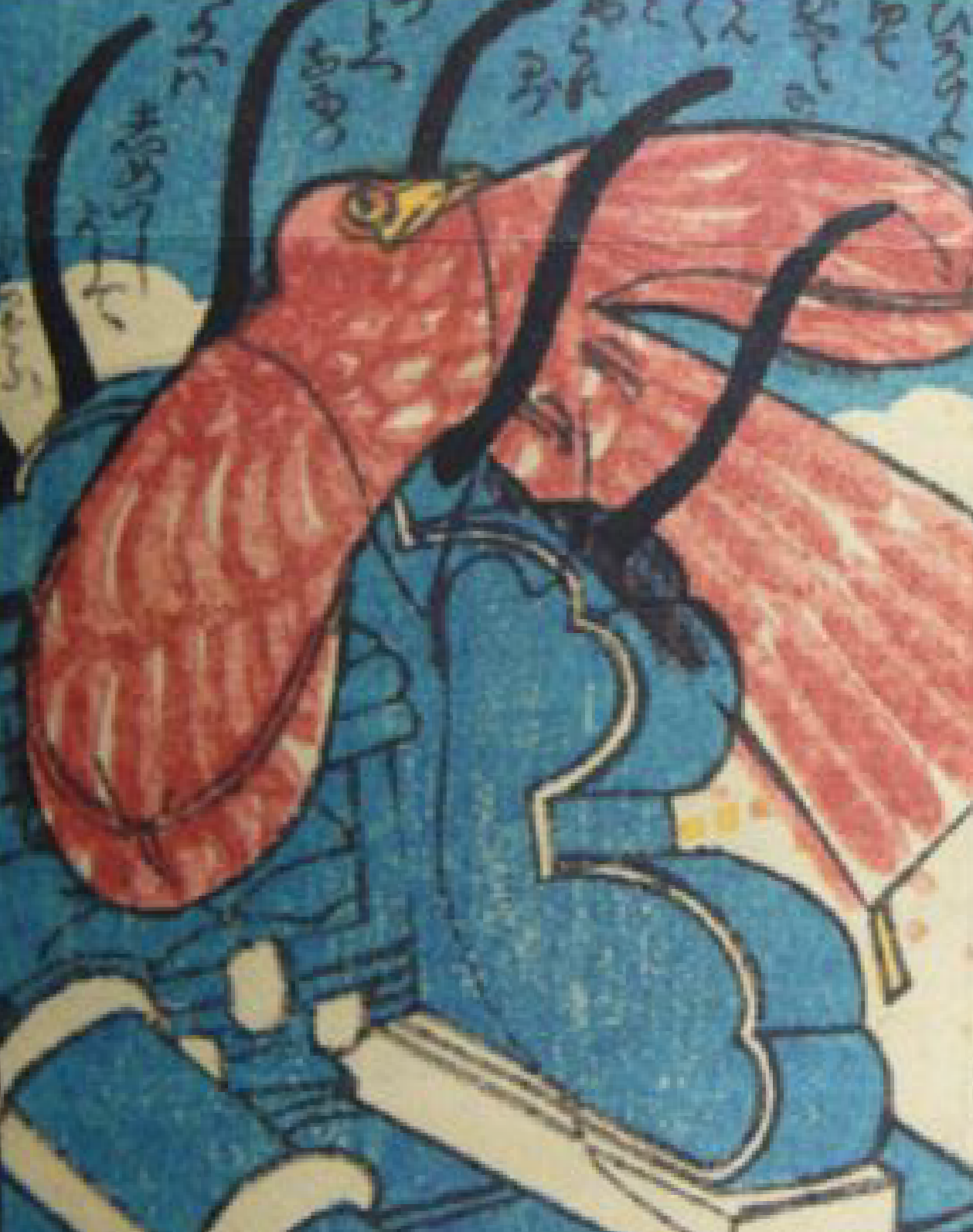
Ali Fujino. The game board’s Tombi-Dako square.